
Most of us choose thread in a fairly practical way. We need the right color, we want the machine to behave, and we would prefer the thread not break halfway through a seam. Then we look at the label and find a collection of numbers and terms that do not explain themselves.
A thread label may tell you the weight, fiber and number of plies. It may also mention tex, denier, mercerizing or some type of finish. Each piece of information tells you something different. Once you know which part of the thread it describes, the label becomes much more useful.
This post contains affiliate links. If you purchase something through one of these links, I may earn a small commission at no additional cost to you. I only recommend products I own, use and genuinely like.
Why a higher weight number means a finer thread
With the weight system commonly used for quilting thread, a higher number generally means a finer thread. An 80-weight thread is finer than a 50-weight thread. A 12-weight thread is much heavier than either one.
Many cotton thread manufacturers use a measurement called Number English, abbreviated Ne. It is based on how many 840-yard lengths of yarn are needed to weigh one pound. A fine yarn requires more length to reach a pound, so it receives a higher number.
That is why the numbers feel backward. They are based on length and weight rather than the visible diameter of the thread.
Tex and denier measure thread differently. Tex tells us how many grams 1,000 meters of thread weighs. Denier tells us how many grams 9,000 meters weighs. With both tex and denier, a higher number means a heavier thread.
Ne, tex and denier are established measurement systems. The inconsistency usually appears when manufacturers translate those measurements into the simplified weight numbers printed on retail spools. Fiber, ply and construction also affect the finished diameter. Two products labeled as the same weight may not look or sew exactly the same.
Weight numbers are most reliable when comparing threads made by the same manufacturer.
What the different weights are used for
There is no single list of every thread weight. Manufacturers make different sizes for quilting, embroidery, serging, upholstery and industrial sewing. These are the ranges quilters are most likely to encounter.
3 to 5 weight
Threads this heavy are usually used for couching, embellishment and very bold hand stitching. They may be too heavy to run through an ordinary sewing-machine needle. Couching solves that problem by laying the heavy thread on the surface and using a finer thread to stitch over it and hold it in place.
8 weight
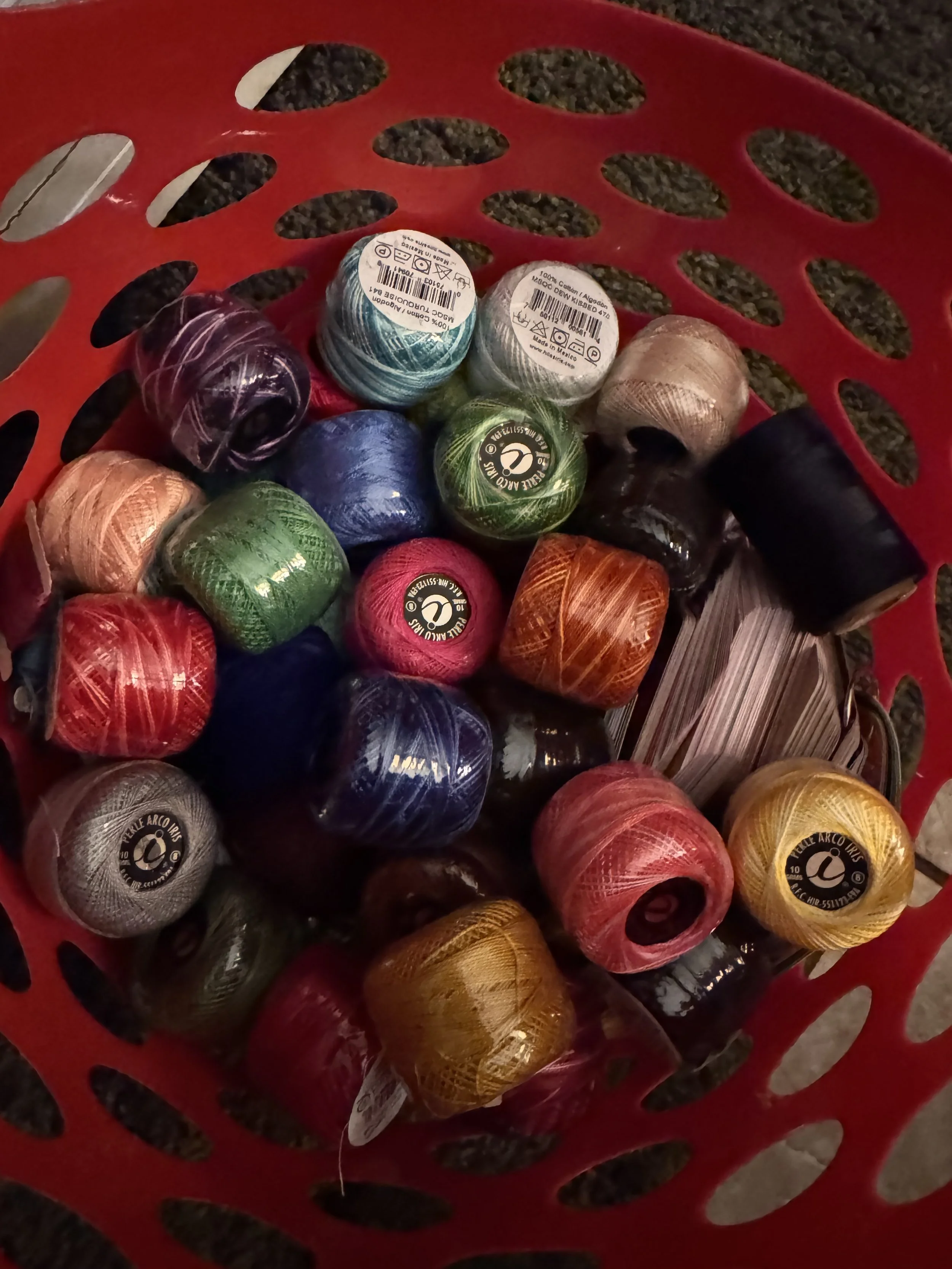
An 8-weight thread produces a bold, textured stitch. It is used for hand quilting, embroidery, sashiko, wool appliqué and other decorative handwork. WonderFil Eleganza is one example of an 8-weight perle cotton.
12 weight
Twelve-weight thread is a common choice for big-stitch hand quilting, embroidery, visible mending and decorative machine stitching. It is heavy enough to become part of the quilt’s design.
Some 12-weight threads can be used in a sewing machine. They need an appropriate needle and may require tension adjustments. A finer thread is often used in the bobbin.
18 to 20 weight
These threads are used for decorative quilting, embroidery, topstitching and embellishment. They produce a pronounced stitch without being quite as heavy as 8- or 12-weight thread. They are less common in general quilt construction, but they appear in specialty cotton, rayon, silk and metallic thread lines.
28 and 30 weight
A 28- or 30-weight thread makes the stitching clearly visible. These weights work well for decorative machine quilting, hand quilting, thread painting and topstitching.
They generally need a larger needle than ordinary piecing thread. The eye and groove of the needle need enough room to protect the thread as it moves through the fabric.
35 and 40 weight
These threads create more definition than 50-weight thread. They are commonly used for machine quilting, embroidery, decorative sewing and topstitching. Forty weight is a good choice when you want the quilting to show without having it completely take over the quilt.
50 weight
Fifty-weight thread is the general workhorse of quilting. It is fine enough for accurate machine piecing but substantial enough for quilting, appliqué and general sewing. If someone wants one thread that can handle most machine piecing, 50 weight is a sensible place to start.
60 weight
Sixty-weight thread falls between ordinary 50-weight piecing thread and the very fine 80- and 100-weight threads. It works well for detailed piecing, appliqué, embroidery, bobbin work and subtle machine quilting. It is worth trying when the seams in small or intricate blocks feel bulky.
80 weight
Eighty-weight thread is extremely fine. It adds very little bulk and works well for English paper piecing, hand appliqué, precision piecing and fine machine stitching.
WonderFil DecoBob is an 80-weight, 2-ply cottonized polyester. Aurifil makes an 80-weight, 2-ply cotton. I use both when I want a fine, unobtrusive machine stitch.
100 weight
A 100-weight thread is exceptionally fine. WonderFil InvisaFil is a 100-weight, 2-ply cottonized polyester that nearly disappears into the fabric. Threads this fine are useful for English paper piecing, appliqué, microquilting, detailed embroidery and any work where the stitching should be difficult to see.
Cotton and polyester are only the beginning
Weight tells you how fine the thread is. Fiber tells you what it is made from. That affects its strength, appearance, texture, lint and how it behaves in the machine.
Cotton
Cotton thread has a matte appearance and works well with quilting cotton. It softens with washing and is available in everything from very fine appliqué thread to heavy thread for visible hand stitching.
Cotton can create more lint than some synthetic threads. The amount depends on the quality and length of the original cotton fibers and how the thread was processed.
Polyester
Polyester thread is strong, smooth and resistant to abrasion. It can be made extremely fine while remaining strong enough to sew with, which is one reason it works so well for appliqué, low-bulk piecing and fine quilting.
Not all polyester thread is constructed the same way. It may be made from short spun fibers, continuous filaments or a filament core wrapped with other fibers.
Polyester thread is sometimes accused of cutting through cotton fabric. Fiber alone does not determine whether that will happen. Thread weight, construction, tension, stitch length, fabric strength and the way the quilt is used all matter. A fine, well-made polyester thread used at an appropriate tension is very different from a heavy industrial thread pulled tightly through lightweight cotton.
Cottonized polyester
Cottonized polyester is still polyester. It has been processed to give it a softer feel and a more cotton-like, matte surface. WonderFil DecoBob and InvisaFil are cottonized polyester. They give us the strength and fineness of polyester without the shiny appearance often associated with synthetic thread.
Cottonized does not mean cotton-wrapped. It describes the way the polyester has been processed and finished. The manufacturer’s specifications should identify the actual construction.
Silk
Silk is strong for its diameter and can be made into an extremely fine thread. Fine silk is often used for hand appliqué because it passes through the fabric easily and settles into the seam.
Heavier silk threads are used for quilting, embroidery and decorative work. Silk is more expensive than most cotton or polyester thread and usually benefits from a fine needle and gentle handling.
Rayon
Rayon is usually chosen for its shine. It is widely used in machine embroidery and decorative stitching when the thread is meant to catch the light.
It is generally less durable than comparable polyester embroidery thread. It can also be more sensitive to abrasion, strong detergents and bleach. I would use it for decoration before I would choose it for a seam expected to withstand repeated strain.
Wool
Wool thread creates a soft, raised line of stitching. It is used for wool appliqué, embroidery, embellishment and other textural handwork. It needs a needle with an eye large enough to carry it without excessive rubbing.
Metallic
Metallic thread is usually made from several materials. A metallic layer may be wrapped around a core and protected with an outer coating.
Construction varies between manufacturers, which explains why one metallic thread can sew beautifully while another makes you question every decision that led you to the sewing machine.
Metallic thread usually performs better with a metallic or topstitch needle, a slower sewing speed and less upper tension. It also helps to check the thread path for rough spots that could scrape the metallic surface.
Monofilament
Monofilament is one continuous filament rather than several strands twisted together. It is useful for machine appliqué, stitch-in-the-ditch quilting and other work where the thread should be difficult to see.
Monofilament may be made from nylon or polyester. Those materials respond differently to heat, sunlight and age, so it is worth reading the manufacturer’s care instructions. Polyester monofilament is often preferred for quilts that will be pressed and washed regularly.
Textured polyester
Textured polyester begins as continuous filaments that are processed to add softness, stretch and loft. It is often found in serger loopers under names such as woolly polyester.
It works well for soft seam finishes, rolled hems, knits and decorative edges. It is generally used in the loopers rather than threaded through an ordinary sewing-machine needle.
Embroidery floss and perle cotton
Embroidery floss is made from several strands that can be separated and recombined depending on how heavy you want the stitching to be.
Perle cotton is tightly twisted and used as a complete thread. It produces a rounded, defined line in embroidery, hand quilting and decorative work. The size numbers used for floss and perle cotton do not directly correspond with ordinary sewing-thread weights.
How thread is put together
The same fiber can be made into several different kinds of thread. Construction affects strength, lint, stretch, texture and how smoothly the thread travels through the machine.
Spun thread
Spun thread begins with short fibers called staple fibers. The fibers are aligned and twisted into yarns. Two or more yarns may then be twisted together to create the finished thread.
Most familiar cotton sewing threads are spun. Polyester can also be made into spun thread.
Continuous-filament thread
Continuous-filament thread is made from long, unbroken filaments. It is generally smoother and more uniform than spun thread and can be manufactured in very fine sizes. A continuous-filament thread may contain several filaments twisted together.
Monofilament thread
Monofilament contains one continuous filament. It does not contain several yarns or filaments twisted together.
Core-spun thread
Core-spun thread has a continuous-filament core wrapped with shorter fibers. The core supplies strength. The outer fibers affect the thread’s surface, appearance and handling. The wrapping may be cotton or polyester.
Textured thread
Textured thread begins with continuous filaments that are mechanically changed to add softness, bulk or stretch. This allows the thread to cover more area without becoming as stiff as an ordinary heavy thread.
Bonded thread
Bonded thread has a resin or similar coating that holds its fibers or filaments together and improves abrasion resistance. It is usually intended for leather, upholstery, bags and other heavy-duty sewing.
It may require a heavy-duty needle and machine. It is not an ordinary quilting thread.
What ply means
Ply tells us how many individual yarns were twisted together to make the thread. A 2-ply thread contains two yarns. A 3-ply thread contains three.
The weight number and ply both affect the finished thread, but they do not tell us its exact visible diameter. Fiber and construction affect that too. A spun cotton thread and a continuous-filament polyester thread can look different even when their labels suggest a similar size.
A formal designation such as 50/2 identifies two 50-count yarns combined into the finished thread. Retail quilting labels often simplify that information to “50 weight, 2-ply.” The simpler label is easier to shop by, but the weight number alone does not describe the complete thread.
Twist direction
Fibers, filaments and yarns must be twisted together to create many types of thread. The twist may run in an S direction or a Z direction, named for the direction of the center stroke in those letters.
Twist direction affects how thread reacts to the motion of a needle and hook. Most ordinary home-sewing threads are manufactured to work with standard lockstitch machines, so quilters rarely need to choose thread by twist direction. It becomes more relevant when a specialty thread repeatedly untwists, loops or breaks.
What happens to thread during manufacturing
Making the yarn is only part of the process. Thread may be treated, smoothed, dyed, lubricated and finished before it reaches the spool.
Mercerizing
Mercerizing treats cotton with a caustic solution under controlled tension. This changes the fiber’s structure, improves dye absorption, increases strength and gives the thread a smoother surface with more luster. Most high-quality cotton sewing threads are mercerized.
Gassing or scorching
Gassing passes spun thread quickly through a flame or heated area to remove protruding fiber ends. The body of the thread moves too quickly to burn. Only the projecting fibers are removed.
The result is a smoother thread with less surface fuzz and usually less lint.
Glazing
Glazed thread is coated with wax, starch or another dressing and then polished. The coating creates a smooth, firm surface and improves abrasion resistance.
Glazed cotton is commonly intended for hand quilting. It should not be used in a sewing machine unless the manufacturer specifically approves it. The coating can collect inside the machine’s tension system and thread path.
Bonding
Bonding uses a resin to hold fibers or filaments together. It improves strength and abrasion resistance and is usually reserved for leather, upholstery and other heavy-duty applications.
Lubrication
Machine-sewing thread usually receives a carefully controlled lubricant during manufacturing. This helps it pass through the needle, tension discs and other contact points without creating excessive heat or friction.
A properly manufactured sewing thread generally does not need additional lubricant applied at home.
What I use in my Jukis
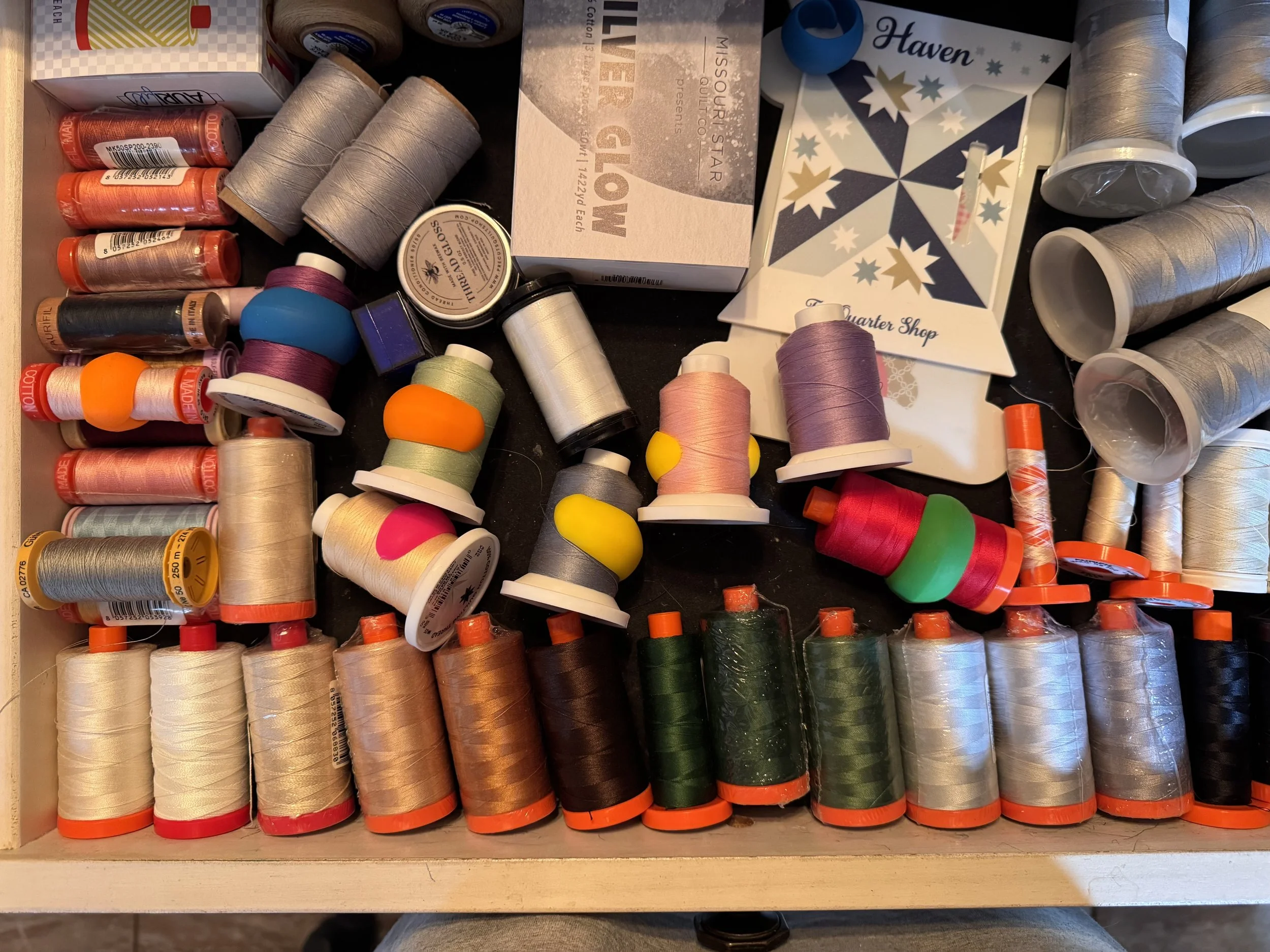
My Jukis seem to love Aurifil, so Aurifil has become my go-to for machine piecing and general machine sewing. Both machines sew consistently well with it, and I have no reason to argue with them.
When I want an especially fine machine stitch, I use either Aurifil 80 weight or WonderFil DecoBob 80 weight. Both reduce bulk and give me a fine, unobtrusive stitch. That can make a noticeable difference in detailed piecing, machine appliqué and any work where an ordinary piecing thread looks heavier than I want.
Manufacturer recommendations are useful, but machines do have preferences. A thread that sews beautifully in one machine may need tension or needle adjustments in another. When a machine consistently likes a particular thread, I pay attention.
What I use for English paper piecing
English paper piecing is where fine thread really earns its keep. A bulky thread can make the pieces harder to pull together, add a ridge along the seam and leave more of the stitches showing on the front.
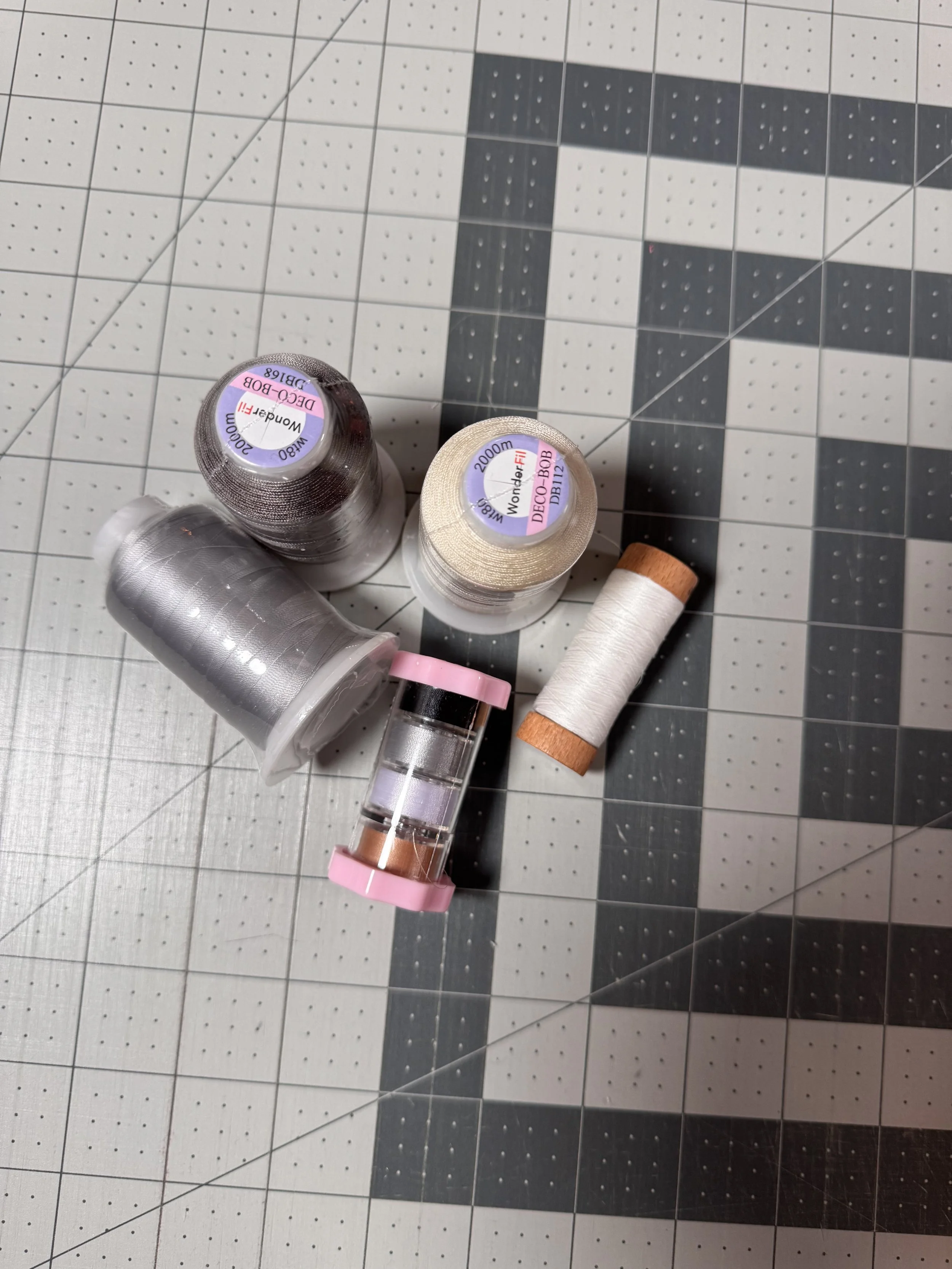
WonderFil is my go-to for EPP. DecoBob is an 80-weight, 2-ply cottonized polyester that is fine, strong and easy to work with. InvisaFil is even finer at 100 weight and nearly disappears into the fabric. Aurifil 80-weight cotton is another good option, especially for someone who prefers cotton thread.
Then there is the WonderFil Bobbinator, which is a simple little tool and an excellent one.
The Bobbinator holds four prewound bobbins. One sits in the top and feeds the thread while three more remain stored underneath. It keeps the thread contained, gives me several colors in very little space and saves me from carrying full spools in my EPP bag.
Fat Quarter Shop carries the Sue Daley Designs DecoBob Thread Set with Bobbinator. The set includes the Bobbinator and ten Class 15 prewound bobbins of 80-weight DecoBob in assorted colors. It works particularly well for stitching in the car, taking EPP to a retreat or carrying a handwork project without bringing an entire bag of thread.
The needle has to fit the thread
The thread needs room to pass through the eye of the needle and settle into the groove running down the front. When the needle is too small, the thread may fray, shred or break. The machine may also skip stitches.
Fine threads can generally use smaller needles. Heavy decorative threads need larger needles with larger eyes and grooves. The fabric and type of stitching matter too, so thread weight should never be the only consideration.
The manufacturer’s needle recommendation is a useful starting point. Test the thread and needle together on scraps from the project. For machine quilting, make a small sandwich using the same top fabric, batting and backing.
If the thread keeps breaking, check the needle before blaming the thread. Confirm the size and type, rethread the machine, inspect the spool for a snag and check the tension. Sometimes the thread is simply being forced through a needle that is too small for it.
Start with what you want the stitch to do
Choosing thread becomes easier once you decide whether the stitches should disappear, quietly support the piecing or become part of the design.
For nearly invisible EPP, appliqué or fine machine stitching, I use an 80- or 100-weight thread. For general machine piecing, 50 weight is a reliable choice. For quilting that needs more definition, I look at 35 or 40 weight. When the stitching should become part of the design, I move toward 30, 28, 20, 12 or 8 weight.
Then I test it.
For piecing, I sew a seam and press it the same way I plan to press the block. That tells me how much room the thread takes up inside the seam and whether the seam will lie flat.
For quilting, I sew through a sample sandwich and look at both sides. I also set it down and step back. A line of quilting can look awfully bold when my nose is six inches from it and be exactly right when I see the quilt from across the room.
A label can tell us the thread’s weight, fiber and construction. It cannot tell us exactly how that thread will look in our fabric or behave in our machine. The label narrows the choices. The test sample settles the argument.
For all the choices available, my own thread habits are fairly simple. Ninety-five percent of the time, either one of my Jukis is threaded with Aurifil 50-weight cotton in whatever color the project calls for, and my EPP needle is threaded with WonderFil DecoBob 80 weight. I keep other threads for the jobs that need them, but those two do most of the work around here.
Chris
Technical information was checked against current educational and product information from Aurifil, WonderFil, Superior Threads, AMANN, Coats and American & Efird.
