
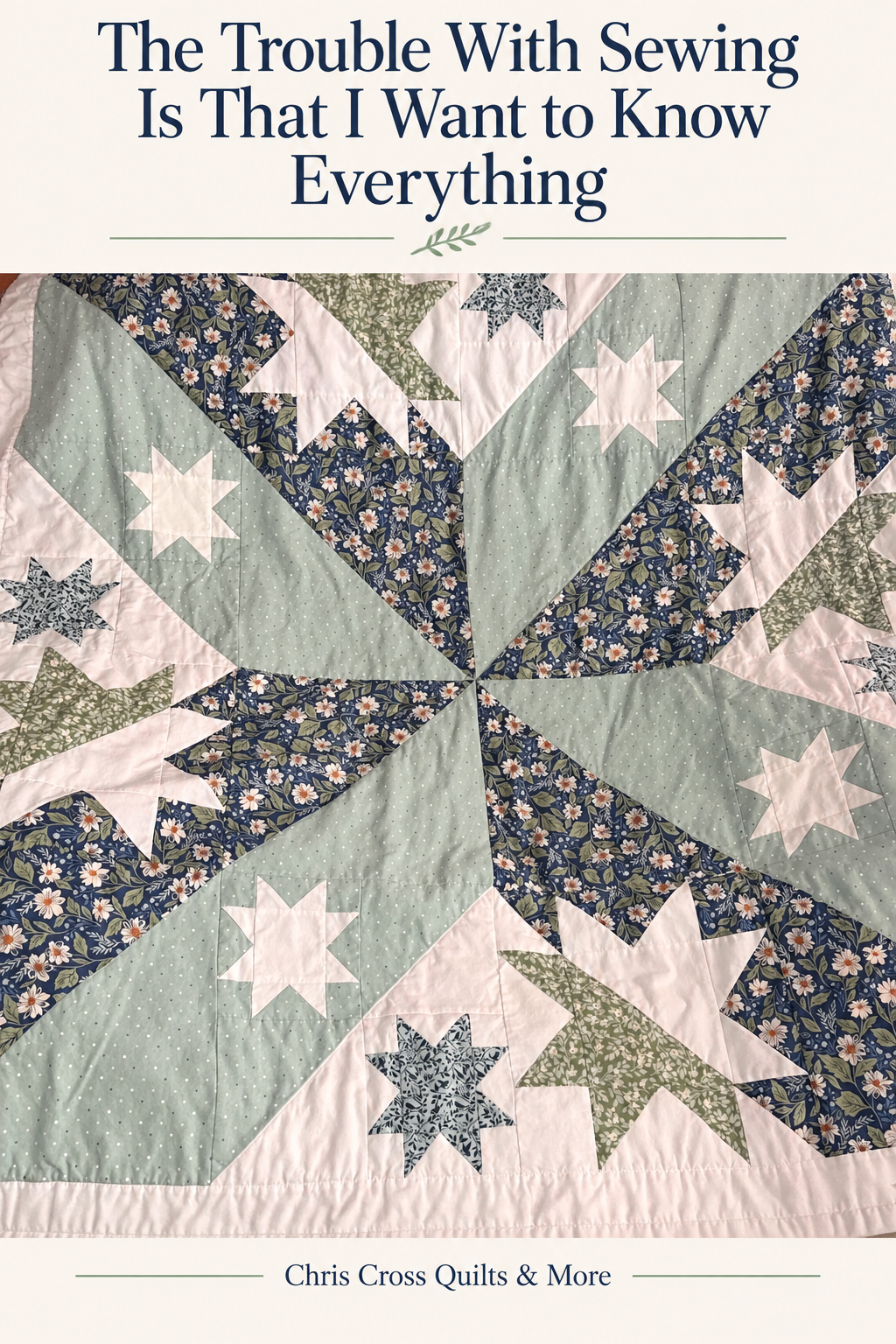
The Sewing chair #10
I never expected to get this wrapped up in sewing. Now I want to make quilts, clothes, bags and things for my home—and I’m a little jealous of everyone who makes it look easy. The surprise is how much I’ve learned along the way without noticing.
The Trouble With Sewing Is That I Want to Know Everything
I am jealous of people who know how to sew.
This is an awkward thing to admit when I also know how to sew. I have made quilts, worked with appliqué, tried English paper piecing and Manx blocks, and begun hand quilting. I understand a quarter-inch seam, have preferences about rulers and know which of my machines I want for a particular job. I am not standing in front of a sewing machine wondering where the thread goes.
But another quilter will look at a block and immediately see four ways to construct it. She knows which method wastes the least fabric and which will give her better points. I am still trying to determine how the block was assembled in the first place. Someone else matches striped binding so neatly that the join disappears. Another person identifies a fabric collection from a sliver of print in a photograph.
I admire them. I also feel a small, unreasonable flash of jealousy. I don’t want them to know less; I would just appreciate knowing what they know, preferably without making every mistake required to get there.
What makes this especially ridiculous is that I never expected to care about sewing at all. I certainly never imagined I would become this wrapped up in it. I thought I might learn to make a few things. I did not anticipate spending an evening reading about batting, developing opinions about seam allowances or looking at someone’s bag and trying to work out how they made the corners. At some point, “I’d like to try sewing” became “I need to understand everything that can be done with fabric and thread,” which was a fairly significant change in scope.
ONE QUESTION LEADS TO TWELVE MORE
Quilting alone could keep me busy for the rest of my life. There is piecing, appliqué, foundation paper piecing, English paper piecing, hand piecing, hand quilting, free-motion quilting and longarming. Each one comes with its own tools, techniques and people who have very convincing reasons for doing things differently from one another.
I can decide to learn more about hand quilting and immediately find myself comparing needles, thread weights, batting, marking methods and thimbles. I came in hoping to make smaller stitches. Apparently, I first need to choose a position on approximately six other matters.
Even sewing two squares together can become an education. We sew them, press them, cut them apart and sew the pieces back together in a different arrangement. Then someone explains a method that would have produced the same block more accurately with fewer steps. That explanation usually arrives shortly after I have finished mine.
And quilting is only part of what I want to learn.
I want to sew clothes that fit well. I want to alter a pattern without wondering whether one small change will somehow move the entire sleeve to the wrong side of my body. I want to understand fabric drape, ease, linings and why a garment that looked lovely in the pattern photograph looks quite different once a real person inhabits it.
I want to make bags with neat zippers, sturdy straps and enough structure to stand up without resembling a piece of luggage. Bag makers seem able to choose between interfacing, fleece, foam and various other materials with complete confidence. I would like to know how they do that before I commit several hours of work and a perfectly good piece of fabric to the wrong one.
Then there is home décor. Curtains, cushions and slipcovers sound approachable until measuring becomes involved. A quilt can be a little larger than planned and still be a quilt. A curtain that is four inches too short will spend every day informing you of that fact.
These are all forms of sewing, but competence in one does not automatically transfer to the others. Knowing how to make a quilt has not given me the ability to fit trousers or install a professional-looking bag zipper. I think the shared use of a sewing machine creates a false impression that they are all roughly the same activity. The machine knows better.
THE PART I TEND TO FORGET
The internet does not help with the jealousy. It puts a beautifully fitted jacket, a quilt with perfect points and a handmade bag with immaculate topstitching in front of me within five minutes. I see the finished work, not the years of practice behind it. I know, intellectually, that the person who made the jacket may have sewn twenty others. That does not prevent me from looking at mine and wondering why I have not mastered jacket fitting yet, despite having made exactly zero jackets.
At the same time, I have caught myself doing something that surprised me: explaining sewing to other people.
I can explain why a scant quarter-inch seam matters, why I might press one seam differently from another or why I reach for a particular ruler. I can look at a block with points that do not match and usually work out where things went astray. I have learned when a mistake needs fixing and when I have simply been staring at the project from four inches away for too long.
Some of what I once had to look up now comes easily. I have preferences based on what has worked for me, not just what the packaging promised. The knowledge arrived a little at a time, attached to projects, mistakes and seams I would rather not unpick again. Because there was no obvious moment when I became more skilled, I had not quite noticed how much I had learned.
I wonder if the quilters I envy feel the same way. They may be completely comfortable constructing the block I cannot figure out, then go home and stare suspiciously at a garment pattern. Someone new to quilting could probably look at my work and assume I have everything figured out, which would be flattering and wildly inaccurate.
I still feel jealous sometimes. I want the experience behind those beautifully made clothes, bags and quilts, and I am impatient about how long it takes to acquire it. But I am also beginning to recognize that I have already acquired quite a bit. I am not starting from scratch every time I sit down to sew, even when the project in front of me asks something I have never done before.
The interest that took me by surprise has grown into something much bigger than a list of projects I want to make. I want to understand how they work. That may mean I will always be aware of what I have not learned yet, but it also means there will always be something interesting waiting when I return to the sewing room.
Happy stitching! Chris
Saturday Stitch Report #8
A Fat Quarter Shop Designer Mystery block is finished, and I improvised my way into a new patchwork bag. Between family and clinic work, I’ve also been wondering what I want this quilting blog to become.
A Bag, a Block, and a Question
It has been a busy stretch around here. Family has needed my time, and I’ve been working on posts for my clinic, Inspired Life Wellness Clinic at www.inspired-lifewellness.com. If you’d like to follow along with that writing, you can find the clinic online. The quilting page and blog have been quieter.
I did manage to finish a few things.
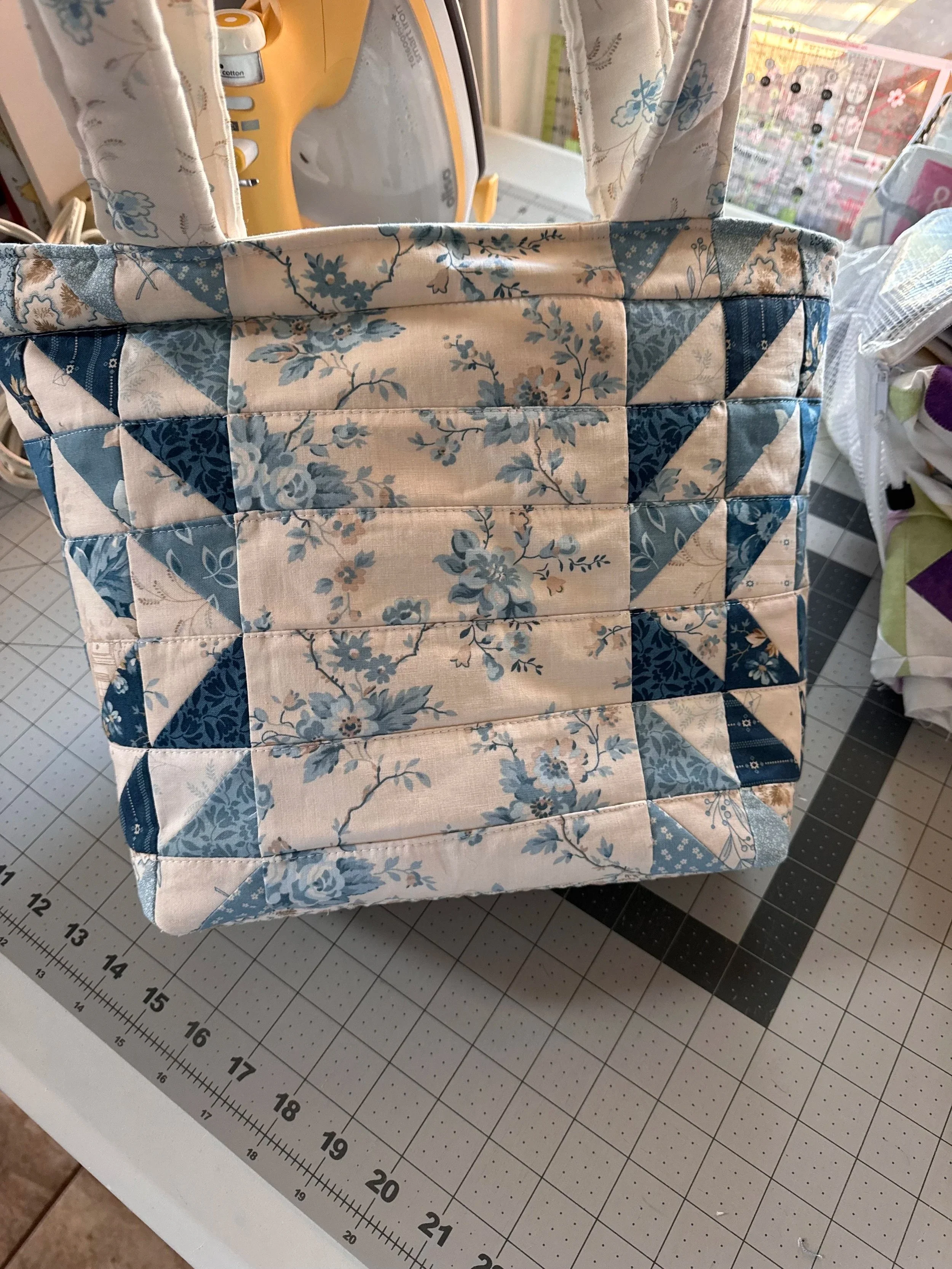
The latest block for the Fat Quarter Shop Designer Mystery quilt is pieced and ready for the growing collection. I also made a bag using a pattern I created as I went. The blue and cream fabrics and patchwork came together into a bag I’m happy with, even though the pattern itself exists only as a vague series of decisions in my memory.
Did I write any of it down? Of course not. I winged it.
So if I ever want to make this bag again, I’ll either have to reconstruct the process from the finished one or accept that the next version will be a completely different bag with the same general ambitions.
Lately, I’ve also been questioning whether I should keep the page and blog going. There are so many good quilting blogs out there. Many share tutorials, detailed instructions, and videos. I don’t feel especially qualified to talk about quilting in that way, and I don’t have the time right now to make videos or build a library of tutorials.
I’m still figuring out what I want this space to be—and whether I have the time and energy to keep tending it. I don’t have a decision to announce today. For now, I have a finished block, an improvised bag, and a reminder to write down the next pattern before I forget how I made it.
Have a great week and happy stitching!
Chris
Jane Austen’s Other Work: The Patchwork Coverlet at Chawton
Jane Austen, her sister Cassandra, and their mother made a patchwork coverlet with more than 2,500 tiny diamonds in its border. I went looking for the story behind those fabrics and found myself wondering where the quilts we make today might end up two centuries from now.
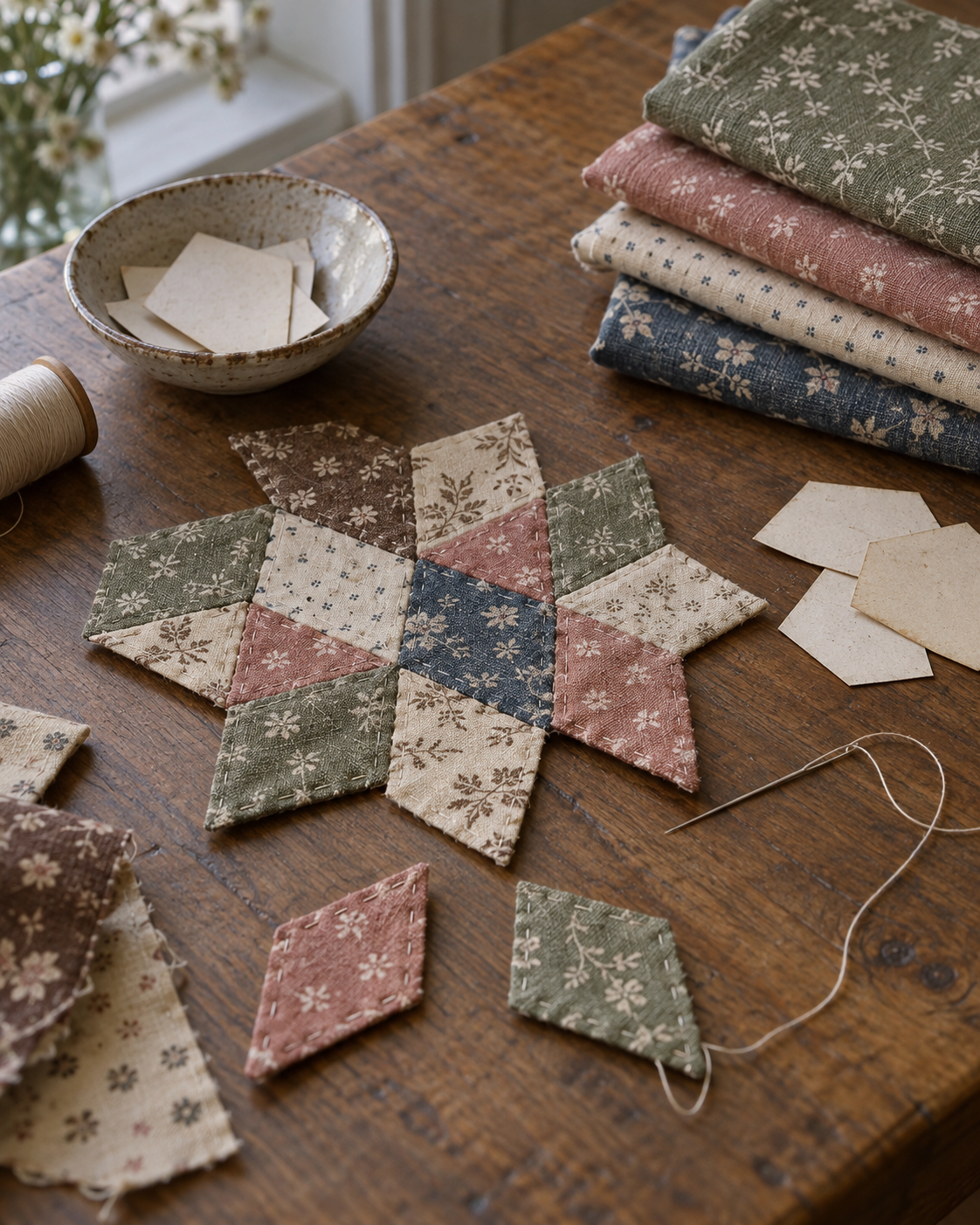
**The image accompanying this article is an AI-generated illustration of diamond piecing, not a photograph of the Austen family coverlet. You can see the actual coverlet at Jane Austen’s House.
In May 1811, Jane Austen wrote to her sister Cassandra to ask whether she had remembered to collect pieces for their patchwork. They were, Jane said, “at a standstill.”I was delighted to find this in her correspondence. Not because I think Jane Austen and I had identical sewing lives—I own a rotary cutter and she wrote Pride and Prejudice—but because waiting on one particular fabric is a problem I recognize. I have plenty of fabric. That has never prevented me from deciding that the one piece I need is somewhere else.We cannot know for certain whether the patchwork mentioned in Jane’s letter is the coverlet that survives at Jane Austen’s House in Chawton. The museum connects the letter to the coverlet, which it attributes to Jane, Cassandra, and their mother. It dates the piece to around 1810. Jane Austen’s House The surviving piece is often called Jane Austen’s quilt. Strictly speaking, it is a patchwork coverlet: a pieced top with a cotton backing, but no batting between them and no quilting stitches holding layers together. I know. We have barely begun admiring it and I am already correcting what people call it. But the coverlet was complete with those two layers. The patchwork itself was the finished work. Textile conservator Kate Gill examined its construction.
The diamonds. So many diamonds.
A large diamond sits at the center, cut from fabric printed with birds and a basket of flowers. Around it are rows of smaller floral diamonds separated by narrow strips of spotted fabric. Then there is the border, made with more than 2,500 tiny diamonds, each with sides measuring about 30 millimeters. Jane Austen’s House I would like to know how the three women felt about that border by the time they reached the end of it. Unfortunately, the historical record has neglected the exact sort of detail I most want. Jane was willing to write that they had run out of pieces, but apparently did not leave us a full account of the emotional consequences of sewing diamond number 2,417.The design itself suggests they had a plan. The central arrangement has fourfold symmetry, and the border matches from top to bottom and side to side. Gill’s examination found that the symmetry extends to the placement of individual printed fabrics. That takes more than cutting whatever scrap happens to be handy and hoping it looks intentional later. I have tried that method. It has its limits. Jane Austen’s House; Kate Gill Conservation The museum identifies at least 64 different fabrics in the coverlet. Some are lightweight printed fabrics of the sort used for dresses, while the border also includes furnishing fabrics. The pieces were made by English paper piecing: fabric was secured around paper shapes, then the shapes were stitched together by hand. The museum describes stitches as small as about twelve to an inch.Those numbers tell us something about the time involved, but the arrangement tells us just as much about the women making it. They were considering color, print, repetition, and balance while working with the pieces available to them. Saving fabric could be practical. Making something beautiful from it still required choices.
The fabric had a life before the coverlet
Jane’s request to Cassandra gives us one possible source of new pieces. Cassandra was staying with their brother Edward’s family in Kent, where clothing made for his large household might have left useful remnants. That is a possibility noted by the museum, rather than a record of where any particular fabric came from. Jane Austen’s House Printed cotton was valuable enough that offcuts were worth keeping. It also had a history far beyond the Austen home. Cotton cloth circulating in England was connected to growing, manufacturing, trade, and colonialism. Jane Austen’s House discusses the wider cotton trade alongside the coverlet. We cannot trace every piece in this coverlet to its origin, but I would love to know where the Austen women found those prints. Which came from clothing, which were left over from furnishings, and which, if any, did Cassandra bring back from Kent? Two hundred years later, that trail is probably impossible to follow. Still, it makes me look at the individual fabrics, not just the finished design.That is one reason I enjoy studying old textiles. A single piece can be personal, practical, and beautiful while also carrying a much larger story about how people lived and what materials they could obtain.
What we can see—and what we cannot
We do not know exactly when the coverlet was begun or finished, or how Jane, Cassandra, and their mother divided the work. We cannot tell who planned the layout or who sewed the last diamond into the border.It is tempting to fill in those blanks. I can readily picture the three of them discussing prints, changing their minds, and disagreeing mildly over a placement before somebody decided it was fine where it was. That might have happened. It might also be me projecting my own sewing room onto theirs, and I have enough projects without taking responsibility for theirs too.The coverlet gives us plenty to examine without making up the conversation around it. Its seams and fabric placement are still there. Even its changing colors tell part of the story. Gill found that some dyes have faded with exposure to light, while protected areas on the back retain brighter color. The coverlet the Austen women saw was not quite the one we see now. Kate Gill Conservation And that may be the detail I find most fascinating: we can still see it at all. Something made in their home more than two hundred years ago has lasted long enough for us to study their fabric choices and their stitches. I wonder whether they ever considered that possibility. Most of us are occupied with getting a project finished, washing it, giving it away, or deciding whether the binding looks all right. We are rarely planning for a museum conservator to inspect the back.It makes me wonder where the things we are sewing now will end up. A quilt might wear out from years of being used and loved. It might be passed to a grandchild, spend decades in a closet, or turn up in the hands of someone who has no idea who made it. Perhaps a little of its story will travel with it. Perhaps someone will have to look closely at the fabric and stitches and make their best guess.Jane Austen left us novels that tell us a great deal about how she observed people. Her family’s coverlet shows us decisions made with fabric: what to save, what to place beside something else, and how to keep working when the pieces they needed had not arrived. I can’t know where the quilts in my sewing room will be two hundred years from now. I do like imagining that one of them might make somebody curious enough to look closer.If you’d like the wider picture of sewing and patchwork in Austen’s time, I wrote about it in Quilting 250 Years Ago.
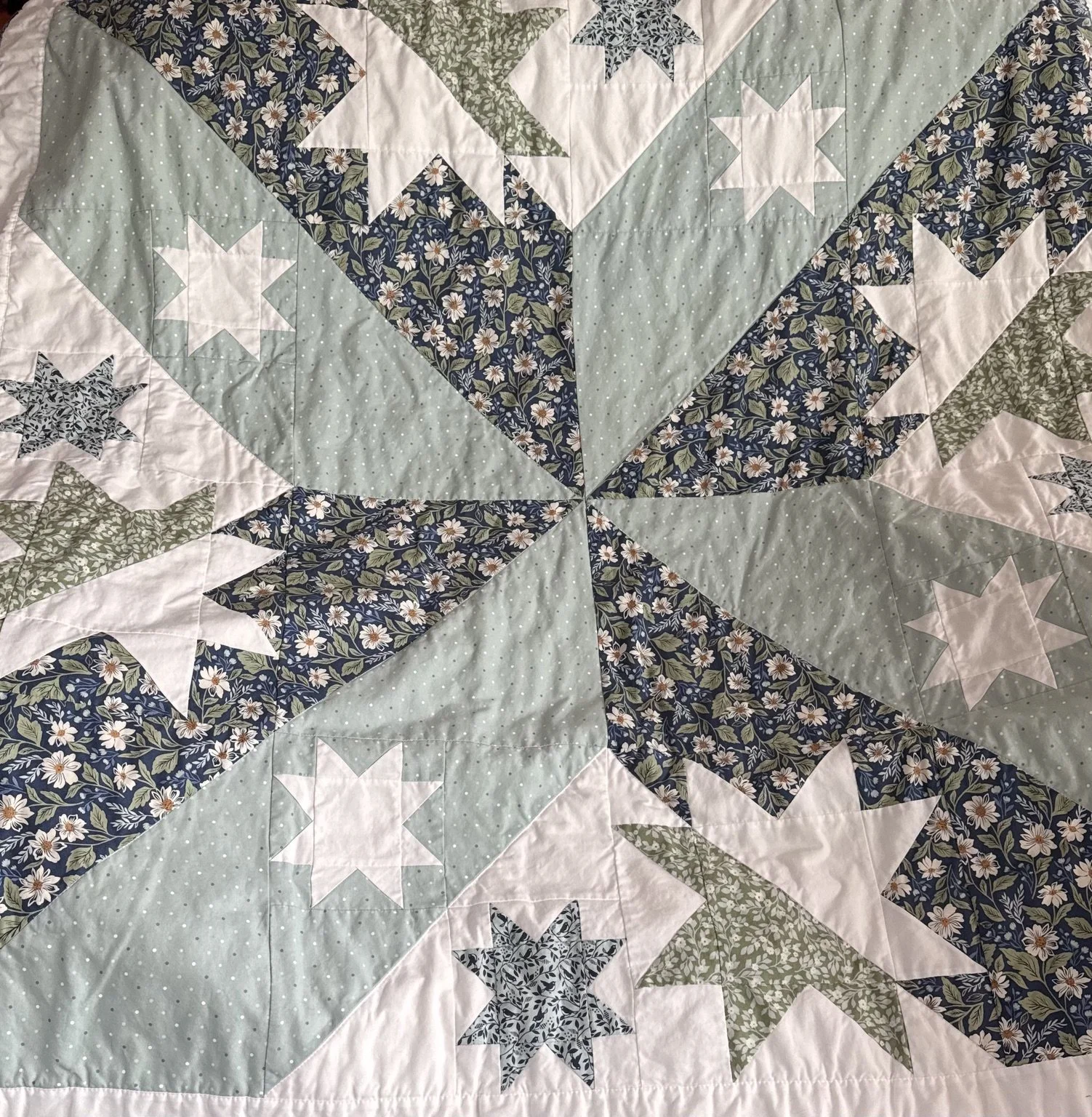
The sewing chair #9
I never expected to get this wrapped up in sewing. Now I want to make quilts, clothes, bags and things for my home—and I’m a little jealous of everyone who makes it look easy. The surprise is how much I’ve learned along the way without noticing.
The Trouble With Sewing Is That I Want to Know Everything
I am jealous of people who know how to sew.
This is an inconvenient admission from someone who also knows how to sew.
I can make a quilt. I understand a quarter-inch seam, know why pressing matters and have developed firm opinions about rulers, rotary cutters and which sewing machine should be used for which job. I have pieced blocks, worked with appliqué, experimented with English paper piecing and Manx blocks, and begun hand quilting.
None of this was something I expected. I never imagined I would become interested in sewing, much less this wrapped up in it. I thought I might learn to make a few things. I did not anticipate developing opinions about seam allowances, spending an evening reading about batting or looking at a bag and wondering how its corners were constructed.
Yet here I am, regularly watching another quilter do something that makes me wonder where I was on the day everyone else learned that.
Someone will casually match a striped binding perfectly at the seam. Another person will identify a fabric collection from three inches of floral print in the corner of a photograph. Someone else can look at a quilt block and immediately explain four ways to construct it, which method wastes the least fabric and why one of them will make the points behave better.
Meanwhile, I am studying the same block as though it may eventually confess its secrets under questioning.
The jealousy is not mean-spirited. I do not want these people to lose their knowledge. I would simply like a duplicate copy placed directly into my brain.
Unfortunately, sewing knowledge does not arrive that way.
THERE IS ALWAYS SOMETHING ELSE TO LEARN
Quilting alone is enormous.
There is traditional piecing, curved piecing, appliqué, foundation paper piecing, English paper piecing, hand piecing, hand quilting, free-motion quilting, ruler work and longarming. There is color theory, fabric history, quilt restoration and enough batting choices to make one suspect that cotton, wool, polyester and bamboo have formed separate committees.
Every subject opens into another subject. Learning about hand quilting leads to needles, thread weights, batting, marking tools, thimbles and the mystery of why one person can make twelve tiny, even stitches appear on a needle while I am negotiating with three.
Even sewing two squares together is not necessarily simple. We sew them together, press them in a particular direction, cut them apart, rearrange them and sew them back together. Then we discuss whether the finished block would have been more accurate if we had used a completely different method from the beginning.
But I do not only want to quilt.
I want to make clothes that fit. I want to understand garment construction well enough to alter a pattern without feeling that I am interfering with structural engineering. I want to insert a zipper beautifully, make a collar lie correctly and sew a sleeve into an armhole without either one becoming openly hostile.
I want to make bags with crisp structure and professional hardware. I want to know which stabilizer will give a tote some body without turning it into carry-on luggage made of drywall. I want neat zippered pockets, straps that do not twist and corners that look deliberate from every angle.
I want to make curtains, cushions, slipcovers, table linens and all the other things included in the cheerful phrase home décor sewing. That phrase makes it sound as though one simply selects a lovely fabric and spends an afternoon improving the house. It does not mention measuring windows, calculating pattern repeats, matching large prints or discovering that the floor, ceiling and window frame have never agreed on what constitutes a straight line.
Quilting, garment sewing, bag making and home décor may all involve fabric, thread and a sewing machine, but they are not small variations of the same skill. They are neighboring countries with related languages, separate customs and surprisingly specific border requirements.
Naturally, I want citizenship in all of them.
EXPERIENCED SEWISTS MAKE IT LOOK DECEPTIVELY REASONABLE
People who have spent years sewing can make difficult things look perfectly manageable.
They say, “I just drafted a facing,” or “I changed the pocket,” or “I added foam stabilizer,” with the same calm tone I use when announcing that I reheated my coffee.
Their hands know how fabric behaves before the fabric has an opportunity to misbehave. They clip, grade, understitch and turn, and a smooth, finished edge emerges without drama. They cut into expensive fabric without requiring a period of silence first. They seem to know exactly how much ease they need, which needle belongs in the machine and why the thread is causing trouble.
Some of them can hear that a sewing machine is not quite right.
I am deeply impressed by all of this. I am also a little irritated.
Not with them, exactly. I am irritated by the number of years and projects required to become the person who knows those things.
I would like the skill that comes from making twenty shirts, but I would prefer to acquire it somewhere around shirt number two. I want the judgment developed through several failed bags without having to produce the bags that teach it. I want to skip directly to confidently altering patterns while retaining the right to be surprised when the instructions suddenly introduce a gusset.
This is unreasonable, but it is sincere.
SOMEWHERE ALONG THE WAY, I LEARNED QUITE A LOT
The internet places the work of thousands of skilled people in front of us without necessarily showing the history behind it. We see the beautifully fitted jacket, not the years of sewing or the practice garments that came before it. We see the perfect quilt points, not the seam that was unpicked three times. We see the finished handbag standing upright with gleaming hardware, not the earlier version whose zipper wandered off course.
Even knowing that, comparison gets under my skin. Someone else’s strongest skill sits beside my current attempt, and for a moment the difference looks like talent rather than years of practice and accumulated mistakes.
The strange thing is that while sewing continually shows me what I do not know, it has also begun to reveal how much I have already learned.
I sometimes hear myself explaining why a scant quarter-inch seam matters, how pressing a seam in a different direction may affect the next step or why one ruler works better for a particular cut. I can look at a block whose points do not match and usually make a reasonable guess about what happened. I know when my accuracy is beginning to drift and when I am too tired to make the decision the project requires.
I have learned enough to have preferences based on experience instead of packaging.
Techniques that once seemed mysterious have become familiar. Tasks that required repeated trips back to the instructions now happen almost automatically. The knowledge accumulated so gradually that I did not notice how much of it I was keeping.
There was no particular project after which I suddenly became knowledgeable. There were simply quilts, blocks, experiments, mistakes and corrections, each leaving behind a little more understanding than I had before. Somewhere along the way, I became genuinely competent in more areas than I realized.
That recognition feels almost as strange as the jealousy.
I still see what other quilters and sewists know that I do not. But a person just beginning might look at something I have made and assume I possess the same mysterious confidence I see in others. She cannot see the seams I ripped out, the instructions I reread or the number of times I searched for an explanation of something everyone else appeared to understand.
She sees the finished quilt.
Perhaps that is what I am seeing when I look at everyone else.
WHAT I WANT TO LEARN NEXT
I have begun to notice that my jealousy often points toward something I genuinely want to learn.
If I feel a pang when I see a beautifully fitted handmade dress, it may be because garment sewing interests me. If I keep examining someone’s precise bag construction, perhaps I am ready to make more bags. If hand quilting stops me every time, I probably want more practice with the rhythm and control of those stitches.
It is easy to take someone else’s skill as evidence that I am behind. But sewing has no sensible finish line. A talented quilter can still be a beginner at fitting pants. A garment sewist can make a beautifully tailored coat and remain entirely uninterested in calculating half-square triangles. Nobody knows all of it.
I know far more than I once did, and there is still an astonishing amount I do not know. Both are true.
I still want to walk into a fabric store and understand exactly how each material will drape, stretch, press and behave. I want to fit trousers, construct beautiful bags, make useful things for my home and continue exploring every corner of quilting that catches my attention.
I will never learn all of it. Considering that I never expected sewing to interest me in the first place, I am not entirely sure how I ended up with a list this long.
I am, however, going to need another notebook.
~Chris
saturday Stitch Report #7
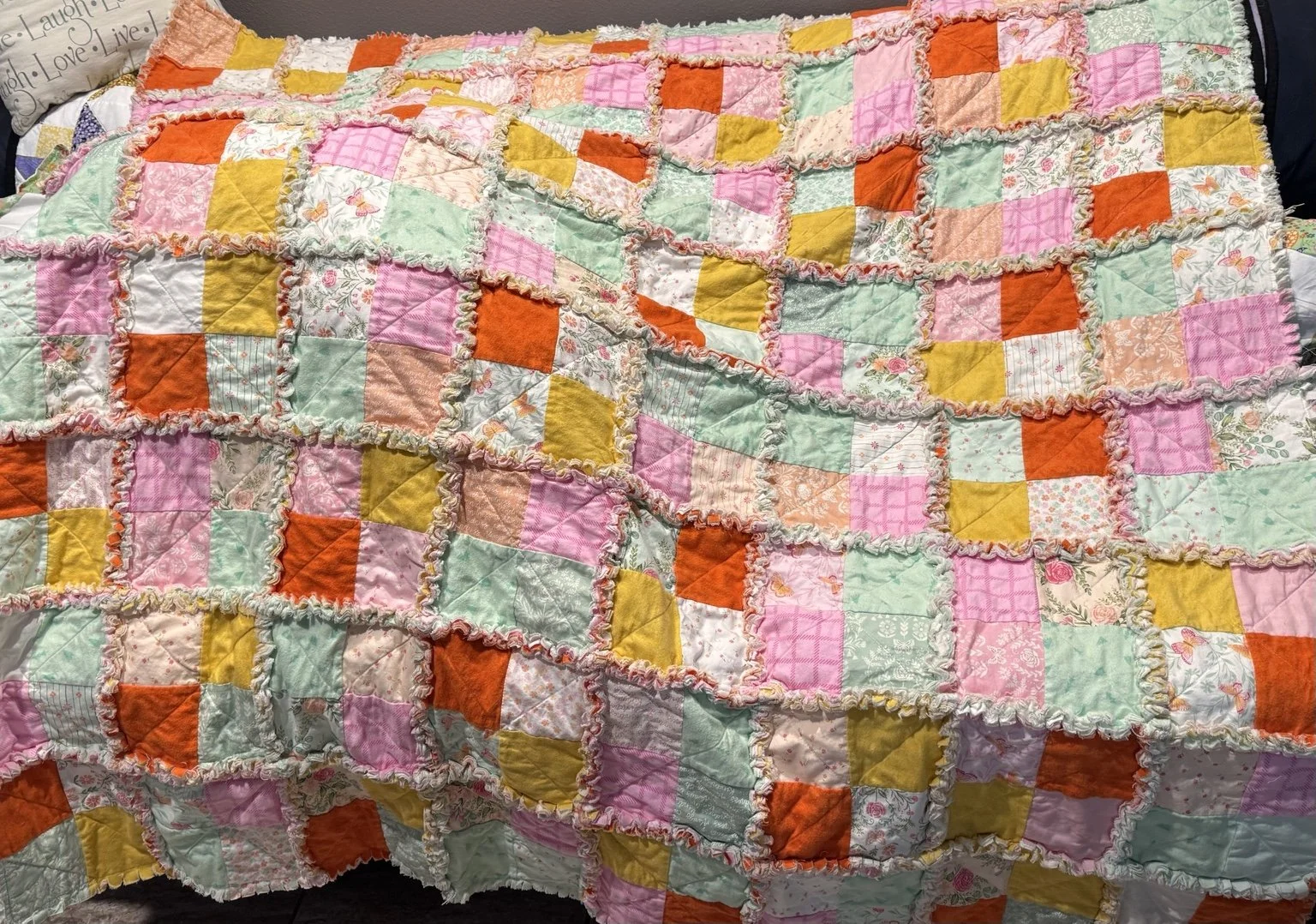
Another rag quilt is finished, bringing the birthday-quilt count to five grandchildren down and two to go. I also made the latest A Quilting Life Block of the Month in two very different colorways while several unfinished projects compete to be next. Beyond the sewing room, school and football are underway, Mom has begun cancer treatment, and the first glorious signs of fall have arrived.
FIVE DOWN, TWO TO GO
School has been underway long enough that, for the most part, everyone is falling into the routine again. Mornings have structure, calendars have filled, and football is a thing—which is probably the most accurate way to describe how thoroughly it occupies our time and conversation right now.
The sewing room has been busy too, although I have once again reached the point where I have several perfectly reasonable things to work on and cannot decide which one I want to do next.
Affiliate disclosure: This post contains affiliate links. If you make a purchase through one of these links, I may earn a commission at no additional cost to you. As an Amazon Associate I earn from qualifying purchases.
ANOTHER RAG QUILT FINISHED
I finished another rag quilt for one of my grandchildren, all have been patterns I created, which has been a fun twist to quilt making. All seven of them are getting one for their birthdays this year, and this finish brings the official count to five down and two to go.
For this quilt, I used the Kindness collection by Deb Strain for Moda Fabrics. It is a wonderfully cheerful mix of pink, coral, aqua, yellow, florals, and plaids. I also used coordinating flannel solids, which add softness and help tie all the prints together. Rag quilts have such a soft, relaxed look once all those exposed seams begin to fluff. They are not particularly complicated quilts, but there is still a great deal of sewing involved—and then comes the clipping. So much clipping.
When it comes to clipping the seams, my favorite pair of snips helps make the job much easier. They are comfortable to use and help reduce some of the hand fatigue that comes from all that repetitive cutting. With seven rag quilts on the birthday list, anything that makes the clipping more manageable is welcome.
Still, there is something satisfying about making the same general kind of quilt for each grandchild while choosing fabrics that make every one of them different. By the end of the year, all seven will have a quilt made by Grandma, and I will presumably have regained full use of my hands after cutting all those seams.
ONE BLOCK, TWO COMPLETELY DIFFERENT QUILTS
I also completed the latest block for the A Quilting Life Block of the Month—twice.
As I mentioned before, I am making each block in two different colorways so I can eventually make two quilts. The design is identical, but the fabrics make the blocks feel entirely different. One is soft and quiet in blue-green, taupe, and white. The other uses navy, red, and bright florals and has considerably more to say.
This is exactly why fabric selection fascinates me. The piecing does not change. The shapes do not change. The placement does not change. Yet the finished blocks have completely different personalities.
WHAT COMES NEXT?
The Spring Dreams blocks are ready to be pieced into a quilt top. After that, it will still need to be basted, backed, quilted, and bound—which makes “almost finished” feel like a somewhat generous description.
The next Designer Mystery block is also waiting to be made, and there are still two rag quilts left on the birthday list. Any one of those would be the logical next project.
Naturally, I am thinking about working on some repurposing projects instead.
I have old clothing and other materials I would like to experiment with, and the idea of turning something no longer used into something useful has been tugging at me. Apparently, having several active projects does not prevent my brain from suggesting entirely new categories of sewing.
For now, I am stuck in that familiar place between wanting to finish what I have started and wanting to follow the latest interesting idea. I could make a sensible list and work through it in order. I could also reorganize fabric while listening to an audiobook and call it preparation.
Both remain possibilities.
LIFE BEYOND THE SEWING ROOM
Mom’s cancer treatment journey has begun. After so much waiting and uncertainty, we have finally moved into the treatment itself. There is some relief in having a plan underway, but treatment brings its own worries with it. We are praying that it goes well and trying to take each part as it comes.
Meanwhile, the rest of life continues to require attention. Interior painting remains on the list, along with the routine house and yard maintenance that needs to happen before the cold and snow arrive. In North Dakota, fall is beautiful, but it also comes with a quiet warning: enjoy this weather, but perhaps locate the snow shovels.
The cool mornings have arrived, and they have been glorious. Fall is my favorite season, and I am planning to decorate the house this weekend. I am ready for the quilts, warmer colors, candles, and all the comfort-food recipes that have been waiting patiently for summer to leave.
While I sew, paint, decorate, clean, or wander from one unfinished task to another, I have been listening to the Shenandoah album book series. Audiobooks remain one of the best ways I have found to make progress on two things at once—or at least to make whatever I am doing feel more interesting.
So that is where things stand: five rag quilts finished, two grandchildren still waiting, two versions of the same quilt growing one block at a time, several projects competing to be next, football underway, treatment begun, and fall finally arriving.
I may not know what I am sewing next, but I do know the fall decorations are coming out this weekend. Some decisions are easier than others.
Happy Fall!
~Chris
The Stitch Report #6
A finished quilt for Mom, completed blocks, football-season worry, a daughter working two jobs, an unexpected yellow-jacket ambush and an audiobook-inspired Christmas rabbit hole—quite a bit happened between Stitch Reports. Fortunately, the quilts provide a timeline when my memory does not.
Catching Up While Life Keeps Moving
It has been a few weeks since my last Stitch Report, which means I had to reconstruct this one from completed quilt blocks, photographs on my phone and whatever details my brain happened to retain. Apparently, this is one more reason to keep reporting regularly. I do have a personal journal that could help with these things. The journal, unfortunately, cannot remind me to write in the journal.
Still, quite a bit has happened—both in the sewing room and everywhere beyond it.
Mom’s Quilt Is Finished
The most important finish was Mom’s quilt.
I made it for the treatment days ahead, although we are still waiting for the official treatment plan. There is something particularly difficult about knowing that something hard is coming without knowing exactly when it will begin or what it will look like.
The quilt was one thing I could do while we waited. I could choose the fabric, sew the pieces, finish the quilting and put something tangible into a situation that otherwise offers very little control. It cannot change the diagnosis or hurry the answers along, but it can keep her warm and remind her that she is loved. Sometimes that is what making things is for.
Affiliate disclosure: This post contains affiliate links. If you make a purchase through one of these links, I may earn a commission at no additional cost to you. As an Amazon Associate I earn from qualifying purchases.
Progress in the Sewing Room
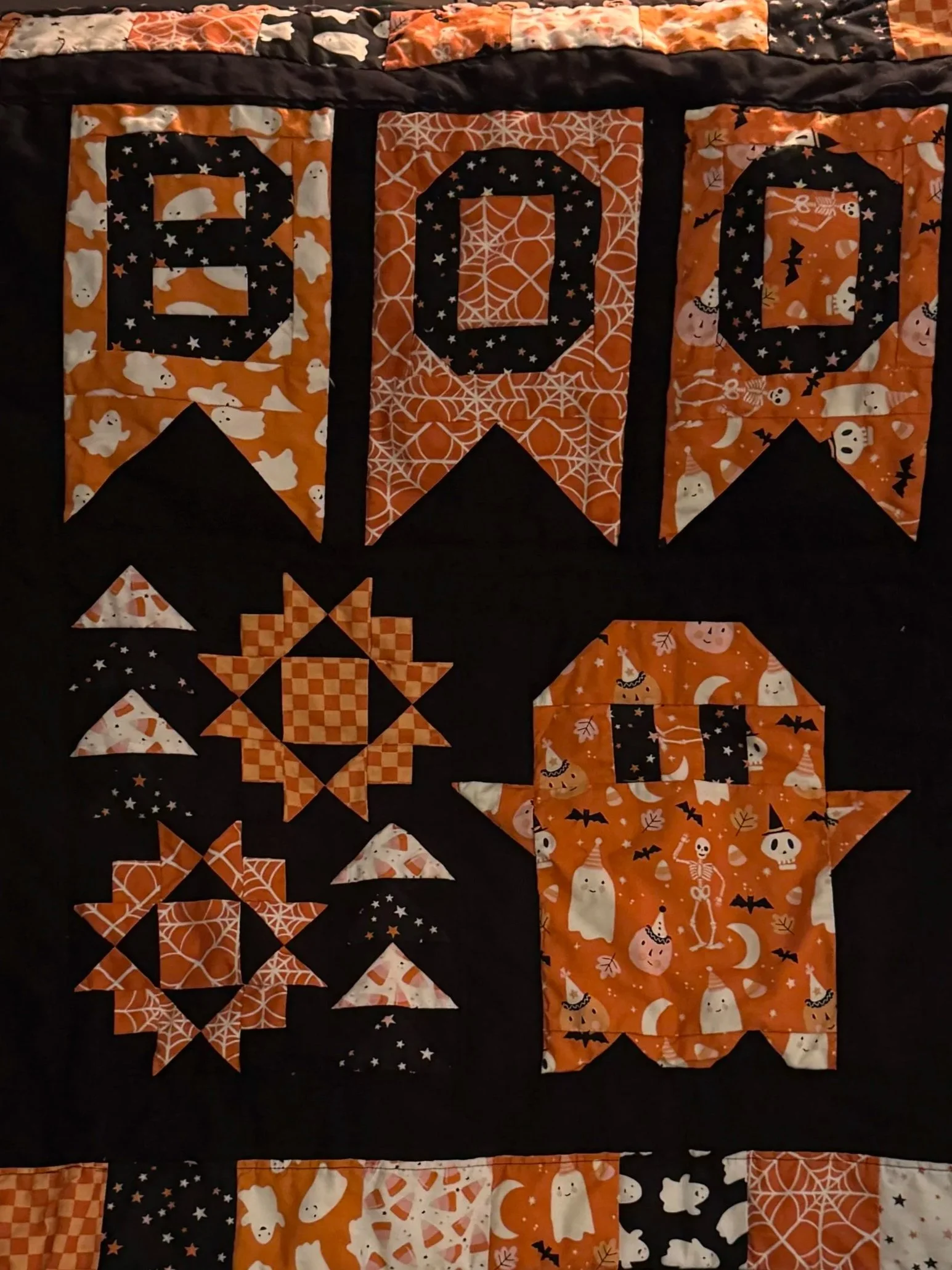
Beyond Mom’s quilt, I finished the final blocks for Spring Dreams and completed Boo to You. I also finished the latest blocks for the Fat Quarter Shop Designer Mystery Block of the Month.
For someone who occasionally feels as though she has accomplished nothing, that is a respectable amount of evidence to the contrary.
Spring Dreams has now reached the stage where the individual work simply needs to be sewn together to become an actual quilt. Boo to You is finished, which is satisfying both because I enjoyed it and because completing something before the holiday it celebrates always feels exceptionally gratifying.
The Designer Mystery quilt continues to grow one installment at a time. A block of the month is a lovely system: someone sends me just enough work to feel productive, but not enough to make me question all of my life choices at once.
Football Season Has Arrived
Football season has started, which means it has become nearly the only topic of conversation between my husband, my son and me.
To be clear, my contribution to these conversations is limited and I’m generally an innocent (and silent) bystander.
My son plays on the line, which means his job involves a considerable amount of deliberate collision. While he is on the field, I am not analyzing formations, coverage or yardage. Other people apparently see strategy unfolding. I am watching my son make and absorb repeated contact while trying to determine whether he is all right.
The detailed analysis happens after the game, when my husband and son discuss what happened, what should have happened and what everyone else on the field was apparently supposed to be doing. By then, I am usually listening while washing a very stinky uniform and trying to follow a conversation conducted almost entirely in a language I still do not speak.
I have been around football for years. I recognize many of the words. I simply cannot guarantee that I understand what any of them mean when arranged into a sentence.
My real interest remains much simpler: Is my kid okay? Is he injured? Did he have a good night? The formations can be reviewed by the people who understand them. I will continue monitoring for limping and locating the stain remover.
Everyone Keeps Growing Up
Grandchildren have started school, that makes four attending now.
My daughter is now working two jobs and becoming an adult with alarming determination.
There is pride in watching her take on more responsibility and build a life of her own. There is also the strange parental adjustment of realizing that the child you have spent years guiding no longer needs—or necessarily requests—your opinion on every decision.
Apparently, raising children successfully results in them becoming independent people. This seems like something we should have been warned about more clearly at the beginning.
Between one child working two jobs and another spending Friday nights on a football field, I am being reminded that parenting older children is largely an exercise in standing nearby, trying not to interfere unnecessarily and remaining available when they need you. It is considerably less physically exhausting than raising toddlers, but I am not convinced it requires less worrying.
The Yellow Jackets messed with the wrong person
I say that with conviction now, but on that day….
The yellow-jacket situation began without any awareness that we had a yellow-jacket situation.
I was pulling weeds in the garden when I went to pick up what I thought was a rock. That was the exact moment the attack began. I was simply gardening, which the yellow jackets apparently interpreted as an act of war when I apparently jostled their home.
Yes, I was chased, yes I ran around the yard like a crazy woman, fortunately I escaped with only a few stings. Of course that would be after sundown, with ammunition and protective gear.
The nest was raided. The yellow jackets are dead. I would like the official record to show that they initiated hostilities.
Gardening is supposed to be peaceful. Mine now requires situational awareness and possibly protective equipment. So, I think I’ll stick to quilting, fewer insects.
In My Ears
While some of this sewing was happening, I was listening to Wedding Ring by Emilie Richards. It led me into an unexpected investigation of “pelsnickling,” a genuine Christmas tradition carried into the Shenandoah Valley by German-speaking immigrants.
I had never heard the word before and was not entirely sure I had heard it correctly. As it turns out, there are so many accepted spellings—Pelsnickling, Belsnickling, Pelznickling and several relatives—that guessing was practically the traditional method.
Pelsnicklers dressed in disguises, visited neighboring homes and expected people to identify them, usually while creating noise, confusion and general seasonal disorder. Christmas customs have apparently not always involved matching pajamas and carefully staged cocoa.
This is what happens when I listen to audiobooks while sewing. I begin with a novel and emerge several hours later researching masked German Christmas visitors. The quilt progresses, but so does the collection of information in my head that will almost certainly appear in an unrelated conversation later.
What the Past Few Weeks Added Up To
Mom’s quilt is finished while we wait for her treatment plan. Spring Dreams has reached its final blocks, Boo to You is complete, and the Designer Mystery quilt has moved forward. Football season has returned, along with the vocabulary I still cannot master and the worry I understand perfectly. Grandkids are growing up. My daughter is working two jobs and steadily becoming her own person. The yellow jackets have been evicted with extreme prejudice.
This is why the Stitch Report cannot be only a list of quilt projects. The quilts become the timeline for everything happening around them. Mom’s quilt will always belong to this period of waiting. These blocks will remind me of football games, stinky uniforms, children becoming adults, an audiobook rabbit hole and the day I tried to pick up a rock that fought back.
A few weeks from now, my brain may reduce all of this to a vague impression that I did not accomplish very much. The evidence says otherwise. I finished a quilt, completed blocks, kept several projects moving, worried about my children, survived a yellow-jacket ambush and learned what pelsnickling means.
That is considerably more than nothing—and exactly why I needed to write it down.
~Chris
Before It Was a Log Cabin: The History of a Block Built from the Center Out
The Log Cabin may have an American name, but its center-outward design belongs to a much older human story. Follow this remarkably versatile block from ancient geometry and Manx patchwork to Lincoln, Civil War fundraising and the unverified tradition of black-centered quilts marking Underground Railroad safe houses.
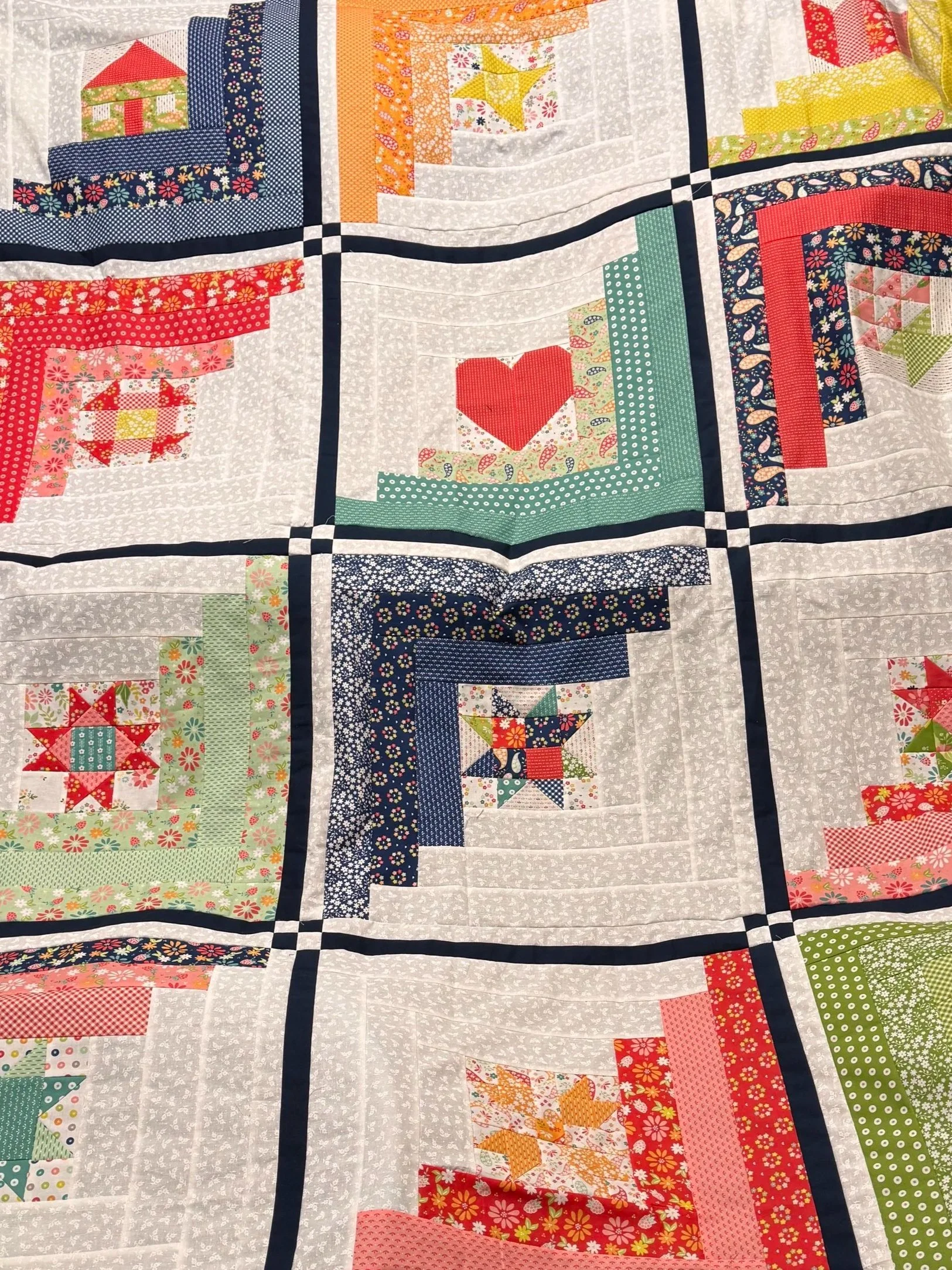
The Log Cabin block begins with a square.
Around that square, the maker adds one strip, then another, turning the block and working outward until something much larger has grown from the original center. It is a beautifully simple construction, although “simple” should not be confused with dull. Rotate the finished blocks and they form Barn Raising, Straight Furrow, Streak of Lightning, Sunshine and Shadow, or one of the many other arrangements quilters have discovered within the same basic design.
Few blocks have done so much with such uncomplicated geometry.
At first glance, the Log Cabin also appears to be one of the most thoroughly American patterns in quilting. Its strips became logs, its center became the hearth, and its name evoked pioneer cabins, westward settlement and Abraham Lincoln. It is difficult to imagine anything more comfortably wrapped in the American story unless someone stitched an eagle into the corner and served it with apple pie.
The construction itself, however, may be much older than the name.
Beginning at the Center
Long before anyone called this a quilt block, people were organizing objects and spaces around a center. Stonehenge contains circular and horseshoe-shaped arrangements of stones around a central area. Baskets were coiled outward from a beginning point. Ancient key patterns turned straight lines around themselves to create squared spirals. Buildings enclosed courtyards, mosaics surrounded central images with successive borders, and textile makers used repeating lines to lead the eye inward or outward.
None of these is an early Log Cabin quilt, nor do they prove that the block descended from Stonehenge, ancient basketry or Celtic art. They demonstrate something more basic: beginning in the middle and building outward is one of humanity’s oldest and most natural approaches to design.
That distinction matters because the Log Cabin has more than one possible beginning. Its underlying geometry is ancient and widespread. Its development as a strip-pieced textile method is difficult to trace and may have occurred in more than one place. Its familiar name and the American stories attached to it belong mainly to the nineteenth century.
When the Pattern Became a Cabin
The earliest American references identified by quilt historians appear during the Civil War.
At the 1863 Ohio State Fair, a Cleveland quiltmaker received special commendation for a “log cabin quilt.” In June 1866, an Iowa diarist known only as Abbie recorded going to town to purchase fabric for her Log Cabin. The following month, she wrote that she was working on it. Quilt historian Barbara Brackman credits researcher Virginia Gunn with identifying these early references.
The entries do not tell us when the first strip was ever sewn around a square. They tell us that by the 1860s, Americans recognized the construction by the name Log Cabin.
The timing gave that name particular weight. William Henry Harrison’s 1840 presidential campaign had already turned the log cabin into a political symbol of humble origins. Abraham Lincoln, born in a Kentucky log cabin in 1809, became even more closely associated with that image when he ran for president twenty years after Harrison.
As the quilt pattern rose to prominence during the Civil War, the cabin could suggest home, self-reliance, frontier endurance, Lincoln and loyalty to the Union. In 1864, a Pittsburgh fundraiser offered a Log Cabin quilt to raise money for hospitalized Union soldiers. That does not mean every woman making one was sewing a political declaration. She may simply have liked the pattern. Quilters were presumably allowed to make attractive things without issuing a public statement through every seam.
Still, the Civil War setting helps explain why this particular name took hold. The block arrived at exactly the right moment to become part of an American national story. Its popularity continued as the country approached its centennial in 1876, when the cabin offered a tidy image of how far the nation believed it had traveled—from rough frontier beginnings to modern prosperity. The Huntington’s history of a Log Cabin quilt places the pattern within this Civil War and centennial setting.
America’s relationship with the Log Cabin is therefore genuine. What is less certain is whether America invented the textile construction it named.
A Roof Before a Cabin?
On the Isle of Man, a related form of strip patchwork is traditionally known as the Roof Pattern. It is made by sewing folded strips to a foundation and working outward from a center. At first glance it looks like a Log Cabin, but the traditional construction is distinctive. The maker could use measurements taken from her own hand rather than a ruler. Each strip was folded to form a narrow pleat, concealing the larger hand stitches while adding weight and thickness. The foundation remained in the finished block, and traditional examples were often made without a separate layer of batting.
Modern accounts sometimes date the earliest surviving Manx patchwork to approximately 1820. That date is repeated frequently, although accessible documentation establishing the provenance of those early pieces is limited. We can confidently say that the Manx Roof Pattern is a regional method of building strips around a center. We cannot confidently draw a straight line from the Isle of Man to the American Log Cabin.
Related quilts also appear in Ireland. Irish quilt researcher Roselind Shaw has documented a wool-and-flannel Log Cabin quilt from Islandmagee, County Antrim, dated to approximately 1885. The Ulster Folk Museum confirms that Log Cabin quilts made from narrow strips of wool, cotton or silk became popular in Ulster.
Did Irish immigrants carry an older version of the construction to America? Did the American pattern later cross the Atlantic in the opposite direction? Did textile ideas circulate back and forth through Ireland, Britain, the Isle of Man and North America? Or did makers in several places independently discover the very practical idea of sewing strips around a center?
At present, the evidence cannot choose among those possibilities.
German-speaking immigrants brought rich textile traditions to America too, particularly linen weaving and woven coverlet making. Their descendants created many remarkable geometric quilts. However, no firmly dated German example has established that immigrants carried this particular block from Germany. A Log Cabin quilt made by a woman with German ancestry tells us who made that quilt, not where the pattern originated.
The most honest history is therefore not a tidy claim of invention. It is a story of an intuitive design appearing in related forms, traveling under different names and becoming especially popular in nineteenth-century America.
We saw an ancient arrangement, gave it an excellent frontier name and made it part of the national identity. Very on-brand.
What Was in the Center?
The center square eventually accumulated stories of its own.
A red center is often described as the hearth or heart of the cabin. Yellow may represent a light glowing in the window. Black has been associated with mourning, secrecy and, most controversially, the Underground Railroad.
Those interpretations may have mattered deeply to some makers, but they were not universal rules. A center square could commemorate a person, express a political loyalty or carry a meaning understood within one family. It could also be the scrap nearest the maker’s hand.
Unless the quiltmaker explained her choice, the finished quilt cannot tell us why she selected a particular color. A red center does not prove she was thinking about a hearth, and a black center does not prove she was signaling a safe house.
Sometimes a scrap is a symbol. Sometimes it is simply the scrap that fit.
The Black Center and the Underground Railroad
According to a popular Underground Railroad tradition, a Log Cabin quilt with a black center was displayed to identify a safe house. The story became widely known through Jacqueline Tobin and Raymond Dobard’s 1999 book, Hidden in Plain View. The book grew from conversations with Ozella McDaniel Williams, an African American quiltmaker and retired school administrator who said a quilt code had been preserved through her family’s oral history.
Williams’s account deserves to be treated respectfully. Oral history is important, especially when researching people whose experiences were poorly represented in written records. A secret practice shared within one family or community might never have appeared in a newspaper, diary or abolitionist report. The absence of written evidence does not make localized use of a quilt impossible.
It does prevent us from presenting an extensive quilt code as established history.
Williams’s account has not been independently confirmed through another family line, a named ancestor connected to the code, a dated family quilt or a contemporary firsthand record. Some of the pattern names included in the proposed code were not documented until after slavery ended.
The National Park Service administers the National Underground Railroad Network to Freedom, which documents and interprets verified Underground Railroad history. Its historians report that no firsthand account has yet been found describing freedom seekers or their allies using a quilt code. National Park Service Underground Railroad FAQ
A black-centered quilt may have identified a safe house somewhere. A family Bible, letter or oral history still waiting to be discovered could change what we know.
Check your genealogy, folks. I need answers.
For now, the most accurate conclusion is that the story is possible but unverified. More importantly, a black center by itself cannot tell us what its maker intended.
A Pattern Larger Than Its Name
The history of the Log Cabin is interesting precisely because it refuses to fit inside one little box.
Its basic geometry—beginning with a center and building outward—is far older than quilting. Its development as a strip-pieced textile construction remains uncertain and may have occurred in several places. Its American name emerged during the Civil War era, when the log cabin was already associated with humble beginnings, Abraham Lincoln and the national imagination.
From that simple construction came extraordinary variety. By turning the blocks, changing the placement of light and dark fabrics, varying the width of the strips or shifting the center away from the middle, quiltmakers could create movement, pathways, zigzags, diamonds and fields of light. One block could be restrained and orderly or wonderfully unruly without ceasing to be recognizable.
Perhaps that is why it has lasted. The Log Cabin allows a maker to begin with one small piece and build around it, adding what she has until a larger structure appears. The center can hold meaning—or none at all. The fabrics can be carefully selected or rescued from worn clothing. The finished quilt can carry a national story, a family story or simply the quiet evidence that someone found beauty in a pile of scraps.
America may keep the name Log Cabin. It is a good name, and after more than 160 years we have earned some attachment to it. But the pattern beneath that name—the simple act of beginning with a center and building outward—belongs to a much older and far larger human story.
~Chris

While Life Is Happening
A quilt may be created for someone else, but something also happens within the quilter while it is being made. Worry can soften, joy can grow, and this week’s clutter can become a little less noisy. The quilt may never reveal everything the maker carried, but it remains a quiet reminder that we were here, making something while life was happening.
Most quilts are made for a reason. A baby is coming. Someone is getting married. A bed needs covering. A friend needs comfort. A wall has been looking suspiciously empty. Yet even when a quilt is intended for someone else, the making of it also belongs to the quilter.
We do not stop feeling when we sit down to sew. We bring our worry, joy, anticipation, disappointment, gratitude, and this week’s clutter with us. Somewhere between choosing the fabric and sewing the final stitch, those emotions may be sorted, softened, strengthened, or simply given somewhere to rest.
Perhaps that is part of the reason repetitive work can feel so soothing. Our hands have something specific to do while our minds wander through whatever followed us into the sewing room. We measure, cut, arrange, stitch, press, and begin again. The work asks for enough attention to steady us without always demanding that we solve everything immediately.
Not that quilting is endlessly peaceful. Sometimes the points line up, the colors work exactly as we imagined, and we briefly believe we have mastered the entire craft. Then the next block comes out half an inch too small and restores the natural order.
Still, the rhythm of making gives us time. A worry that felt enormous at the beginning of the afternoon may not disappear, but it may feel less tangled by the time several blocks are finished. Disappointment may lose some of its sharpness. Excitement may become even more enjoyable as we imagine the person who will receive what we are making.
Joy has always belonged in the sewing room too.
A quilt may begin because a new baby is expected, a child is moving into a first home, or someone we love has reached a milestone worth celebrating. We choose colors while imagining a nursery, a bedroom, or the expression on someone’s face when the quilt is finally opened. The anticipation becomes part of the experience of making it.
Even a quilt made without a particular recipient can hold the pleasure of discovering something new. Two fabrics placed beside each other may work better than expected. A technique that once seemed impossible may suddenly make sense. A pile of scraps may become something far more interesting than the perfectly coordinated bundle we nearly convinced ourselves we needed.
The emotion is not literally trapped in the stitches, of course. A quilt cannot tell its future owner what we thought about while making it. It will not reveal the conversations happening in the next room, the audiobook playing in the background, the news we were waiting to receive, or why we stopped sewing one evening and did not return to it for several weeks.
But the maker may remember.
Years later, a particular fabric can bring back an entire season. We may remember where we lived, who was often in the house, what we were hoping for, and what had us worried. We may remember that life felt uncertain and joyful at the same time. A quilt can hold that strange mixture without requiring us to separate one feeling from another.
Everything I make right now will remind me of the things happening in my life during this season. There are difficult uncertainties, hopeful possibilities, family concerns, new opportunities, financial frustrations, completed projects, and plans still trying to find their way forward. Some days bring encouraging news. Others introduce a fresh matter I apparently needed to think about at three in the morning.
The quilts I am making are not necessarily about any of those things. No one will be able to study the fabric and identify what was happening in my family or what decision I was trying to make while sewing a particular seam. Yet I will know that these quilts were beside me while I lived through it.
That thought also changes how I look at quilts made long ago.
When we study an antique quilt, we naturally notice the fabrics, pattern, stitching, and workmanship. We may be able to estimate when and where it was made or identify the textile dyes available during that period. Occasionally, a name, date, or inscription gives us part of the story.
What we usually cannot recover is the inner life of the person who made it.
We do not know whether she was worried or content while she pieced a particular block. She may have been grieving, waiting for someone to return, preparing for a child, enjoying a peaceful season, or feeling delighted by the fabrics spread in front of her. She may have been sewing with friends, teaching a daughter, or stealing a little time for herself after everyone else’s needs had finally been addressed.
She may also have been tired, irritated, and finishing the quilt because cold weather was coming and people continued to expect blankets. Not every historical quilt needs a dramatic secret. Sometimes a quilt was made because a quilt was needed.
Whatever her circumstances, she was a whole person living a full and complicated life while her hands worked. The tools, fabrics, and demands on her time may have been very different from ours, but the emotions she carried were not beyond our understanding.
For hundreds of years, people have made quilts while falling in love, raising families, facing illness, celebrating births, mourning deaths, enduring uncertainty, and finding moments of happiness wherever they could. Their quilts moved through those lives with them. Some were used until they fell apart. Others survived long enough to reach people the maker could never have imagined.
That may be one of the most remarkable things about a quilt. The emotions involved in making it belong to one person, but the comfort it provides can continue far beyond her.
A quilt made in worry may eventually warm someone during a joyful season. A quilt made in celebration may comfort a person the maker never met. The future owner may know nothing about the hands that cut the pieces or guided the needle, yet still benefit from the care those hands left behind.
We often create quilts for other people, but the making also does something for us. It gives worry room to settle, allows joy to expand, and offers this week’s clutter a place to become a little less noisy. It does not resolve every problem or preserve every memory. It simply provides steady work for our hands while our hearts and minds catch up with our lives.
Long after the details of this season have faded, the quilt may remain.
It will not tell the whole story. But it will remind us that we were here, making something while life was happening.
~Chris
Quilt photo: I recently finished this quilt for my mother to use during cancer treatment. She is the reason I made it, but the hours I spent working on it also gave me somewhere to place my own worry, hope, and love. I could not control what was happening, but I could choose fabric, sew one seam after another, and make something that might bring her comfort. The quilt was always meant for her. The making of it helped me too.
When Flour Came Wrapped in Fabric
Feed-sack dresses were not made from the rough burlap I had imagined. They were sewn from reusable cotton commodity bags that once held flour, sugar, livestock feed, and other necessities. Here is how household thrift, skilled sewing, and clever marketing turned everyday packaging into clothing, quilts, and household goods.
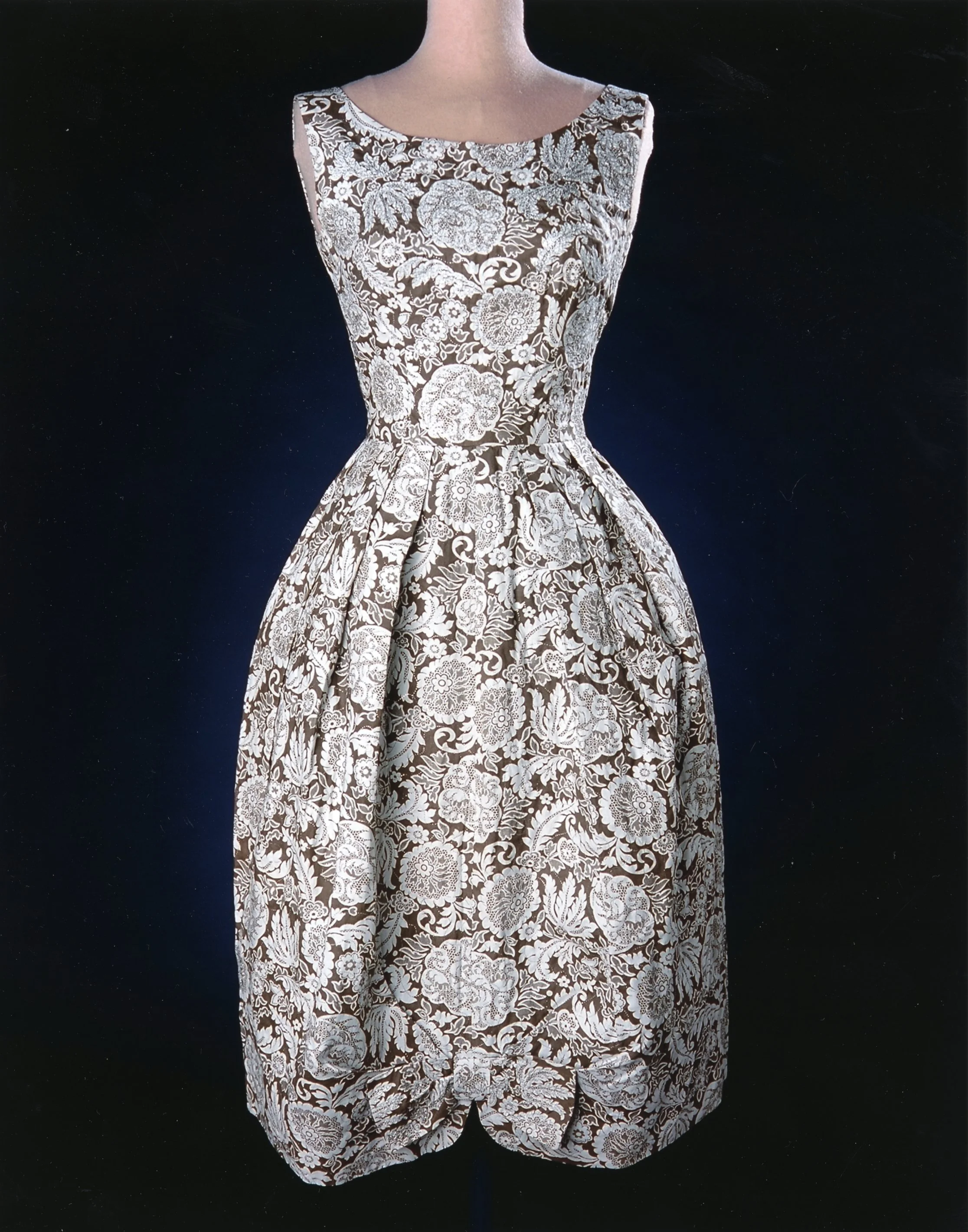
Feed-sack dress made by Mrs. Dorothy Overall in 1959 for the Cotton Bag Sewing Contest. Courtesy of the National Museum of American History, Smithsonian Institution. Public domain.
*Feed-sack dress made by Mrs. Dorothy Overall in 1959 for the Cotton Bag Sewing Contest. Courtesy of the National Museum of American History, Smithsonian Institution. Public domain.
When I first heard about feed-sack dresses, I immediately wondered how anyone could bear to wear one. The only commodity sacks I knew were made from burlap, and a burlap dress sounded less like resourceful sewing and more like punishment.
I was not around when flour, sugar, and livestock feed came in cotton sacks. By the time I arrived, those products were packaged in paper, plastic, or the coarse burlap sacks I had seen. I assumed the dresses I had heard about were somehow made from that same rough material.
They were not.
The feed-sack dresses and quilts I had been reading about were made from woven cotton, not the rough burlap I had imagined. Some sacks were plain, while others were printed with the small florals, dots, plaids, stripes, and novelty designs we now associate with fabrics from the 1930s and 1940s. Once the seams were opened and the sacks were washed, they became usable pieces of cloth.
That discovery made feed-sack dresses considerably easier to understand. It also led me into a much more interesting history involving household necessity, skilled sewing, and manufacturers that eventually realized the fabric surrounding their product could help sell what was inside it.
Before Feed Sacks Became Pretty
During the nineteenth century, cloth bags gradually replaced the wooden barrels traditionally used to ship dry goods. They were lighter, easier to transport, and still useful after the contents had been consumed.
Although we commonly call them feed sacks, they held far more than livestock feed. Flour, sugar, salt, rice, seed, fertilizer, and other dry goods were packaged in cotton bags. The International Quilt Museum uses the broader and more accurate term cloth commodity bags for sacks used to package these different products.
Long before manufacturers began printing cheerful designs on them, women were saving the plain cotton bags. Once the contents were gone, the sacks were washed, opened along the seams, and put back to work. Some became dish towels or curtains. Others became underwear, quilt backs, and clothing.
The earliest cotton sacks were usually white or cream and printed with the name of the mill, the contents, or the weight of the product. Those markings had to be soaked, scrubbed, bleached, covered, or carefully positioned when the fabric was cut.
No child needed to advertise a flour mill while walking to school.
Women were reusing these bags well before the Great Depression. The financial hardship of the 1930s made the practice more important and more widespread, but it did not create it. What changed during the early twentieth century was the appearance of the sacks—and the manufacturers’ understanding of who was choosing them.
When the Fabric Began Selling the Flour
Manufacturers eventually realized that women were not simply using the sacks after the flour or feed was gone. The fabric itself could influence which product a family purchased.
By the 1920s, and increasingly during the 1930s and 1940s, companies began offering sacks made from printed cotton. Small florals, dots, stripes, plaids, geometrics, novelty prints, and border designs appeared. Some manufacturers used inks that were easier to remove or switched to paper labels that could be soaked off.
The familiar version of this history says that manufacturers noticed families struggling during the Depression and began using prettier fabric to help them. The printed sacks were certainly useful, but this was also a very effective marketing decision.
A sack of flour might be necessary. A sack of flour packaged in fabric that coordinated with a woman’s current fabric stash was much more appealing.
One sack was rarely enough to make an entire garment. Depending on the size of the sacks and the person wearing it, a dress might require several matching bags. Curtains, bedding, and adult clothing could require even more.
Women searched through available sacks for matching or coordinating prints. Neighbors could also trade sacks when someone needed another piece of a particular design.
This gave families a reason to continue purchasing the same brand. The flour inside might be perfectly acceptable, but if another company offered a print that completed the dress already underway, the packaging could determine what went home.
Manufacturers responded by offering more designs and promoting the many things that could be made from them. Pattern companies and textile-bag organizations published sewing ideas that explained how many sacks different projects required and how to prepare the fabric for use.
Women had found value in material that began as packaging. Manufacturers discovered that value could sell more flour.
The Fabric Was Useful, but It Was Not Effortless
Feed-sack fabric is sometimes described as free because the family needed to purchase flour or feed anyway. The fabric did not require a separate trip to the store, but turning it into clothing or a quilt still required considerable work.
The household first had to acquire enough sacks. Farm families purchasing large quantities of animal feed may have accumulated fabric more quickly than families buying smaller bags of flour, sugar, or salt. Finding enough matching fabric could require repeated purchases, searching, saving, and trading.
The sacks then had to be emptied, washed, and opened. Heavy stitching held them together, and removing it could leave a row of small holes along the edges. Labels and logos had to be washed away, hidden within seams, or avoided when the pieces were cut.
Only then could the sewing begin.
Women selected patterns, matched prints, fitted garments, added collars and trims, embroidered plain fabric, and arranged scraps into quilts. They were not simply cutting holes into an empty sack and pulling it over someone’s head.
Many surviving feed-sack dresses are so carefully made that nothing about them immediately reveals where the fabric began. They look like garments made from the small floral and geometric cotton prints popular at the time—which is precisely what the sack manufacturers intended.
Even so, wearing feed-sack clothing could carry embarrassment. For some families, it was an obvious sign that new fabric was unaffordable. Children could be teased, and women often took great care to remove any markings that disclosed the material’s original purpose.
The pretty prints are part of the history, but so is the necessity behind them. These women were not participating in a charming repurposing trend. They were clothing their families and furnishing their homes with the materials available to them.
Their work required judgment, planning, and sewing skill. It also changed the market. Manufacturers produced more desirable sacks because women’s preferences influenced which products families bought.
Feed Sacks Outlasted the Depression
Feed-sack sewing is so closely associated with the Great Depression that it is easy to assume the practice ended with the 1930s. It did not.
Cotton sacks became especially useful during World War II, when wartime demand created textile shortages and families were encouraged to conserve and reuse materials. They continued to be used throughout the 1940s and 1950s, particularly in rural communities.
The Smithsonian’s National Museum of American History owns a flour-sack dress made in 1959. Its collection also includes a flour-sack bassinet quilt dated between 1950 and 1969.
This makes dating a quilt by its feed-sack fabric difficult. A sack manufactured in the 1930s might have remained in someone’s sewing supplies for years before becoming part of a quilt. A dress could be worn until it was no longer useful and then cut into pieces for another project.
Quilters have storage skills historians do not always account for.
Paper bags, plastic packaging, and new methods of bulk transportation eventually replaced most cotton commodity sacks. The newer packaging was cheaper, but families no longer received a useful piece of fabric along with something they already needed to purchase.
Is It Really Feed-Sack Fabric?
Once I understood that the feed-sack dresses I had read about were made from cotton rather than burlap, another question followed: How can anyone tell whether a piece of vintage fabric actually came from a sack?
Sometimes the answer is obvious. An intact sack may still have its original seam, chain stitching, label, product markings, or the name of the mill printed on it.
An opened sack may retain a row of tiny holes where the heavy needle passed through the fabric. The State Historical Society of North Dakota uses these holes as one clue when identifying flour-sack textiles in its collection.
Once those edges were trimmed away and the fabric was cut into clothing or quilt pieces, much of the evidence disappeared. Feed-sack prints can look very similar to other cotton fabrics manufactured during the same period. Unless the family preserved the history of the fabric, a small floral scrap may be difficult to identify with certainty.
Not every vintage print in an old quilt once held flour or chicken feed. It may have the correct age, weave, and style, but without stitching holes, markings, or a known history, there is room for doubt.
What Is the Modern Feed Sack?
There is no exact modern replacement for printed feed sacks. Products may still be sold in cloth bags, and we still have items called flour-sack towels, but neither provides several yards of printed cotton along with an ordinary household purchase.
The closest comparison may be the fabric already passing through our homes.
Sheets can become quilt backs. Worn cotton shirts can become quilt blocks. Old jeans can become bags. Clothing that no longer fits can be altered or taken apart and made into something entirely different.
The connection is not the particular type of fabric. It is the decision to look at material that has finished one job and consider whether it can perform another.
That idea feels especially relevant now. Fabric is expensive, many households are looking for ways to reduce spending, and some of us already own enough material to remain productive for quite some time.
The women who sewed with feed sacks were responding to the cost of living, the materials available to them, and the needs of their families. They did not merely tolerate the fabric. They selected prints, planned projects, exchanged sacks, and used considerable skill to turn packaging into clothing, quilts, and household goods.
I began this history imagining women enduring dresses made from burlap. Instead, I found cotton prints, carefully constructed garments, very effective marketing, and another example of women recognizing possibilities in a material that might otherwise have been discarded.
The cotton sacks may be gone, but the question behind them remains useful:
What do I already have, and what can I make from it?
Sources and Further Reading
The Sewing Chair No. 7
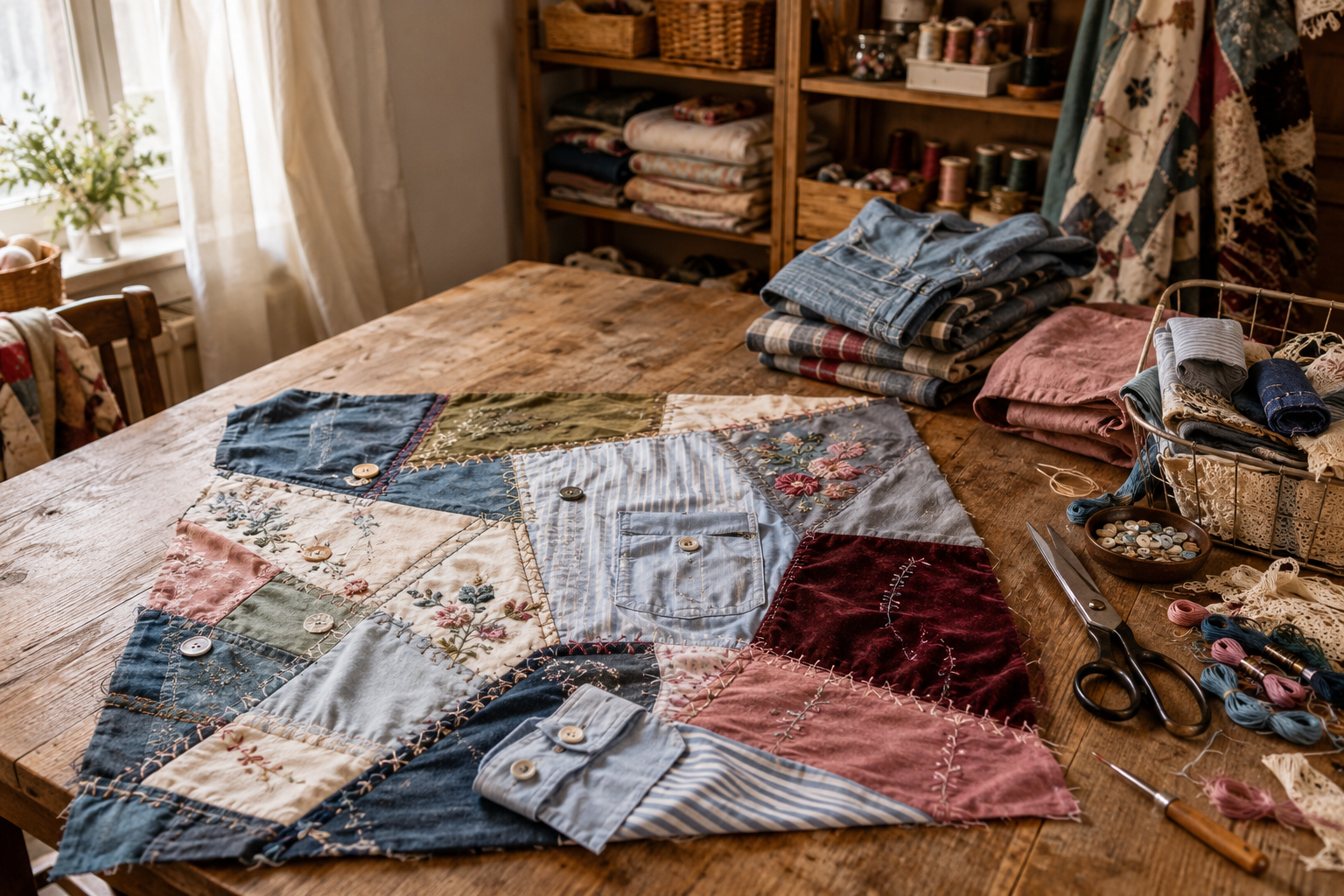
The economy is encouraging me to buy less fabric and look more creatively at what I already own. By working from my stash, repurposing clothing, finishing existing projects, and beginning a crazy quilt, I’m returning to the resourcefulness—and artistry—that has always been part of quilting.
Making Do—and Seeing What Happens
The economy has been making itself known lately. Not in an abstract, economists-on-the-news sort of way, but in the much more personal form of grocery totals, household bills, and the astonishing amount of money that can disappear while buying nothing particularly exciting.
Fabric has not escaped this. Neither have batting, thread, patterns, rulers, or any of the other things that quietly follow a quilter home. I am not criticizing quilt shops or fabric companies. Good fabric costs money to produce, and I want those businesses to survive. I also know myself well enough to admit that I can walk into a quilt shop with no identified need and come out having supported the industry with remarkable enthusiasm.
But right now, I do not need more fabric.
That is not the same as saying I do not want more fabric. Let us remain reasonable.
The truth is that I already own enough fabric to keep me occupied for years. I have kits, unfinished blocks, works in progress, leftover pieces, precuts, yardage bought for forgotten purposes, and fabrics apparently selected by an earlier version of me whose plans were never properly documented. There are also old clothes waiting to be repurposed because I have saved them with the vague but persistent belief that they could become something else.
So I am stepping back from buying and looking instead at what I already have.
This began partly as a financial decision. I canceled the Sew Sampler box because reducing unnecessary spending makes sense right now, but money was not the only reason. How many notions does one quilter really need? At some point, another clever tool is not expanding my creative possibilities; it is simply becoming one more object I have to store, organize, and remember that I own.
My sewing room was beginning to look less like a place where an artist works and more like a hoarder’s hovel with a cutting table. I had plenty of supplies but less room to use them, which rather defeats the purpose. I do not need another box arriving each month to give me more things. I need to rediscover the things already here, finish some of the projects occupying the room, and create enough space to sew without first conducting an archaeological excavation.
I am working through the block-of-the-month programs already in progress. I will still need practical things from time to time—batting, backing, thread, or a specific supply required to finish something—but I do not need to keep accumulating projects and notions faster than I can use them.
As I began thinking about what this could look like, the decision became more than a sensible response to the economy. It started to become interesting.
What can I make with what is already here?
That question sits much closer to the history of quilting than our modern habit of choosing an entire coordinated fabric collection for one project. Quilters have often worked with what was available: worn clothing, leftover dress fabric, feed sacks, household textiles, pieces exchanged with friends, and scraps too useful to discard. They did not always begin with a perfectly arranged bundle containing twenty prints that had already agreed to cooperate.
Sometimes they had to create the harmony themselves.
I want to return to more of that kind of making—not because everything done in the past was automatically better, but because resourcefulness is a skill. I suspect some of us have allowed convenience to do more of the creative thinking than we realize.
This is where the old clothing comes in.
I have clothes that are no longer worn but still contain usable fabric. Some pieces carry memories. Others simply contain too much good material to justify throwing them away. I already know how to take garments apart efficiently, alter clothing, follow clothing patterns, and determine which fabrics need stabilizing. The technical part is familiar. The new challenge is deciding what these materials can become when I stop seeing them as clothing.
A shirt may offer more than yardage. Its pocket, cuff, placket, buttons, or worn edge might become part of the design rather than something to cut around and discard. Different fibers and fabric weights could lead toward quilts, bags, wearables, appliqué, or combinations I have not considered yet. I am not beginning with a need to learn how to handle the clothing. I am beginning with the more interesting question of how to use what I already know in a different and more creative way.
And then there is the crazy quilt.
A crazy quilt feels like the perfect place for this experiment because it does not require every fabric to pretend it came from the same family. It can hold cotton, clothing scraps, embroidery, saved trims, unusual textures, and whatever else proves willing to participate. It offers room to refine decorative stitching without requiring the stitches—or me—to achieve perfection before I begin. It can become part sewing project, part embroidery sampler, and part record of what was already in the house.
It may also become evidence that I should not be left unsupervised with buttons.
I do not yet know exactly what this crazy quilt will look like. I do not know whether it will become a full quilt, a wall hanging, a table runner, or one magnificently overworked block that teaches me enough to make the next one better. That uncertainty is part of the appeal.
I will learn how fabrics with different weights and textures behave beside one another in a quilt. The embroidery will give me a place to refine stitches I already know and pursue the perfection that has been keeping needleworkers occupied—and mildly dissatisfied—for centuries. I know perfection is not actually going to happen, but that has rarely prevented any of us from continuing to negotiate with it. I will also explore balance without a repeating block pattern to create it for me and decide when a section needs one more detail—and, perhaps more importantly, when it has quite enough going on already.
Perhaps the most important thing I will learn is how to rely more on my own creativity.
Coordinated fabric collections are beautiful, and I am certainly not opposed to them. They make it easier to see how colors and prints will work together, and sometimes that is precisely what I want. But they also arrive with much of the visual problem already solved. When I work from my stash, combine unrelated scraps, or cut usable fabric from an old garment, I have to make those connections myself.
I have to decide what belongs together, where contrast is needed, which unexpected combination is more interesting than the obvious one, and how to create unity among fabrics that were never designed to meet. A seam, pocket, worn edge, or limited amount of fabric may influence the design rather than disqualify the material. The limitation becomes part of the composition.
That brings quilting back to its artistry. It asks me to see possibilities rather than simply follow a supply list. The crazy quilt may be the clearest expression of that because there is no single correct arrangement and no coordinated collection waiting to keep me safely between the lines. Every choice—fabric, placement, embroidery, texture, color, restraint, and the occasional complete lack of restraint—becomes part of my own visual language.
Using what I already have may save money, but I suspect it will also make me a more inventive quilter. When the answer cannot always be “buy the perfect fabric,” I will have to look longer, think differently, and create the answer myself.
Working from the stash will teach me other lessons, too. Limited choices may force me to think harder about value, scale, contrast, and color. Finishing the projects already underway will show me what I genuinely enjoy and what I keep avoiding. Repurposing clothing may lead toward quilts, bags, repairs, or garment sewing. Some experiments will work. Others will produce highly educational objects that never need to be seen in public.
And I am genuinely looking forward to it.
What began as a sensible response to the economy is becoming a personal creative challenge. Working within limits may lead me toward combinations, techniques, and ideas I would never discover while shopping for the ideal fabric.
I am not pledging never to enter a quilt shop again. There will be supplies I need and fabrics worth bringing home. I simply want to become more intentional about what I buy—and discover how much creativity emerges when the answer is not always to buy something new.
Maybe doing things a little more like they used to be done will change how I see what I own. A scrap may become material rather than clutter. An old shirt may become color, texture, memory, or structure. An unfinished project may become an opportunity to solve a problem instead of proof that I started too many things.
There is an entire sewing room full of possibilities waiting for my attention. The challenge now is to see them differently.
Who wants to join me? What is waiting in your stash, closet, or unfinished-project pile—and what could you create from it?
~Chris
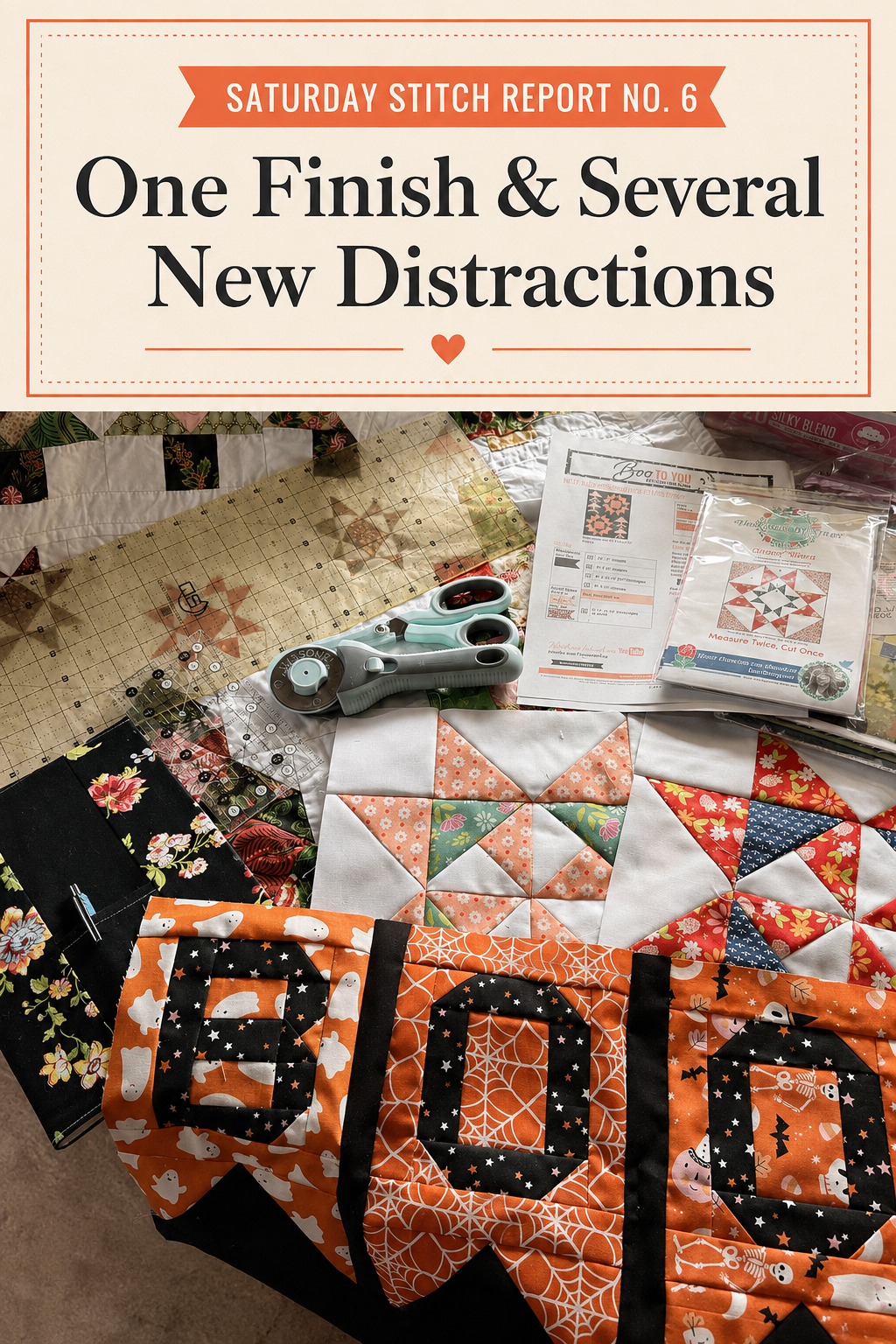
Saturday Stitch Report No. 6
The Jolly Tree Farm wall hanging is finished, the August A Quilting Life blocks are complete, and the Boo to You Quilt Along has begun. This week’s sewing table also holds several waiting BOMs, ongoing handwork, hardworking tools, and plans involving a beloved serger.
One Finish and Several New Distractions
The Jolly Tree Farm wall hanging is finished.
Not merely the blocks. Not almost finished. The entire project is complete, which means I can officially count it as a finish rather than moving it from one work-in-progress list to another for the next six months. It was a Fat Quarter Shop quilt-along, and I am pleased to have the whole wall hanging completed while we are still far enough from Christmas that I can enjoy feeling unusually prepared.
I also completed the August blocks for A Quilting Life Block of the Month. I am making two of each monthly block in different colorways because I plan to make two separate quilts from the pattern. One will be a red, white, and blue quilt for the Fourth of July next year. It is far enough away that this currently feels like responsible advance planning, although I reserve the right to be sewing the final binding on July third.
Finishing one quilt-along apparently left a small opening in the schedule, so I immediately filled it by beginning Fat Quarter Shop’s weekly Boo to You Quilt Along. Week Two is already waiting for me, along with Month Eight of Missouri Star’s Spring Dreams Block of the Month and Block Three of the Fat Quarter Shop Designer Mystery Block of the Month.
There was a brief moment when I could have admired the completed Jolly Tree Farm wall hanging and enjoyed having one fewer active project. I chose not to linger there.
Affiliate disclosure: This post contains affiliate links. If you make a purchase through one of these links, I may earn a commission at no additional cost to you. As an Amazon Associate I earn from qualifying purchases.
My Quilters Select 6½-by-24-inch acrylic ruler and Creative Grids 3½-by-6½-inch acrylic ruler both got a considerable workout this week. So did my ride-or-die Missouri Star scissors and rotary cutter. The Oliso iron, ironing board, and sewing chair were all used extensively as well. It was not one of those weeks when the sewing room sat looking tidy and decorative. Things were being cut, pressed, stitched, trimmed, and completed.
School is starting soon, which means notebook covers need to be made. Before I begin those—or work on any of the quilt blocks currently waiting—I need to pull out the serger and do some clothing alterations.
The serger is patiently waiting, but I cannot wait to bring it out. I love this serger. Clothing alterations may sound like the practical interruption standing between me and the quilts, but using a machine I genuinely enjoy makes them considerably more appealing. There is something deeply satisfying about watching a serger trim, stitch, and finish an edge all at once. It is industrious, efficient, and perhaps slightly smug about how much it accomplishes in one pass.
The handwork projects continue to occupy the quieter parts of my sewing time. I am finishing the hand binding on a completed quilt and continuing to hand quilt the Garden Girl quilt. I have also been practicing embroidery and English paper piecing, and I am still mindlessly making Manx blocks whenever I want something uncomplicated to work on.
The Manx blocks do not yet have a definite destination. I am simply making them, adding them to the collection, and trusting that eventually there will be enough of them—or enough of an idea—to determine what they are becoming. It is a pleasantly low-pressure project, which may explain why I continue reaching for it.
I have also discovered that I really enjoy Hawaiian appliqué. I like the symmetry of the designs, the process of revealing the shape, and the amount of visual impact that can come from one carefully cut piece of fabric. I am now trying to develop a pattern that I could use to make an entire quilt with this method.
This is slightly inconvenient, considering the quilt-along blocks, alterations, notebook covers, binding, hand quilting, embroidery, English paper piecing, and Manx blocks already in progress. Apparently my sewing plans were at risk of becoming manageable.
Tomorrow’s Sewing Chair will look more closely at what I am planning next. A crazy quilt has entered my thoughts, and unlike some fleeting project ideas, this one makes a suspicious amount of sense. I have embroidery I want to practice, old clothing I want to repurpose, scraps I cannot quite bring myself to discard, and a growing interest in projects that invite handwork without demanding absolute precision.
But first: the serger, the alterations, the notebook covers, and the projects already waiting in the wings.
Probably.
~Chris
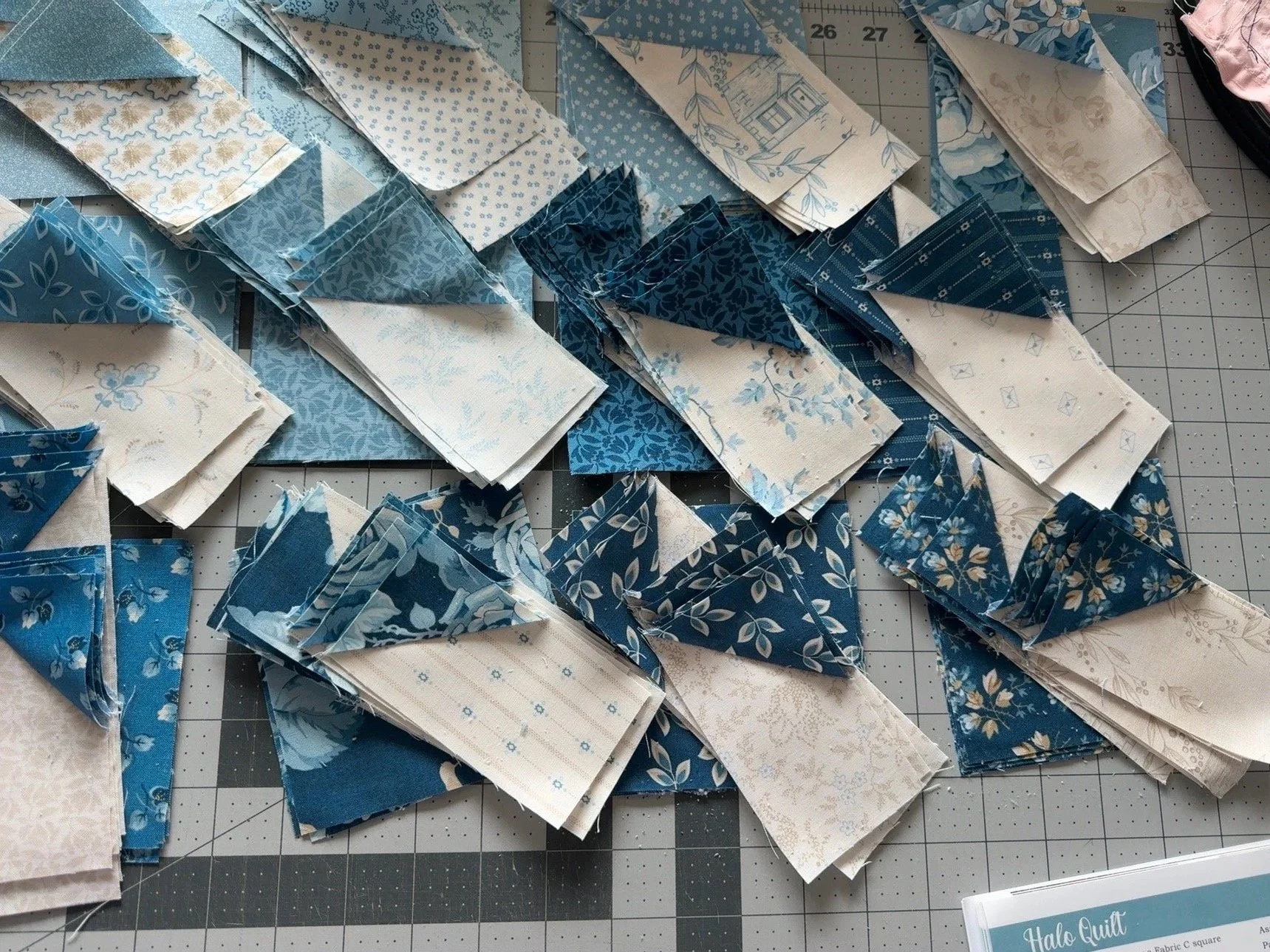
there is no efficient way to make a quilt
Quilting may be one of the least efficient ways imaginable to make a blanket. We cut perfectly good fabric apart, sew it back together, sometimes cut it apart again, and then spend hours quilting it. But perhaps efficiency was never the point. Sometimes the value of making something lies not only in what we finish, but in what those hours spent making it give us.
There Is No Efficient Way to Make a Quilt
There is something a little ridiculous about quilting when you really stop to think about it.
We buy perfectly good fabric. Beautiful fabric, in fact. Fabric that has already survived an impressive journey through growing, weaving, dyeing, printing, shipping, folding and finally landing on a shelf where we decide we absolutely need it. We bring it home, admire it for some period of time, and then take a rotary cutter to it.
We cut it into strips. We cut the strips into squares. Sometimes we cut the squares into triangles. If we are feeling particularly ambitious, we cut those pieces into even smaller pieces. Then we carefully sew some of those pieces together.
And sometimes, because quilting is apparently a perfectly reasonable pastime, we take the pieces we just carefully sewed together and cut them apart again.
Then we rearrange those new pieces and sew those back together.
Eventually, after enough cutting, sewing, cutting things we already sewed, rearranging and sewing yet again, we end up with one large piece of fabric.
Which is essentially what we started with.
This is apparently a hobby.
It is also spectacularly inefficient.
Most of the rest of my life is organized around trying to make things take less time. I order things online because driving around looking for them is annoying. I keep lists because I don't want to make three trips to the grocery store. I have machines that wash my clothes and dishes, a phone that can answer almost any question within seconds, and sewing machines capable of making thousands of perfectly respectable stitches in the time it would take me to make a few dozen by hand.
Naturally, I have recently decided to hand quilt.
I could put the quilt under the machine. I could send it to a longarmer. I could probably have the entire thing finished before I manage to get particularly far with my current hand-quilting efforts. Instead, I am sitting in my chair with a tiny needle, making stitches one at a time and occasionally stopping to inspect them as though they have personally agreed to become smaller if I stare at them hard enough.
They have not.
And yet I keep picking it up.
That has made me think about how strange making things has become in a world where we no longer have to make very many things at all. Quilts once had an obvious practical purpose. Beds needed covering. Fabric was valuable. Clothing and household textiles were used, reused and sometimes worked into other things. Sewing wasn't simply a pleasant way to spend an afternoon; for many households, it was part of the work required to keep people clothed and warm.
That isn't why I'm doing it.
I can buy a blanket. In fact, I can buy one for considerably less than I spend making a quilt, which is another detail we probably shouldn't examine too closely. I certainly don't need to spend months making one from hundreds of pieces of fabric when perfectly adequate blankets are available in nearly every department store in America.
So if the goal were simply to own something warm for the bed, quilting would be a terrible solution.
But the finished quilt isn't the entire point.
I think that's where efficiency becomes a funny way to measure a hobby. Efficiency makes sense when the objective is to get something over with. If I have to clean the kitchen, I would prefer to accomplish that without turning it into an all-day event. I don't particularly need to savor the experience of loading the dishwasher. There is no part of me wishing I could wash every fork individually by hand so I could feel more connected to the process.
Quilting is different because I don't actually want to eliminate the process.
I like choosing the fabric. I like cutting it. I like watching blocks accumulate and eventually begin to look like the quilt I imagined. I like the moment when something that looked questionable in pieces suddenly works once it is sewn together. I even like some of the repetitive parts, particularly when I don't have to think very hard about them. There are evenings when sitting at the machine sewing the same seam over and over is exactly what I want to be doing.
Lately, though, I've found myself choosing some of the parts of making that take the longest. I've been doing more embroidery, cross stitch, English paper piecing and Manx blocks, and now I've added hand quilting to the mix. I can sit in my recliner for a couple of hours and have remarkably little physical evidence of how I spent them. A few inches of quilting. Part of an embroidery motif. A handful of stitches that nobody but me is likely to examine closely.
But measuring those hours by what I finished misses most of what happened during them.
Handwork occupies my hands and just enough of my attention that everything else becomes quieter for a while. I'm concentrating, but not in the same way I concentrate on work or on a problem that needs solving. My attention has somewhere specific to go. There is fabric in my hands, a needle that needs to go in one place and come out in another, and a small bit of progress appearing underneath my fingers.
It doesn't require me to accomplish very much to be satisfying.
That may be why the inefficiency doesn't bother me. The time isn't merely being spent on the quilt. The quilting changes the way I experience the time itself. Two hours that might otherwise disappear into scrolling, mentally rearranging tomorrow's to-do list, thinking about things I cannot do anything about at ten o'clock at night, or simply wondering where the evening went become two hours in which I was thoroughly occupied by something I enjoy.
There is a different satisfaction in work that cannot be hurried very much. A hand-quilted line gets from one side of a block to the other exactly as fast as my hand can put stitches into it. There is no button that makes it go twice as fast. There is no particularly useful way to multitask it. My hands are occupied, my eyes are occupied, and enough of my attention is required that most of the other things rattling around in my head have to wait their turn.
I don't think slowness is automatically virtuous. I am quite fond of my sewing machines and have no intention of reenacting 1850 in my living room. I like modern conveniences. I like getting things done. I own rulers that make cutting faster, machines that sew faster and gadgets designed to eliminate practically every mildly inconvenient part of quiltmaking. If someone invents something tomorrow that makes trimming half-square triangles less tedious, I will happily investigate.
But I also like having something in my life that doesn't need to be optimized.
We hear so much about making better use of our time that it is easy to start treating time as though every minute should produce the maximum possible return. We combine errands. We listen to something while doing something else. We look for shortcuts. We buy tools that promise to save minutes. None of that is inherently bad. There are plenty of things I would happily spend fewer minutes doing.
But perhaps the question isn't always how much we can accomplish in an hour. Sometimes it matters what that hour is like while we're living it.
There are parts of life we make efficient precisely because we'd rather use our time somewhere else. I have no desire to make loading the dishwasher a richer, more immersive experience. I want the dishes clean so I can move on.
Quilting is different. I want the quilt at the end, certainly, but I also want the hours it takes to make it. I want the satisfaction of watching pieces become blocks and blocks become something recognizable. I want evenings in the recliner with fabric in my lap and a needle in my hand. I want what happens when my attention narrows for a while to fabric, thread and the next stitch.
Making all of that faster wouldn't necessarily make it better. At some point, making it more efficient would begin eliminating part of the reason I chose to do it in the first place.
Which makes my current hand-quilting project rather interesting. I can spend two hours working on it and accomplish only a few inches. By almost any ordinary measure of productivity, that's terrible. But those few inches aren't the only thing I got from those two hours.
Maybe that's why quilting doesn't really feel inefficient at all. There are parts of life we rush through because what we want is waiting on the other side. Then there are the things we willingly give our time to because of what happens during the hours we spend doing them.
I want the quilt.
But I also want the time I spend making it.
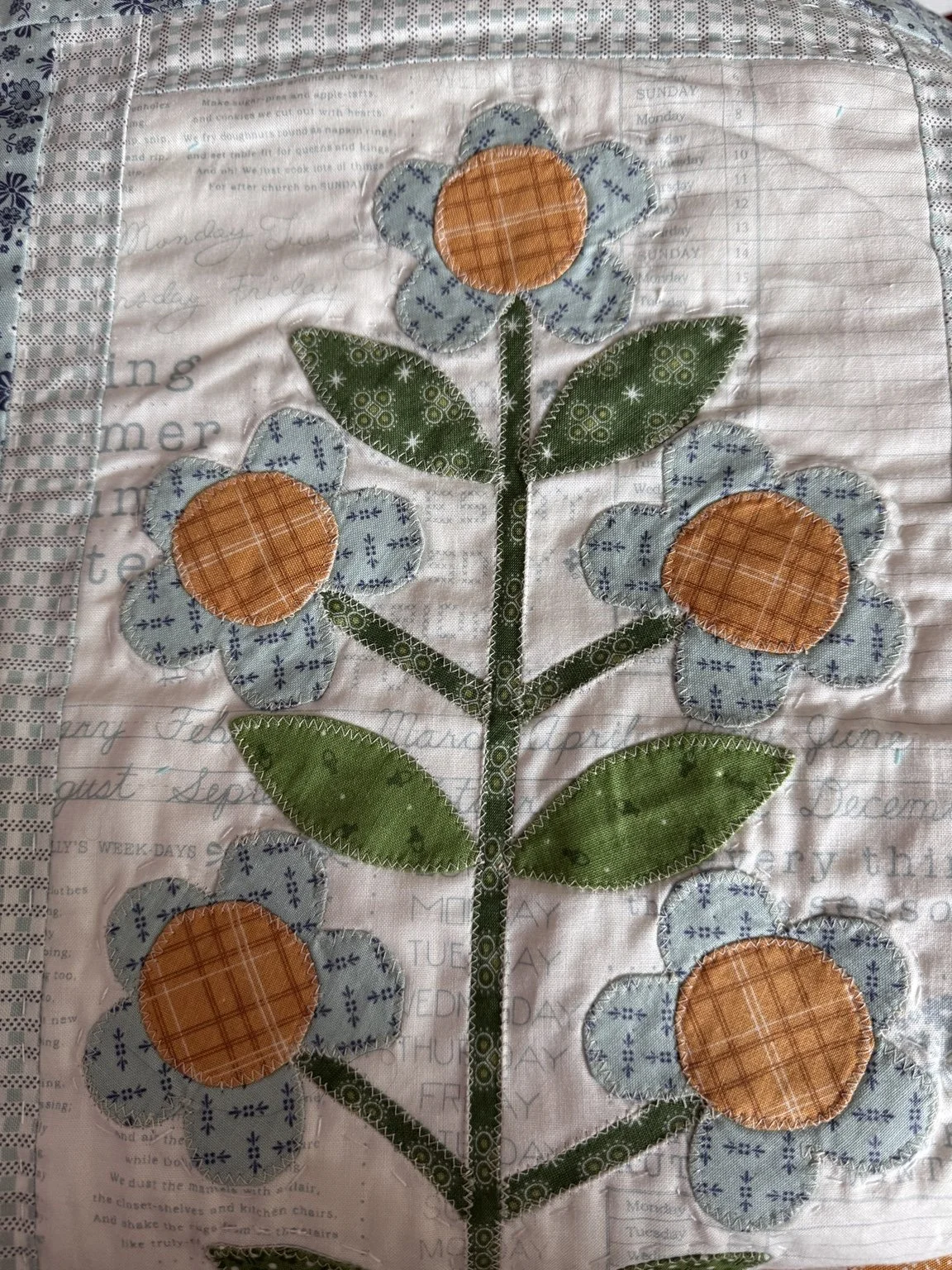
Why Are Tiny Hand-Quilting Stitches So Difficult?
Why are tiny hand-quilting stitches so difficult? As I struggle to reach even four stitches per inch, I went looking for answers. From needles and batting to thread, technique, and a whole lot of practice, hand quilting turns out to be another quilting rabbit hole worth exploring.
I have recently started hand quilting, which has introduced me to an entirely new way of questioning my quilting abilities.
I can sit for an evening, work my way along a quilting line, look back at my stitches and think they don't look half bad. Then I start reading about hand quilting and discover that six stitches per inch is often considered a reasonable place to begin. Keep reading and you'll find people talking about eight, ten, twelve, and even twenty stitches per inch.
Twenty.
I'm currently struggling to get four.
Naturally, this made me curious. How in the world are people making stitches that small? Is there some technique I'm missing? Is it the needle? The batting? The thread? Or is the rather disappointing answer simply that I need to sit here and do this about ten thousand more times?
And then, because one quilting question never seems to remain one quilting question for very long, I started wondering about the women who made those beautifully hand-quilted antique quilts. They didn't have YouTube videos demonstrating the rocking stitch in slow motion. They didn't have LED lights, magnifiers, ergonomic thimbles or the ability to order six different packages of needles from the recliner because somebody on the internet said one of them might change their life.
They still managed to make those tiny stitches.
So, what am I missing?
My first thought was the needle, and there may actually be something to that. Traditional hand-quilting needles are called betweens, and they're surprisingly short if you've never used one. That short length isn't accidental. It makes the rocking motion used in traditional hand quilting easier and allows several small stitches to collect on the needle before the thread is pulled through.
Then there are milliners, or straw needles, which some hand quilters prefer. They're longer, and the shaft remains fairly consistent in diameter through the eye, which can make them particularly useful with heavier threads.
I would love to tell you that my research uncovered the best hand-quilting needle and we can all go buy it and move on with our lives.
It did not.
Apparently choosing a hand-quilting needle is like choosing most things in quilting. There are strong opinions, perfectly reasonable arguments on several sides, and experienced quilters making beautiful quilts with completely different choices.
The more I read, the more I think the best needle may simply be the one that allows your hand to make the stitch comfortably. I'm going to experiment with several because I don't know yet what that needle is for me.
I also hadn't given much thought to batting. I knew batting changed the loft, drape and appearance of a finished quilt, but I hadn't really considered what it was doing to the person trying to push a tiny needle through it.
Of course it matters.
A thin batting compresses differently than a lofty one, and the needle has less distance to travel through the quilt sandwich. Fiber content and density affect how easily that needle passes through as well. Suddenly "How do I make smaller stitches?" had turned into "What exactly am I trying to make those stitches through?"
Then I got to thread. Finer traditional hand-quilting threads lend themselves to a different stitch than the heavier threads often used for more visible modern hand quilting. Fabric density matters too. The quilt sandwich I happen to be holding isn't necessarily the same quilt sandwich someone else was holding when she produced those beautiful little stitches I'm comparing mine to.
Which brings me back to practice.
I was hoping to find a loophole here.
There doesn't appear to be one.
The traditional rocking stitch itself is a learned movement. The hand above the quilt and the finger underneath have to work together while the needle rocks through all three layers. Experienced hand quilters can load several tiny stitches onto the needle before pulling the thread through, and when you watch someone who has done it for years, the whole thing looks ridiculously easy.
Then you try it.
It is not ridiculously easy.
But that made me think again about those antique quilts and the women who made them. We're looking at the finished work and not necessarily considering the hands that made it.
Many women learned to sew when they were children. They mended clothing, made garments, worked on household linens and spent years handling needles and thread because sewing was an ordinary part of life. By the time an experienced quilter sat down to produce the kind of fine hand quilting we admire today, she may already have spent thousands of hours sewing.
I have not.
Not even close.
There's also a bit of survivor bias involved when we look at historical quilts. Not every woman in the nineteenth century was sitting around producing twenty perfect stitches per inch. Everyday quilts survive with larger stitches, uneven quilting, repairs, worn fabrics and all sorts of evidence that actual human beings made and used them. The spectacular examples are spectacular precisely because they are exceptional, and those are understandably the ones more likely to be carefully preserved, collected, photographed and displayed.
I'm comparing my first attempts not only with experienced hand quilters, but sometimes with the best work of generations that came before me.
That seems a little unreasonable when I put it that way.
So I'm still curious about six stitches per inch. I want to get there. I want to try different needles and pay attention to what happens when I use different batting and thread. Mostly, though, I need to practice the rocking motion until my fingers understand something that my brain currently understands only in theory.
For now, four stitches per inch is where I am.
And I'm actually okay with that.
Hand quilting is one more thing I've discovered about quilting that looked fairly straightforward until I tried it myself. Then the door opened and, behind it, was another entire world of needles, thread, batting, technique, history and people who have spent decades getting very, very good at something.
I seem to keep finding those doors.
That's probably one of the reasons I love quilting.
Of course, I know myself well enough to know how this will probably go. Someday I'll look down, count six reasonably even stitches in an inch and be ridiculously pleased with myself.
For approximately five minutes.
Then I'm going to wonder how they get eight.
If you're an experienced hand quilter, I'd really like to hear how this happened for you. Was it simply practice? Did changing your needle, batting or thread make a noticeable difference? And, perhaps most importantly, do you ever stop counting the stitches?
~Chris
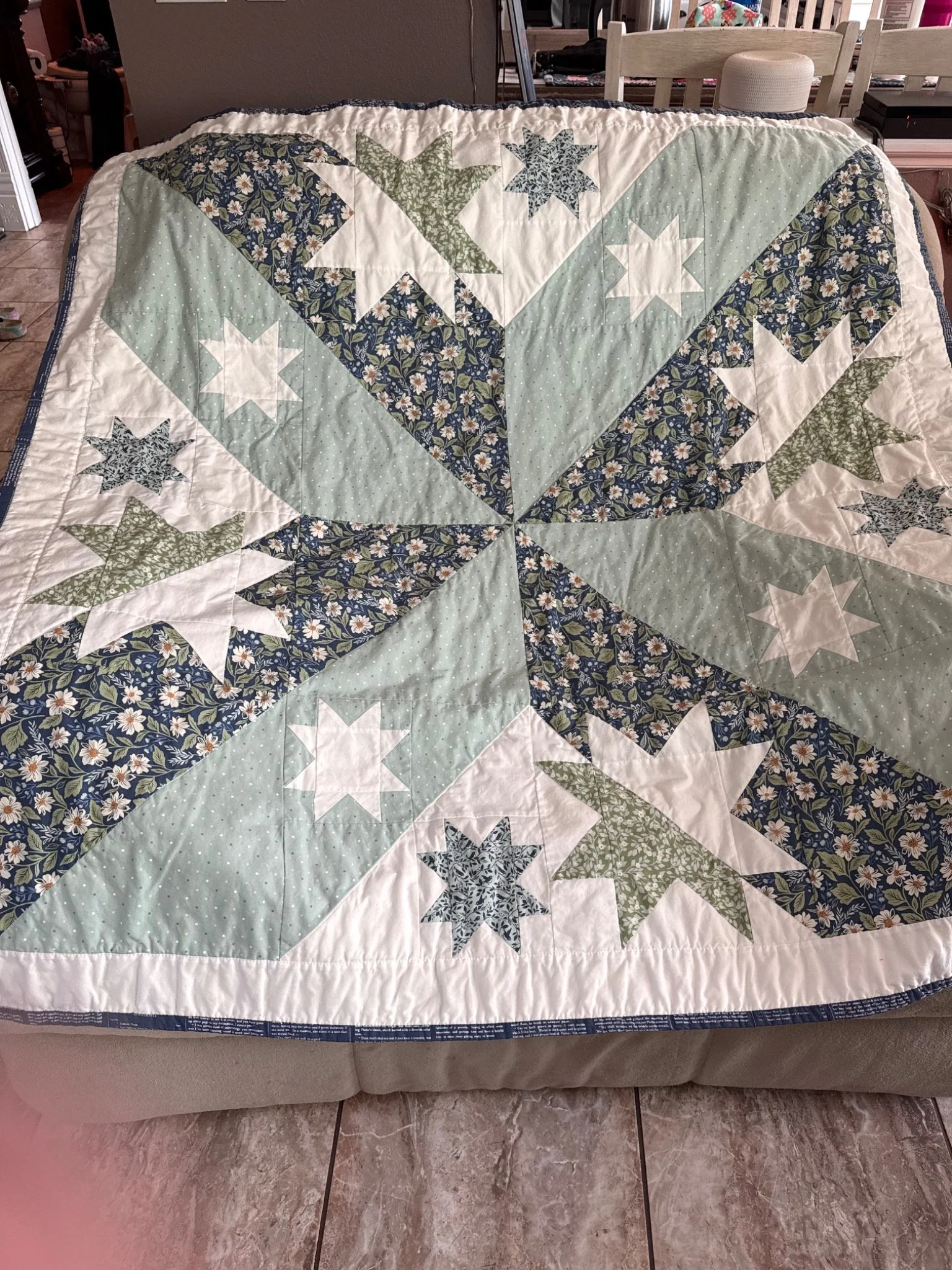
I Thought I Was Learning to Quilt
When I first started quilting, I thought I was learning how to make quilts. I never expected to find myself wandering through the worlds of textile science, color theory, geometry, history, hand quilting, and countless other rabbit holes along the way. The deeper I go, the more I realize quilting isn't a hobby you finish learning—it's a lifelong conversation. This week I'm reflecting on why that endless curiosity, and the quiet peace that comes with it, may be quilting's greatest gift.
When I made my first quilt, I thought I was learning one skill.
Cut some fabric. Sew a quarter-inch seam. Press. Repeat enough times and eventually, if all went well, there would be a quilt.
It turns out I wasn't simply learning how to make quilts.
I was opening the door to a world that has no apparent end.
Every time I think I've reached a point where I understand something, another door opens. Fabric alone could occupy a lifetime. Why does one cotton behave beautifully while another stretches and frays? What makes one batting loftier than another? Why do some quilts soften with age while others remain crisp? Before long, you're reading about fiber length, thread count, weave density, dyes, shrinkage, and textile manufacturing, wondering how something as ordinary as cotton became so fascinating.
Then there's color.
At first, it's simply choosing fabrics you like. Before long you're learning about value, hue, temperature, saturation, contrast, optical illusions, and why two perfectly beautiful fabrics can become complete strangers the moment you sew them together.
Just when you think you've wrapped your mind around that, geometry quietly taps you on the shoulder. Suddenly you're discovering why certain blocks fit together so elegantly, why precision matters, how angles create movement, and why a tiny fraction of an inch can ripple through an entire quilt.
Then history steps in.
Quilts aren't just blankets. They are family stories, engineering projects, works of art, historical documents, cultural traditions, practical necessities, and sometimes expressions of grief, celebration, or hope. Every pattern has a story, and every era has left its fingerprints in cloth. Before long, you aren't simply making quilts anymore. You're learning about the people who made them, the lives they lived, and the reasons certain traditions endured while others quietly faded away.
Lately I've been teaching myself hand quilting. Like most of my quilting adventures, it began with a dangerous amount of confidence. I watched the first couple of minutes of a video, ordered some 12-weight Aurifil thread, found a milliner's needle, and thought, Well… this can't be that hard.
I was right.
It isn't hard.
It simply opened another door.
Every answer seemed to lead to another question. Why this thread instead of that one? Why does one quilter prefer a hoop while another quilts entirely in her lap? Why does one quilter reach instinctively for a long milliner's needle while another wouldn't quilt with anything but a traditional between? Why do some swear by 12-weight thread while others wouldn't dream of using anything but finer cotton?
The more I explored, the more I realized quilting isn't a collection of rules waiting to be memorized. It's a conversation that has been unfolding for generations. Every quilt carries the fingerprints of the person who made it, not only in the fabrics they chose, but in the techniques they adopted, the traditions they inherited, and the small discoveries they made along the way. There is rarely a single right answer. More often there are thoughtful reasons behind many different approaches, and understanding those reasons has become every bit as enjoyable as learning the techniques themselves.
That realization has been surprisingly freeing.
I no longer feel as though I have to find the best method or the correct tool. Instead, I find myself listening to experienced quilters with genuine curiosity. One person's approach doesn't cancel out another's. Each has been shaped by years of practice, successes, frustrations, and discoveries. Learning why they make the choices they do has become just as fascinating as learning the techniques themselves.
There is also something quietly restorative about hand quilting itself.
Sitting in a chair with a needle, thread, and quilt stretched across my lap changes the rhythm of the day. The world becomes quieter. News headlines fade into the background. Emails can wait. My phone becomes considerably less interesting than the tiny stitch I'm trying to make just a little more even than the last one.
Hand quilting doesn't reward speed, and perhaps that's part of its appeal. It asks me to slow down and give my attention to one stitch at a time. Somewhere along the way, without ever intending to, my breathing settles, my thoughts become less hurried, and an hour slips by almost unnoticed.
It reminds me that not everything worthwhile needs to be efficient.
I think that's part of what keeps drawing me back to quilting.
There is always something more to learn, but there is never any pressure to learn it all. If I become fascinated by textile history, there are enough books to keep me occupied for years. If I decide to understand fabric manufacturing, color theory, appliqué, English paper piecing, embroidery, drafting quilt blocks, antique quilt restoration, or the engineering behind traditional quilt designs, there are people who have devoted entire lifetimes to each of those subjects.
Rather than feeling overwhelmed by that, I find it comforting.
There will always be another book to read, another technique to try, another quilt to admire, another maker whose experience offers something new to consider. There is no expectation that I master every corner of the craft. The joy comes from remaining curious.
Perhaps that's why quilting has held people's attention for centuries.
So much of life is measured by accomplishments. Finish the project. Meet the deadline. Check another item off the list. We become accustomed to believing that satisfaction comes from reaching the end.
Quilting offers something different.
It invites us to enjoy the middle.
It reminds us that making something with our hands is reason enough to spend an afternoon. It encourages us to notice small improvements instead of dramatic transformations. It teaches patience without ever announcing the lesson, and it quietly demonstrates that there are often many beautiful ways to arrive at the same destination.
When I made that first quilt, I thought I was learning a craft.
What I was really discovering was a lifelong companion.
A craft with enough history to fill libraries, enough techniques to occupy generations, enough creativity to ensure no two quilts are ever quite alike, and enough quiet moments to remind me that slowing down is sometimes the most productive thing I can do.
For me, that may be quilting's greatest gift.
Not that I'll ever know everything.
But that I'll never run out of beautiful things to learn.
~Chris
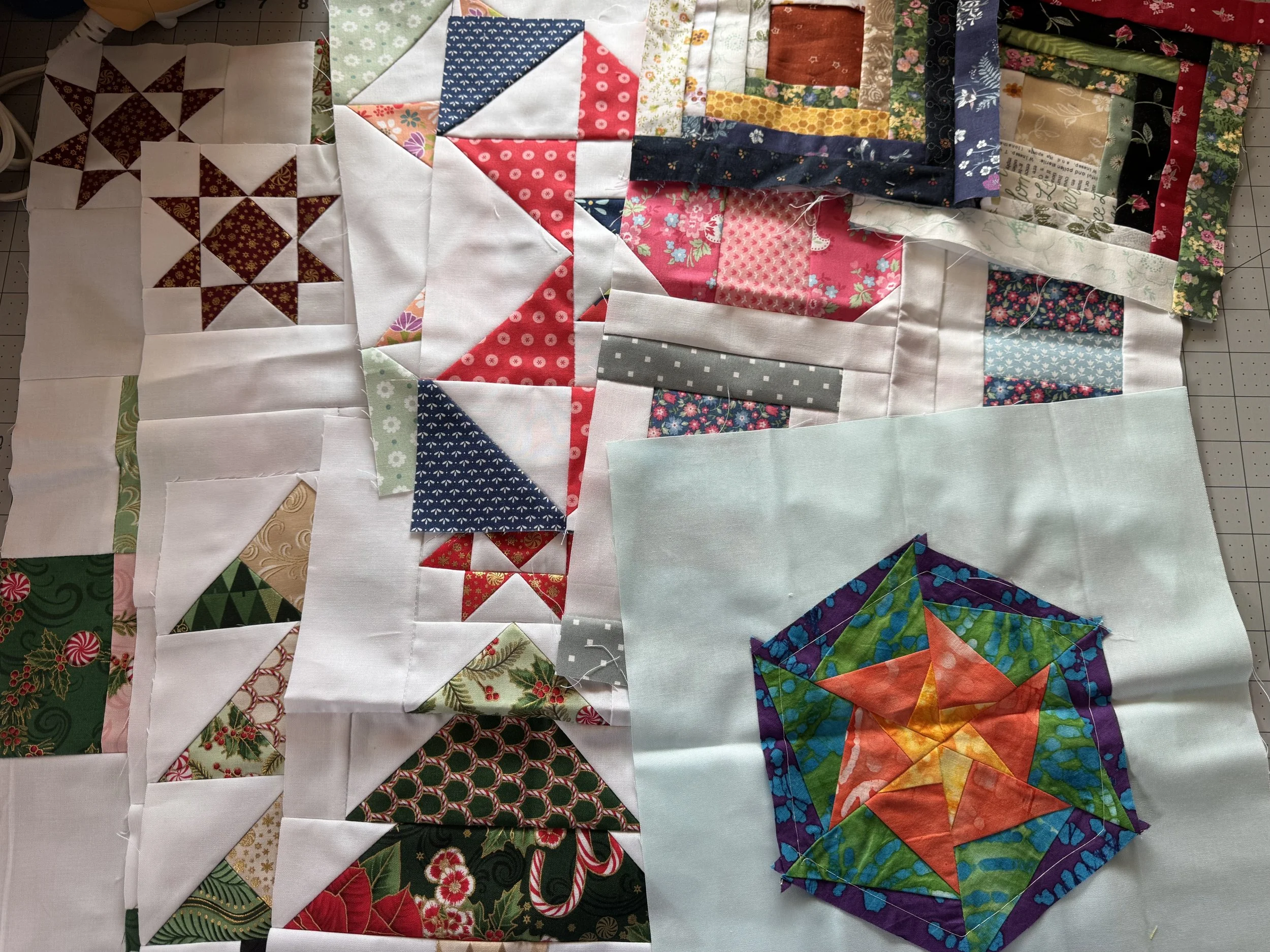
Saturday Stitch report #5
A very productive week at the sewing table included two versions of the A Quilting Life block, four completed Jolly Tree Farm blocks, progress on several monthly quilt-alongs, embroidery, EPP, Manx quilting, and a long-overdue supply organization. Next up: hand quilting Garden Girl and getting an early start on Christmas gifts.
Apparently, I’m Making Two of Everything Now
This week involved a satisfying amount of actual sewing, a little embroidery, some handwork practice, and enough organizing to confirm that I do not need more projects, fabric, thread, or supplies.
Naturally, this realization will probably have no lasting effect on my behavior.
I completed this month’s A Quilting Life Block of the Month block in two different colorways. Somewhere along the way, I decided that instead of choosing between the two fabric combinations, I would simply make two quilts from the pattern this year.
This is the kind of practical decision that makes perfect sense when you already have several other block-of-the-month projects underway.
Both versions are developing their own personalities, and I am enjoying watching the same block look completely different depending on the fabric. That is one of my favorite things about quilting. The pattern may provide the structure, but the fabric gets quite a bit of say in the final result.
Caught Up at Jolly Tree Farm
I also completed all four blocks currently available for the Jolly Tree Farm Quilt Along.
For the moment, I am officially caught up and waiting for next Tuesday’s instructions. There is something deeply satisfying about being caught up on a quilt-along, even when everyone involved knows the feeling may be temporary.
Still, caught up is caught up, and I intend to enjoy it.
The blocks have been fun to make, and I am looking forward to seeing how the quilt develops as more of the pattern is released.
Designer Mystery: Month Two Complete
Month two of the Designer Mystery Block of the Month is also finished.
Monthly programs always feel very manageable when they arrive one block at a time. Then several programs begin arriving one block at a time, and suddenly the sewing room has quietly developed its own project-management department.
So far, I am keeping up reasonably well. More importantly, I am still enjoying the process rather than treating the blocks like assignments that need to be submitted before midnight.
Spring Dreams Continues
I am currently working on Month Seven of the Missouri Star Spring Dreams Block of the Month.
This project has required a little more patience because of the templates and construction methods involved, but I have learned quite a bit from it. Some blocks come together quickly, while others require me to slow down, check the instructions again, and occasionally reconsider every choice that brought me to that exact moment.
Month Seven is still in progress, but it is moving forward.
Freezer Paper Piecing With the Guild
I also completed a freezer paper piecing block for another monthly quilt-along through my online guild.
This was a separate project from the other block-of-the-month programs, because apparently the current theme of my sewing life is that one monthly quilt project is never enough.
Freezer paper piecing is one of those techniques that can sound more complicated than it is. Once the process begins to make sense, it becomes a very useful way to create precise shapes without some of the paper-removal frustrations that come with traditional foundation paper piecing.
The block is finished, and I am pleased to have added another technique to the growing collection of things I am willing to attempt without being entirely certain what I am doing.
A Little Embroidery and Handwork
Not everything this week happened at the sewing machine.
I spent some time working on embroidery and practiced a little more English paper piecing. I also completed two additional Manx quilting blocks.
The Manx blocks have become a particularly good project for working from the recliner. They are portable, repetitive without being boring, and satisfying to complete one at a time.
There is something very different about handwork. Machine sewing gives me the pleasure of visible progress, while hand stitching slows everything down enough that I notice the process itself.
I am still learning, still experimenting, and still mostly trusting that repetition will eventually make everything feel more natural.
The Great Supply Organization
I also organized some of my sewing supplies.
This was useful, productive, and somewhat revealing.
I knew I had plenty to work with, but seeing everything gathered, sorted, and returned to its proper place made one thing very clear:
I have a lot to work with.
Not “I could probably make a small project this weekend” amounts of supplies.
More like “I could remain indoors through several winters and still have options” amounts of supplies.
The good news is that organizing everything reminded me how many lovely fabrics, patterns, threads, and unfinished ideas are already here. It also made it much easier to see what I can use for upcoming projects instead of automatically looking for something new.
Whether that lesson survives the next fabric release remains to be seen.
What’s Next
The next major project on my list is hand quilting the Garden Girl quilt.
I have been looking forward to learning more about hand quilting, and Garden Girl feels like the right quilt for it. I have my 12-weight Aurifil thread, a milliners needle, and the confidence that comes from watching approximately two minutes of a video before deciding the rest could probably be figured out along the way.
What could possibly go wrong?
I am also beginning to think seriously about Christmas gifts.
Christmas sewing always seems comfortably far away until it suddenly is not. My goal is to begin early enough that December does not become a frantic combination of sewing, wrapping, baking, family gatherings, and wondering why I once again believed handmade gifts would be relaxing.
For now, the supplies are organized, several monthly blocks are complete, the handwork pile is growing, and Garden Girl is waiting patiently for her turn.
That feels like a very good sewing week.
What are you working on this week, whether it's crafty or otherwise?
~Chris
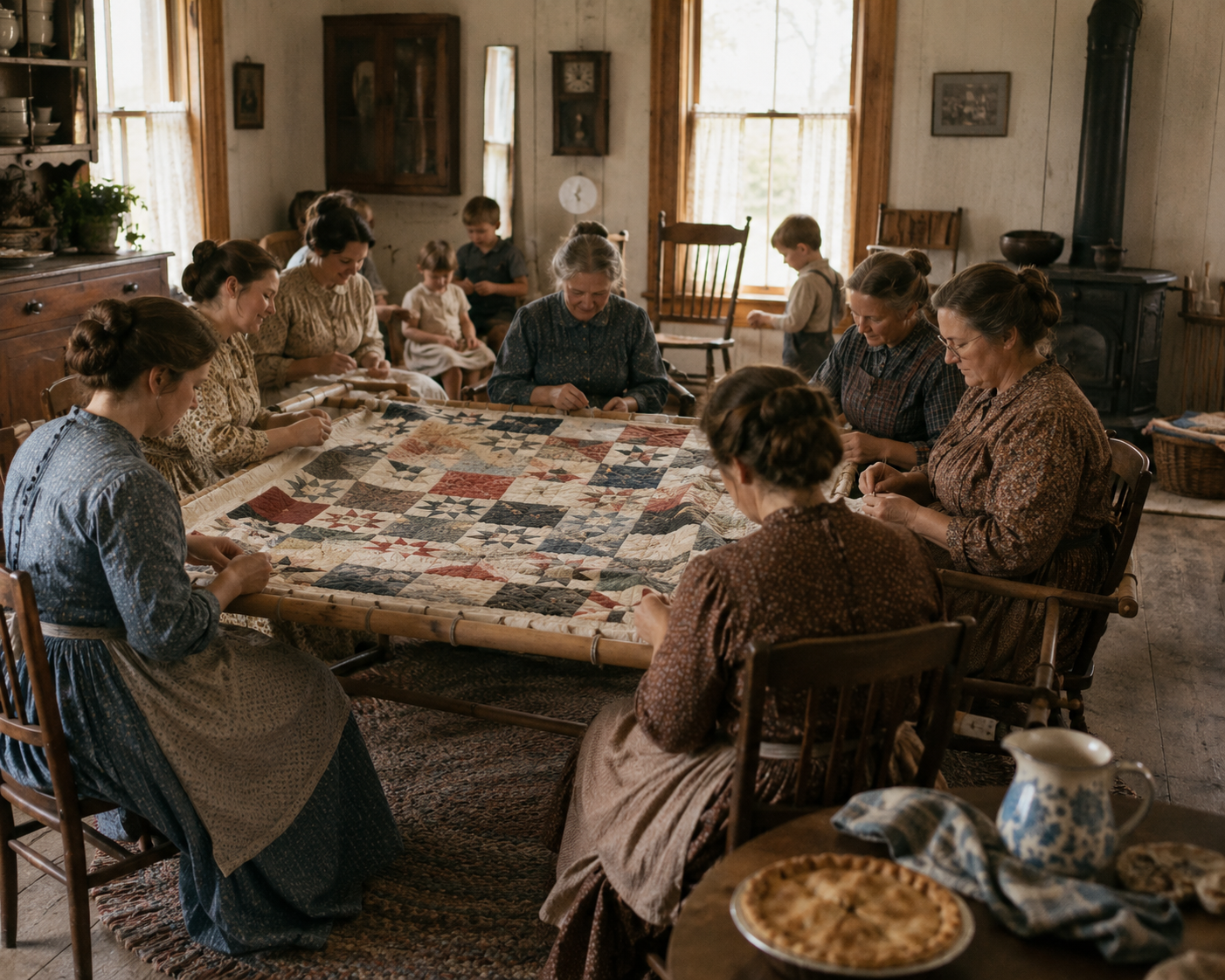
When Quilting Bees Brought Communities Together
Quilting bees were about far more than finishing quilts. Long before social media, neighbors gathered around a quilt frame to share news, teach skills, celebrate milestones, and support one another through life's joys and hardships. This week's Quilting History explores how these gatherings stitched communities together—and why their legacy still lives on today.
Last week, I mentioned that today’s history post would head in a different direction. We will get there, but after the week I have had, this story felt more appropriate. Sometimes the best thing about history is the reminder that people have always needed one another, and quilting bees are a wonderful example of how communities once gathered, worked, talked, and cared for each other around a quilt frame.
For many of us, the words quilting bee bring to mind a group of women sitting together, quietly stitching while coffee and pie wait nearby. That picture is not entirely wrong, but it is incomplete. Quilting bees were practical work gatherings, social occasions, teaching spaces, and important parts of community life. In isolated rural areas, they gave people a reason to come together and offered a chance to exchange news, share skills, and help a neighbor complete a large job.
Before sewing machines and longarm quilting, finishing a quilt required an enormous amount of handwork. Once a quilt top had been pieced, the layers had to be assembled and quilted with thousands of stitches. One person could do it alone, but it might take weeks or months. A group of experienced quilters gathered around a frame could complete much of the work in a day, especially when the quilting design was simple and everyone knew what she was doing.
The gathering usually began because a quilt needed to be finished, but the work was only one part of the day. Neighbors brought food, children came along, and conversations continued while hands stayed busy. People shared family news, recipes, gardening advice, sewing techniques, and updates about illness, births, deaths, weddings, and local events. In communities where homes were far apart and travel was difficult, these gatherings helped people remain connected.
Quilting bees were also places where knowledge was passed from one generation to the next. Younger quilters learned how to space stitches, mark designs, manage tension, and work efficiently at the frame. They also learned the habits and traditions of the women around them. Much of this information was never written down. It was demonstrated, corrected, repeated, and remembered.
The social importance of quilting bees should not be overstated or romanticized. The work could be tiring, the expectations placed on women were often demanding, and not every gathering was warm or harmonious. Quilting bees were made up of real people, which means there was likely friendship, laughter, judgment, gossip, disagreement, and the occasional person whose stitches were probably discussed after she went home.
They also did not look the same in every place or community. Some were organized to finish a bride’s quilt before her wedding. Churches and charitable groups made quilts for families facing illness, poverty, or disaster. Communities gathered to sew for soldiers during wartime, while immigrant families brought quilting and textile traditions shaped by their own cultures and experiences. African American, Indigenous, European American, and other quilting communities developed different practices depending on available materials, regional customs, and family traditions.
Although women generally did the quilting, a bee could become a larger family or neighborhood event. Children played nearby, meals were shared, and the evening might include music, games, or visiting after the sewing was finished. In areas with few opportunities for recreation, a quilting bee offered both productive work and a welcome break from the isolation of daily life.
Modern quilters may not need a roomful of neighbors to finish a quilt before winter, but the desire to gather has not disappeared. We find each other through guilds, retreats, quilt shops, classes, sew-alongs, church groups, and online communities. The setting is different, and most of us are no longer leaning over the same wooden frame, but we still share patterns, techniques, family stories, advice, encouragement, and opinions about fabric.
That may be the most enduring part of the quilting bee. Quilts have always been useful objects, but the making of them has also created opportunities for friendship and support. The quilt may have been the reason people gathered, but the relationships built around it were often just as important.
Next week, we will return to the topic I had originally planned. This week, however, a little history about people showing up for one another felt like the better place to pause.
~Chris
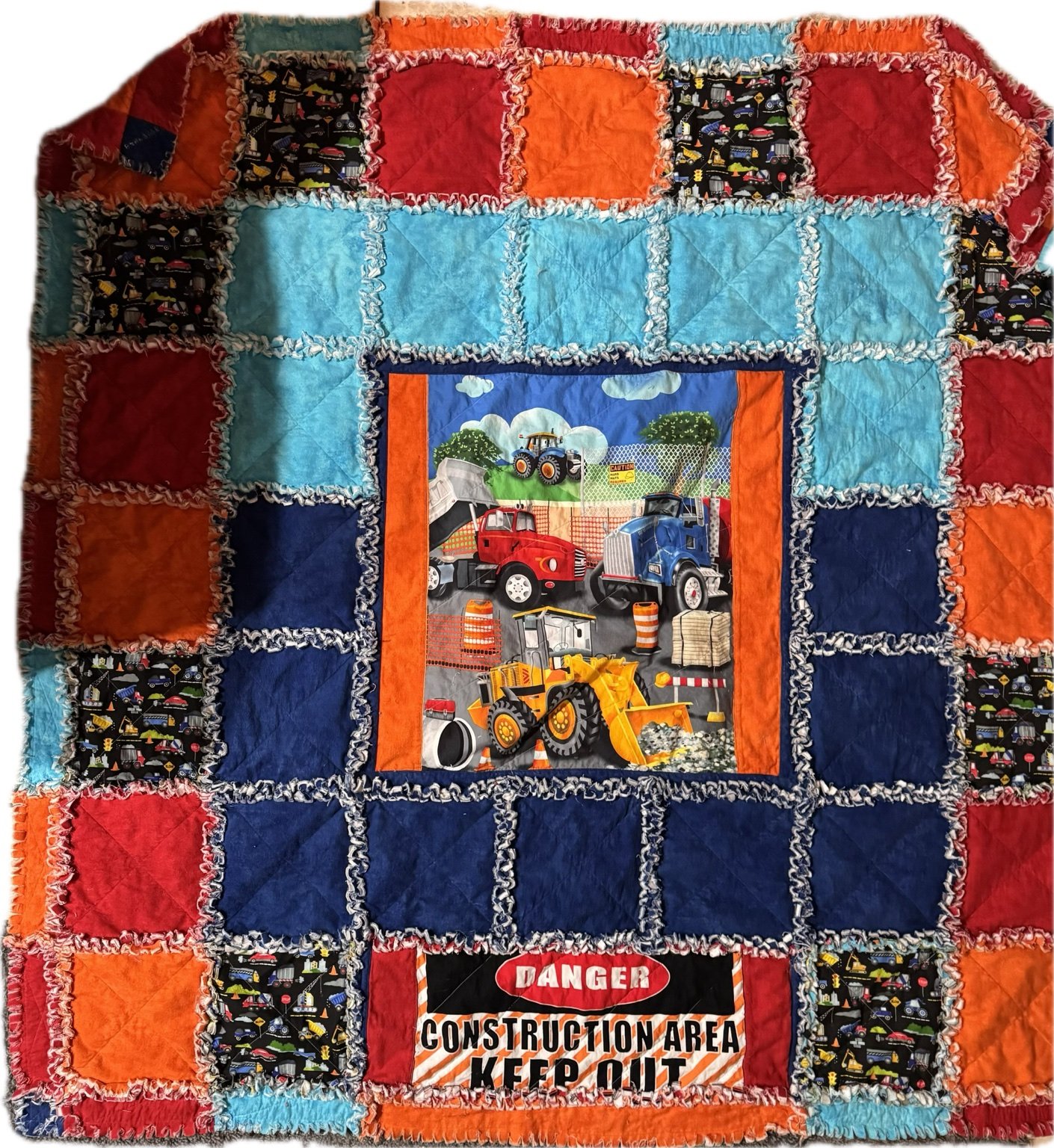
The Sewing Chair no.5
We spend so much of life trying to finish the next project, reach the next goal, and cross one more thing off the list. This week in The Sewing Chair, a construction-themed quilt becomes a reminder that growth, learning, and the life happening in the middle may matter just as much as the finished result.
Still Under Construction
Pull up a chair. Stay awhile.
A few months ago, I made this construction-themed rag quilt for my grandson's birthday. It has bright orange fabric, trucks and tractors, ragged edges, and a panel near the bottom that reads, "Construction Area. Keep Out." At the time, I simply thought it fit the theme of the quilt. It made me smile, and I knew it would make him smile too.
This week, as I walked past it again, I realized that little sign might be describing more than a child's quilt. It could just as easily describe my sewing room.
There are several Block of the Month projects waiting for their next block. A sampler quilt is slowly becoming a collection of quilting techniques from around the world. There is a quilt I'd like to hand quilt, and beside my recliner sits a growing stack of Manx quilt blocks that I work on while watching television or listening to an audiobook. Beyond quilting, there are cross-stitch and crochet projects waiting patiently, and an entire house that keeps reminding me it would appreciate a fresh coat of paint.
Looking around, it would be easy to see nothing but unfinished work. I suspect most of us have done exactly that. We look at the list of things we haven't completed and somehow convince ourselves that the list is measuring us.
The more I thought about it, the more I realized that every finished quilt I own once looked exactly like the projects scattered around my sewing room today. Before it was folded on a shelf or draped across the back of a chair, it was simply another idea in progress. Fabric hadn't been cut yet. Blocks hadn't been sewn. There were mistakes to fix, decisions to make, and days when it sat untouched because life required my attention somewhere else.
That isn't failure.
It's how quilts are made.
Somewhere along the way, I think many of us begin treating our own lives differently than we treat our hobbies. We celebrate growth when we're learning a new quilting technique, but we become impatient with ourselves when life takes longer than we expected. We convince ourselves that happiness will arrive after the next accomplishment, the next promotion, the next project, the next vacation, the next debt is paid, or the next item is crossed off the list.
There is always another list.
The problem is that if we're always living for what comes after this project, we risk missing the life that's happening while we're still building it. Most of our days are not spent standing at the finish line. They're spent learning, adjusting, making mistakes, changing plans, and becoming a little different than we were yesterday. That's true whether we're making a quilt, raising a family, building a career, or simply trying to become a wiser version of ourselves.
When I look around my sewing room now, I don't see evidence that I can't finish things. A few months ago I finished this quilt for my grandson. This week I finished another quilt for my uncle. The projects that remain aren't abandoned; they're simply waiting for their turn. Some are intentionally long-term because I enjoy working on them slowly. Some will probably be finished sooner than others. None of them needs to become a race.
Perhaps life isn't meant to be a race either.
Maybe we place too much value on completion and not enough on construction. After all, the construction is where we learn the new technique, laugh at our mistakes, solve the little problems, and quietly discover that we know more today than we did when we began. Those moments rarely make the photograph at the end, but they are the part we actually lived.
I hope I always have a sewing room with something under construction. More importantly, I hope I remain a person who's still under construction. I hope there is always something new to learn, another skill to develop, another perspective to consider, and another reason to remain curious.
That little sign on my grandson's quilt made me smile when I stitched it into place.
Now it reminds me of something else.
Construction areas aren't places to avoid. They're places where something worthwhile is being built.
Thanks for stopping by The Sewing Chair.
I'll save you a seat for next Sunday.
~Chris
Saturday Stitch Report #4
One quilt finished, a new quilting tool discovered, and plenty of works in progress still waiting their turn. This week's Saturday Stitch Report is a look inside my sewing room, including an impulse purchase that turned out to be worth every penny and what's next on my quilting table.
Another week has come and gone in the sewing room, and while it wasn't a week filled with multiple finishes, I did complete one project that had been waiting patiently—my uncle's quilt. Seeing that final stitch go in is always satisfying, especially when it's a quilt made for someone you care about.
One unexpected discovery this week was the Micro Stitch tool.
You know how one random thirty-second clip on the internet can end up costing you money? That's exactly what happened. I spotted it briefly in a quilting video, got curious, ordered one, and now I'm wondering how I managed without it. It made finishing my uncle's quilt much easier, so this impulse purchase actually paid off. Time will tell whether it becomes one of those tools I reach for on every project, but my first impression is a very good one.
Of course, finishing one quilt doesn't exactly leave the sewing room empty.
Waiting in the wings are A Quilting Life Block of the Month, the Designer Mystery Block of the Month, Spring Dreams Block of the Month, and a sampler quilt that has become one of my favorite long-term ideas. The goal is to learn quilting techniques from around the world, one block at a time, and eventually bring them together into a single quilt. It's not a race—it's a project I expect to enjoy over quite a while.
There's also the quilt I'd like to hand quilt, along with a growing collection of Manx quilt blocks that I work on from my recliner while watching television or listening to an audiobook. Those quiet hand-sewing sessions have become their own little ritual.
And because apparently quilting isn't enough to keep me busy, there are cross-stitch and crochet projects patiently waiting for their turn, along with an entire house that keeps reminding me it would appreciate a fresh coat of paint.
In other words, I don't think I'm going to run out of things to do anytime soon.
What are you working on this week? Are you faithfully finishing one project at a time, or do you also have a few "waiting in the wings"?
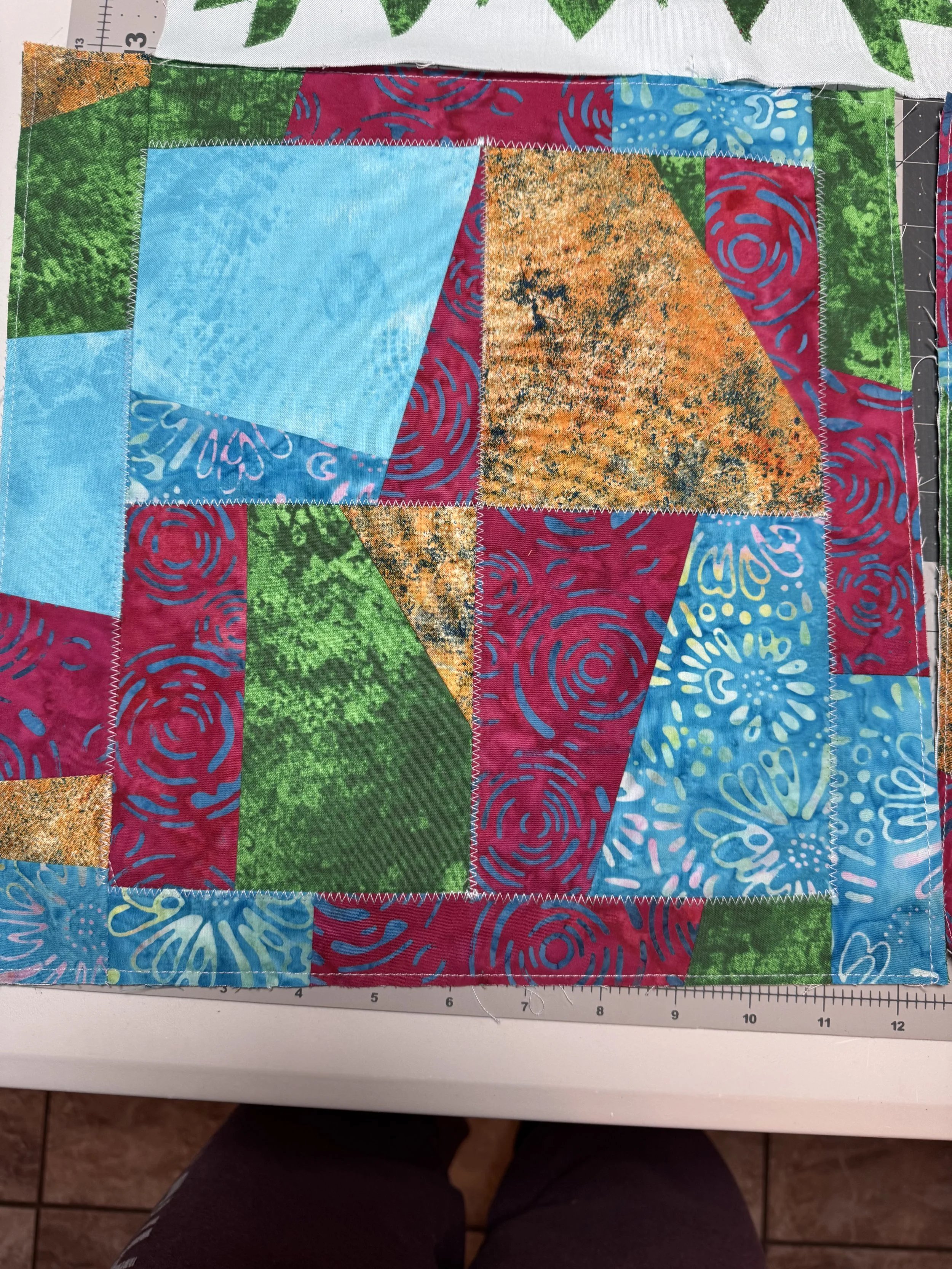
The Beautiful Chaos of Victorian Crazy Quilts
Victorian crazy quilts turned irregular scraps, luxurious fabrics, and elaborate embroidery into richly layered works of textile art. This week, I’m exploring how the style developed, why its apparent chaos required real skill, and why my already ambitious WIP list kept me from starting one of my own—for now.
Photo caption: One of my improvisational quilt blocks. They are not traditional crazy quilt blocks, but their irregular piecing and decorative stitching (which is not completed) offer a small glimpse of the freedom that makes crazy quilting so appealing.
When Breaking the Rules Became an Art Form
Last week, we explored Baltimore Album quilts, where carefully planned appliqué, balanced blocks, and remarkable precision were very much part of the appeal. Victorian crazy quilts moved in an entirely different direction. Instead of orderly repetition and matching shapes, they embraced irregular pieces, lavish embellishment, and the general belief that when it came to fabric, thread, ribbon, beads, and embroidery, more was probably better.
Welcome to the wonderfully unruly world of crazy quilting.
High-style crazy quilts emerged during the last quarter of the nineteenth century and became a major needlework trend during the 1880s. Their makers combined influences from Japanese art and design, English embroidery, popular imagery, and the richly decorated interiors of the Victorian era. Magazines encouraged women to make increasingly elaborate examples, while newspapers and periodicals also criticized the craze as excessive, frivolous, or evidence of poor taste.
More Art Than Bed Quilt
When we hear the word quilt, most of us picture something made to cover a bed and keep someone warm. Many Victorian crazy quilts, however, were intended primarily as decorative objects. The finest examples were often smaller parlor pieces, displayed across furniture or placed where visitors could admire the maker’s fabrics, embroidery, and artistic skill.
Interestingly, many early crazy quilts were not technically quilted in the way we usually use that word. Their irregular patches were commonly sewn onto a foundation fabric and then backed with a lining, but they often contained no batting and were rarely quilted through all the layers. Some were tied instead. American makers frequently constructed smaller sections or blocks and then joined them to create the larger piece.
The high-style versions used an astonishing variety of materials. Silks, satins, brocades, velvets, ribbons, wool suiting, calico, and even cigar ribbons might all find their way into the same textile. The industrial growth of the late nineteenth century made a much wider selection of manufactured fabrics available, giving makers access to colors, textures, and novelty materials that earlier generations could not have imagined.
Naturally, piecing together mismatched velvet, silk, lace, and ribbon was only the beginning.
The seams might be covered with feather stitches, herringbone stitches, French knots, and other decorative embroidery. Makers added flowers, vines, birds, fans, animals, initials, dates, buildings, political figures, and personal symbols. Lace, metallic thread, beads, sequins, shells, tassels, painted details, commercial appliqués, and photo transfers could all become part of the design.
Some crazy quilts served almost like textile scrapbooks, preserving pieces of clothing, commemorative ribbons, signatures, family memories, and small clues about the people who made them.
By the mid-1880s, the craze had become popular enough that manufacturers offered precut silk kits, marked foundation fabrics, embroidery patterns, transfer designs, and decorative pieces created specifically for crazy quilts. Evidently, the Victorian era had its own version of the quilt kit—and quilters were just as susceptible to it as we are.
Where Did the “Crazy” Come From?
The word crazy did not simply mean that the maker had abandoned all reason and attacked the scrap basket.
The name was associated with the cracked or “crazed” appearance of the irregular lines, much like the fine cracks seen in ceramic glazes. Asymmetrical patterns, broken-looking geometric lines, and unexpected compositions were also associated with Japanese design, which attracted widespread attention in the United States following the 1876 Centennial Exposition in Philadelphia.
Japanese art offered Western audiences a very different approach to composition. Designs did not always depend upon centered motifs, mirror-image balance, or orderly repetition. Natural forms, asymmetry, empty space, and unexpected angles could create their own kind of harmony. Those ideas appeared throughout the decorative arts of the period and became part of the visual language of crazy quilting.
That does not mean every crazy quilt looked the same or followed one exact formula. The most elaborate Victorian examples represent what historians often call the high-style crazy quilt, but crazy patchwork could be made from humble fabrics as well as luxurious ones. The materials, construction, and amount of embellishment varied widely. What connected them was an appreciation for irregularity, varied texture, asymmetry, and decoration that did not need to justify itself by being especially useful.
Crazy, but Not Random
At first glance, a crazy quilt can look as though someone emptied several scrap baskets onto the floor, added every spool of embroidery thread in the house, and decided to see what happened.
The longer you study one, however, the more intentional it becomes.
The shapes may be irregular, but the maker still had to consider color, contrast, scale, and movement. Heavy areas needed to be balanced with quieter ones. Velvets and dark fabrics reflected light differently from silk and satin. Embroidery helped lead the eye from one section to another, while small motifs created places to pause and look more closely.
The apparent disorder often concealed careful planning and a strong understanding of composition. Crazy quilting may have broken the traditional rules, but it did not eliminate skill. It simply required a different kind of skill.
My Turn at Breaking the Rules
One of the things I have enjoyed most about writing this quilt-history series is that it keeps introducing me to techniques I might not otherwise explore. Crazy quilting is one of those techniques, and with the current heat wave keeping me firmly indoors, this would have been the perfect time to make my first Victorian-inspired crazy quilt block.
Unfortunately, I also have a rather ambitious WIP list already competing for my attention. Adding another project—no matter how tempting—simply did not make the cut.
Making the kind of block I wanted to make, with foundation piecing, decorative embroidery, and enough embellishment to properly explore the style, would have required time I was not willing to take away from the projects already waiting on my sewing table. Apparently, even creative freedom has to wait its turn behind the WIP list.
Instead, I am sharing two improvisational blocks I had already made. They are not crazy quilt blocks, and I do not want to present them as though they are. They do, however, offer a general idea of what can happen when repeated patterns and predictable shapes are set aside in favor of irregular pieces, unexpected angles, and decorative stitching.
Making them reminded me that “random” is not necessarily effortless. Years of traditional piecing have trained my brain to look for balance, alignment, and some kind of underlying order. Even when I am intentionally working in an improvisational style, I still catch myself trying to make everything behave.
Apparently, old quilting habits die hard.
The more I have learned about Victorian crazy quilts, the more I appreciate just how much work went into them. The piecing was only the foundation for layers of embroidery, texture, imagery, and personal detail. These were not simply scraps thrown together without a plan. At their best, they were carefully composed works of textile art.
I still intend to give crazy quilting a proper try someday. When I do, I want enough time to enjoy the decorative stitching and embellishment instead of rushing through it simply because I promised myself a block for a blog post. For now, the WIP list wins—but crazy quilting has officially been added to the someday list.
And we all know how short that list tends to be.
Photo caption: Two of my improvisational quilt blocks. They are not traditional crazy quilt blocks, but their irregular piecing and decorative stitching offer a small glimpse of the freedom that makes crazy quilting so appealing.
Why Crazy Quilts Still Matter
One of the things I enjoy most about quilting history is discovering that quilters have always experimented. They borrowed ideas from art, fashion, travel, new technology, and the materials available around them. They adapted older techniques, invented new ones, and occasionally decided that the existing rules could use a little rearranging.
Crazy quilts remind us that quilting has never been only about perfect points, matching seams, and practical bedcovers. It can also be a place for excess, curiosity, memory, and artistic play. A quilt does not always have to be useful. Sometimes it can exist simply because someone wanted to make something beautiful, interesting, or entirely unlike anything she had made before.
After spending years training ourselves to be precise, there is something appealing about a style that welcomes irregularity. That does not mean crazy quilting is easy. If anything, its beautiful chaos may require even more thought.
It simply allows the maker to choose which rules are worth keeping—and which ones can wait at the bottom of the scrap basket.
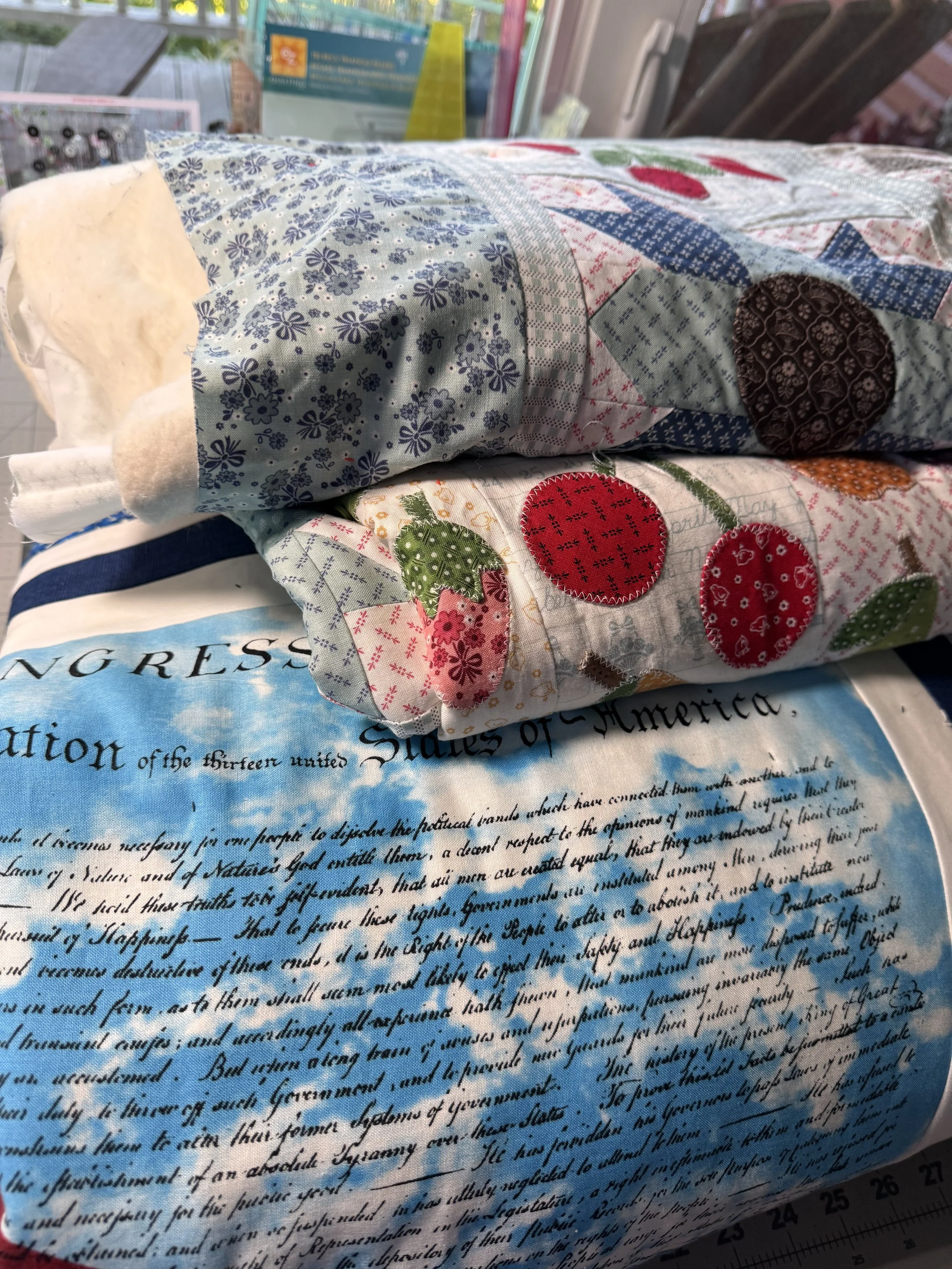
A New Quilting Gadget Gives Me Hope—and That’s Saying Something
I dread sandwiching quilts. Pins shift, spray basting gives me headaches, and something always seems to wrinkle. I finally tried the Micro Stitch tool—and after years of frustration, I might have found a better way.
There are several parts of quilting I genuinely enjoy. Piecing is satisfying, pressing seams is oddly calming, and choosing fabric could easily become a full-time occupation if anyone were willing to pay me for it.
Sandwiching quilts, however, is another matter entirely.
No matter how carefully I smooth the backing, batting, and quilt top, I seem to end up with shifting, bunching, or a wrinkle hiding somewhere underneath. I can pin until the entire quilt looks like it has developed armor, and somehow the backing still finds a way to misbehave. I have also tried spray basting, but the smell gives me a headache, so that method and I are no longer on speaking terms.
Disclosure: This post contains affiliate links. As an Amazon Associate, I earn from qualifying purchases. If you choose to purchase through these links, I may receive a small commission at no additional cost to you. Thank you for supporting Chris Cross Quilts & More!
Last night I had four quilts waiting to be sandwiched, which is not exactly my idea of a relaxing evening. Before I started, though, I decided to try something new: the Micro Stitch tool.
I managed to sandwich two of the four quilts, and my first thought was, Why am I only finding out about this now?
The tool uses tiny plastic fasteners to hold the three quilt layers together. Once I had them in place, the quilts felt much more stable than they usually do when I pin. The layers did not seem to shift while I moved the quilts around, and the entire process felt a little less like wrestling a stubborn octopus.
I should be clear that I have not quilted either of them yet, so this is still very much a first impression rather than a final review. The real test will come when I run them through the machine and see whether the backing stays smooth. Still, I have high hopes. If these little fasteners prevent slipping and puckering, I will gladly spend a few minutes clipping them out afterward. That seems like a perfectly reasonable trade.
Sometimes the most useful quilting tools are not the flashy ones. They are the quiet little gadgets that solve the job you have been dreading for years.
I will report back once these quilts have been quilted and the Micro Stitch has survived the full test.
In the meantime, it has been unbelievably hot here, which means I have been staying inside with the air conditioning, my sewing machine, and a steady supply of audiobooks. I am starting book fifteen of Jennifer Chiaverini’s Elm Creek Quilts series, and I am honestly surprised by how much I have enjoyed these books.
I didn't expect to become quite so invested in the characters, but here we are. They've become perfect sewing-room companions, especially on afternoons when it's simply too hot to be outside.
What I discovered recently made me smile even more. Many of the quilts featured throughout the series have actually been turned into companion pattern books, so you can make some of the quilts you've been reading about. I had no idea those even existed. Now, of course, I'm trying very hard to convince myself I don't need another quilting book on my shelf...although we all know how that usually ends.
If you enjoy listening to books while you quilt, I'd definitely recommend giving the series a try. Just don't blame me if you end up adding a few more quilting books to your collection along the way.
Now I still have two more quilts waiting to be sandwiched, but for once, I'm not quite as grumpy about it.
Have you tried the Micro Stitch tool? I would love to know whether it has earned a permanent place in your quilting toolbox, or whether you have another basting method I need to know about.
~Chris