
Before Christmas trees and elaborate gift exchanges became familiar American traditions, the holiday season often centered on visits, celebrations, and community gatherings. What changed, and what might we learn from the Christmases of the past?
There is something appealing about the idea of Christmas in colonial America. We imagine a crackling fire, candles glowing in the windows, greenery gathered from the woods, and a family sitting together around a table filled with homemade food. Somewhere nearby, a woman is sewing by firelight, perhaps finishing a gift for someone she loves while snow falls gently outside.
It is a lovely picture. Unfortunately, much of it belongs to a Christmas that developed considerably later.
The colonial Christmas we have come to recognize owes quite a bit to Victorian traditions, twentieth-century historical restorations, and our own fondness for imagining that people in the past lived simpler lives. They certainly lived without many of our modern conveniences, but that does not mean their lives were simple. Nor does it mean that everyone celebrated Christmas, exchanged gifts, or considered December 25 particularly important.
Fortunately, some early Americans left written accounts of their holiday seasons. Their diaries, letters, household records, and surviving recipes offer glimpses of what Christmas looked like before electric lights, department stores, sewing machines, and the annual debate over how early is too early to put up the tree.
What I found particularly interesting was how much attention some colonial Americans devoted to gathering with other people. Dinners, dances, visits, music, and celebrations occupied a significant part of the season, while the family gift exchanges that dominate our modern preparations were much less common.
It made me wonder whether, somewhere along the way, we changed not only how we celebrate Christmas, but what we expect Christmas to provide.
A Christmas in Virginia, 1773
In December 1773, a young tutor named Philip Vickers Fithian was living at Nomini Hall, the Virginia plantation of Robert Carter III. Fithian had come from New Jersey to educate the Carter children, and he was fascinated by the customs of Virginia's wealthy plantation families.
Fortunately for historians, he kept a diary.
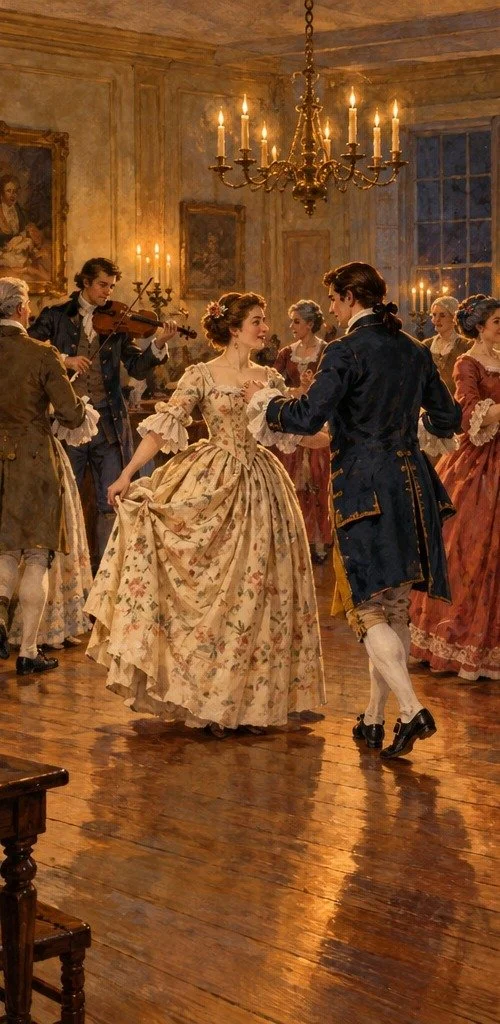
On December 18, Fithian described a gathering filled with dancing, music, conversation, and an impressive amount of social activity. Young people performed minuets and country dances, meals were served, and the festivities continued throughout the day.
As Christmas approached, Fithian observed that conversation increasingly concerned upcoming balls, foxhunts, entertainments, and social gatherings. He was not entirely thrilled by the prospect of participating in everything, suggesting that his horse's lameness might provide a convenient excuse to remain home.
I rather like Mr. Fithian. He appears to have understood that receiving an invitation does not necessarily create an obligation to attend.
His account tells us something important about Christmas in colonial Virginia. Among wealthy Anglican families, the season was not necessarily centered on one day. Entertaining might begin well before Christmas and continue into January, with Twelfth Night, on the evening of January 5, marking a traditional conclusion for many celebrations. Some people extended the festivities even longer.
On Christmas morning itself, Fithian was awakened by gunfire around the plantation, a custom that evidently did not encourage sleeping late. Nelson, an enslaved boy who tended his fire and performed other duties, came to his room and wished him a joyful Christmas. Fithian gave him a small amount of money. Several other enslaved workers also approached him with Christmas greetings and requests for gratuities, a customary practice sometimes called receiving a Christmas box. Eventually, Fithian ran short of small change.
Later that afternoon, he dined with Mrs. Carter and five of her daughters. Robert Carter remained in his room, leaving Fithian responsible for carving, offering toasts, and helping maintain the conversation.
Interestingly, he described the meal as elegant but no different from their customary dinners.
The excitement of the season was not necessarily concentrated into one extraordinary Christmas Day feast. Much of it came from the gatherings, visits, dancing, and entertainment surrounding the holiday.
Of course, the Carters were wealthy plantation owners whose social lives were supported by an extensive household and enslaved labor. Their experience was hardly representative of every colonial family.
Still, Fithian's diary gives us a fascinating glimpse of a Christmas season in which anticipation centered heavily on the people one expected to see and the occasions one expected to attend.
And apparently, on whether one's horse was available to provide a suitable excuse.
Not Everyone Was Celebrating
Travel north into New England during the seventeenth century, however, and you might encounter an entirely different attitude toward Christmas.
Many Puritans opposed the holiday. They believed that Christmas celebrations lacked biblical justification and associated the season with excessive drinking, idleness, and disorderly behavior.
In 1659, the Massachusetts Bay Colony went so far as to prohibit Christmas observance, imposing fines on those who violated the law. The prohibition was repealed in 1681, but opposition to Christmas remained influential in some New England communities for generations.
Imagine living in a community where one family considered Christmas an important religious occasion, another regarded it as an opportunity for dancing and feasting, and a third thought the entire business was an unfortunate excuse for people to behave badly.
Perhaps colonial neighbors weren't so different from modern neighbors after all.
Even within Virginia, observance varied. Anglican communities in the Tidewater region were generally more enthusiastic about Christmas festivities than some Presbyterian communities farther west. Quakers also frequently treated December 25 much like any other day.
There was no single colonial American Christmas.
That distinction matters because when we look backward, we tend to combine customs from different regions and different centuries into one charming scene. The result may be attractive, but it does not necessarily represent how anyone actually lived.
The House Had to Be Ready, and Someone Had to Make It Happen
It is easy to read about colonial holiday gatherings and become enchanted by the candlelight, beautiful clothing, and elaborate dinners. It is considerably easier to overlook the work required to make those things possible.
Preparing an eighteenth-century household for guests involved an enormous amount of labor. Food had to be acquired, preserved, prepared, and cooked. Rooms needed cleaning, fires required tending, and linens had to be washed and maintained. Candles were consumable household supplies rather than inexpensive decorations.
Clothing presented its own demands.
A family preparing for a gathering might need clean and properly maintained garments, stockings, shirts, shifts, gowns, waistcoats, or coats. Clothing could require mending or alteration. Household textiles, including table linens and bedding, were valuable possessions that needed care.
Contrary to the popular image of every colonial woman sitting at a spinning wheel producing all her family's cloth, textile production depended heavily on region, household wealth, access to markets, and available labor.
Many fabrics and finished garments were imported or purchased. Professional tailors, mantua-makers, and other skilled workers supplied clothing, while sewing and textile maintenance also took place within households.
In wealthy Virginia plantation households, enslaved women were among those assigned spinning, weaving, sewing, laundering, and other textile work. Some developed considerable expertise as seamstresses and textile workers. Their knowledge and craftsmanship were valuable, but their assigned labor was performed under coercion, without the freedom to determine how their skills would be used.
Not every enslaved woman worked with textiles, just as not every free woman performed all her family's sewing. Responsibilities varied according to the household, available resources, and the circumstances of the individuals involved.
This is an important part of the history, particularly when we admire the beautiful garments and textiles that have survived.
A finely constructed gown, embroidered accessory, or carefully maintained linen represents someone's knowledge and skill. But it also raises questions about who performed the work, where the materials originated, and whether the maker had any choice in the matter.
That is one of the things I find most compelling about textile history. The finished object is only part of the story.
And while we might admire eighteenth-century clothing construction, I suspect most of us would be considerably less enthusiastic about maintaining an entire family's wardrobe without a washing machine, clothes dryer, or sewing machine.
My appreciation for historical sewing techniques does not extend quite that far.
The Holiday Table Was Not Quite What We Imagine
If you visited a wealthy Virginia household during the Christmas season, you might encounter meats, pies, puddings, cakes, preserved fruits, and other dishes associated with eighteenth-century entertaining.
But there was no single standardized Christmas menu.
At Mount Vernon, Martha Washington's surviving cookery materials included a recipe for Christmas pie containing several kinds of poultry and seasonings. Great cakes, rich with dried fruit and spices, were also associated with entertaining during the period.
Some surviving cake recipes required astonishing quantities of ingredients. One recipe associated with the Washington family called for dozens of eggs, several pounds of butter and sugar, and substantial amounts of dried fruit.
That is a level of holiday baking commitment I am not particularly eager to reproduce.
Historical recipes remind us just how labor-intensive cooking could be. Ingredients required preparation, fires and ovens demanded constant attention, and successful results depended on experience rather than programmable settings.
Martha Washington managed a household known for its hospitality, but she did not personally perform all the cooking. Enslaved cooks and other household workers prepared much of the food and maintained the home.
And while guests might enjoy leisurely meals, conversation, and entertainment, the workers supporting those gatherings experienced the holiday very differently.
At Mount Vernon, historical records indicate that many enslaved workers received several days away from their regular duties during Christmas. For some, this offered a rare opportunity to visit relatives and friends, including loved ones living on neighboring plantations. Maintaining those relationships could require considerable effort when people had little freedom to decide where they lived or worked.
But Christmas did not bring rest for everyone. Enslaved cooks, housemaids, waiters, and other household workers often faced additional responsibilities as the Washington family entertained guests.
Nor were Christmas breaks universally granted on other plantations. Some enslavers refused to allow any holiday from regular work.
We know considerably more about the celebrations of wealthy plantation families than about the personal experiences of many of the people they enslaved. Their lives were recorded less frequently in their own words, and often through records created by the people who controlled their labor.
What we do know is that enslaved people had families, friendships, skills, traditions, faith, and communities of their own. Their lives cannot be understood solely through the work they performed for others.
The hospitality enjoyed by plantation owners and their guests often depended heavily on people whose freedom had been taken from them.
We can appreciate the surviving traditions, craftsmanship, and hospitality of the period without overlooking the circumstances that made some of those celebrations possible.
Where Were the Christmas Trees?
Now we arrive at what may be the most surprising part of colonial Christmas history.
The decorated Christmas trees, elaborate wreaths, fruit arrangements, and candlelit windows that many people associate with colonial homes are not necessarily eighteenth-century traditions.
In fact, much of what we recognize as Colonial Williamsburg Christmas decorating developed during the twentieth century.
When the historic area began creating seasonal decorations in the 1930s, designers used natural materials that would have been available during the colonial period. The results were beautiful, and the style became enormously popular.
But using eighteenth-century materials is not the same thing as reproducing a documented eighteenth-century custom.
According to Colonial Williamsburg's historical research, there is no evidence that elaborate fruit wreaths or candles displayed in windows were standard Christmas decorations in colonial Virginia.
Some homes and churches did use greenery indoors, and mistletoe was known during the period. But the elaborate exterior decorations we associate with colonial Christmas are largely later interpretations.
The first documented Christmas tree in Williamsburg appeared in 1842, when a German immigrant named Charles Minnigerode introduced the custom to the children of a family with whom he was staying.
By then, the colonial period had been over for decades.
I admit that I love the Williamsburg style of Christmas decorating. A wreath made from greenery and natural materials is beautiful, whether its design originated in 1773 or 1933.
But knowing the difference matters.
History becomes much more interesting when we stop asking it to confirm the picture we already have in our heads.
What About Handmade Christmas Gifts?
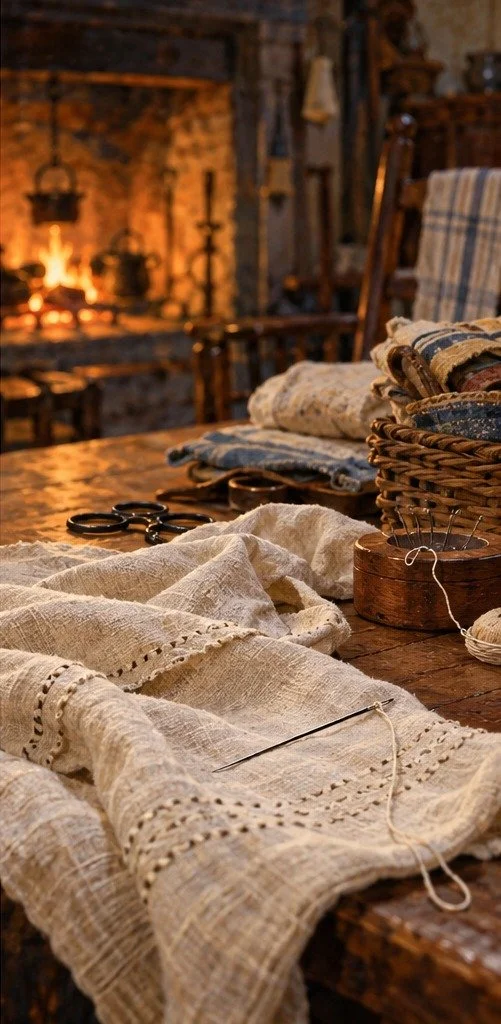
For those of us who sew, quilt, embroider, and spend an unreasonable amount of time contemplating what can be made from the fabric already in our possession, the question of handmade gifts is particularly interesting.
Were colonial women spending December making presents for their families?
Not necessarily.
The modern tradition of exchanging Christmas gifts among family members, particularly the elaborate gift-giving centered on children, became considerably more prominent during the nineteenth century.
That does not mean colonial Americans never gave gifts.
In some communities, gift-giving traditions were associated with St. Nicholas Day, New Year's Day, or particular religious and cultural customs. Some wealthy children received small presents. Money, food, and other items also passed between people during the Christmas season.
But gift-giving often reflected social and economic relationships rather than the reciprocal family exchanges we recognize today.
Servants, apprentices, and enslaved workers might receive seasonal gratuities from people they served. These Christmas boxes represented an opportunity to obtain money or goods, although the custom also reflected the unequal relationships within colonial society.
The familiar scene of a family gathering around a decorated tree to exchange wrapped presents was not yet a defining feature of American Christmas.
Handmade objects, however, were certainly important.
Clothing, embroidered accessories, household linens, and other textiles represented considerable time, skill, and expense. Such objects might be made for practical use, personal enjoyment, sale, or as expressions of affection.
The distinction is that making things for the people around you was not necessarily a seasonal activity. For many households, it was part of the continuing work of daily life.
And perhaps that is where the most interesting connection to our own holiday sewing traditions begins.
Today, I might choose to make someone a quilt or an apron because I want to give them something useful and personal. I have sewing machines, specialized tools, commercially produced fabric, and the pleasure of deciding what I want to make.
A woman sewing in colonial America might have been working under very different circumstances. She could have been making something beautiful for enjoyment, earning money from her skills, fulfilling household responsibilities, or producing clothing because her family needed it. For an enslaved seamstress assigned to produce garments, the work was compelled rather than freely chosen.
The techniques may look familiar, but the circumstances surrounding the work could be entirely different.
That is worth remembering whenever we describe the past as a simpler time.
When Christmas Began to Change
So how did we get from a colonial season of dinners, visits, dancing, and community gatherings to a Christmas centered on decorated trees, children, and presents?
Much of that transformation occurred during the nineteenth century.
Historian Stephen Nissenbaum examined this change in his book The Battle for Christmas, describing how Christmas evolved in many American communities from a public celebration that could be noisy, rowdy, and occasionally disorderly into a more private, domestic holiday focused on family life.
Earlier Christmas customs sometimes involved groups visiting wealthier households and expecting food, drink, or money. Public merriment could challenge the usual boundaries of social class, and celebrations were not always appreciated by people who preferred a quieter holiday.
During the nineteenth century, growing middle-class ideals increasingly favored a Christmas centered on the home, children, charity, and expressions of family affection.
This change was influenced by several developments. Attitudes toward childhood and family life were changing. Urbanization altered social relationships, while industrialization expanded the availability of manufactured goods. Merchants recognized the commercial opportunities created by a holiday increasingly associated with giving presents.
Christmas traditions associated with German communities, including decorated trees and gifts for children, also gained wider acceptance.
Literature helped shape the developing holiday. Washington Irving's nineteenth-century Christmas stories presented nostalgic images of hospitality and celebration, while Charles Dickens's A Christmas Carol, published in 1843, emphasized generosity, compassion, and the importance of human relationships.
Gradually, the Christmas celebration moved toward the home, with children occupying a more prominent place in the festivities.
And gifts became increasingly important.
But it would be misleading to suggest that Americans simply abandoned meaningful gatherings in favor of buying presents.
For many nineteenth-century families, giving a present was itself a way of expressing affection. A book, toy, piece of clothing, or handmade object could communicate love and thoughtfulness. As the family became more central to Christmas celebrations, exchanging gifts became one of the ways people expressed the importance of those relationships.
Commercialization expanded alongside these developments, gradually making purchased presents more accessible and more prominent.
By the later nineteenth century, Christmas had begun to resemble the holiday we recognize today.
The tree, the family gathering, the children anticipating presents, and the expectation that Christmas would be a particularly meaningful domestic occasion were becoming familiar features of American life.
It was not simply that people had begun giving more gifts. The celebration itself had changed.
Did We Replace Connection With Gift-Giving?
This is the question I keep returning to as I read these historical accounts.
In Fithian's diary, the excitement surrounding Christmas had much to do with the gatherings people anticipated. There would be dinners, dances, visits, music, and opportunities to socialize with friends and neighbors.
Certainly, the celebrations reflected social standing, and they could involve considerable drinking, excess, and behavior that would not fit our romantic picture of an old-fashioned Christmas. Not everyone was included equally, and not everyone enjoyed the festivities.
Still, the gatherings themselves were important.
People looked forward to the occasions, the company, and the experiences they would share.
As Christmas became more domestic during the nineteenth century, gift-giving grew alongside the emphasis on family. Presents offered a way to express love and generosity, and there is something genuinely lovely about that tradition.
But I wonder whether, somewhere along the way, the effort devoted to giving presents began to compete with the time available to enjoy one another.
Think about how much preparation goes into a modern Christmas.
There are gifts to choose, purchase, make, wrap, and distribute. Decorations go up, meals are planned, schedules must be coordinated, and expectations seem to multiply with every passing year.
We devote an enormous amount of energy to creating a wonderful holiday for the people we love.
And sometimes, by the time everyone finally gathers, we're exhausted.
It would be easy to blame department stores, advertising, or the commercialization of Christmas. Those certainly played a role in shaping our expectations, but they do not explain everything.
We participate because we want to make the people around us happy. We give gifts because we love them. For those of us who make presents, the hours spent sewing, knitting, woodworking, baking, or creating something by hand are often part of the pleasure.
A handmade gift carries something of the maker into the finished object.
I don't think we've lost the desire for connection. Perhaps we have simply added so many expectations to the ways we express it that the celebration itself can become overshadowed.
And that is quite a different problem.
What the Past Might Teach Us About Christmas
I don't believe colonial Americans necessarily celebrated Christmas better than we do.
Their holidays were shaped by social class, religious disagreement, unequal labor, and expectations that could be every bit as demanding as our own. Some celebrations were lively and welcoming. Others were excessive, exclusive, or simply nonexistent.
And I certainly have no desire to exchange my sewing machines, electric iron, or kitchen appliances for eighteenth-century alternatives.
But I do find something worth considering in the way gatherings occupied such an important place in many recorded colonial celebrations.
The meal, the dancing, the music, and the opportunity to visit friends and relatives were events people anticipated. They weren't merely activities arranged around the exchange of presents.
They were the celebration.
In our family, we have a holiday tradition that involves making gifts for an exchange among my parents, siblings, and our families. Each person makes something, and the recipient is determined through a drawing. The gift is part of the fun, but so is the curiosity about what everyone has made and the experience of gathering together to exchange them.
I rather like that combination.
The making gives us an opportunity to put thought, time, and creativity into something for another person. The gathering gives us the chance to enjoy the people for whom those efforts were made.
Perhaps that is the balance worth preserving.
A gift does not have to compete with connection. At its best, it becomes another expression of it.
As I prepare for another holiday season, with sewing projects underway and more ideas than the calendar can comfortably accommodate, I find myself appreciating both sides of the tradition. I enjoy making things for people I love, and I look forward to the occasions when we are all together.
But I also wonder whether we might benefit from remembering that the success of Christmas cannot really be measured by the number of presents beneath a tree or how much we managed to accomplish before December 25.
The history of Christmas suggests that the ways we celebrate have changed considerably over the centuries. The decorations, customs, meals, and expectations have evolved, sometimes beyond recognition.
Yet the desire to gather with people who matter to us has remained a powerful part of the season.
Perhaps the most useful thing we can borrow from the past isn't a particular recipe, decoration, or holiday custom. Perhaps it's the reminder that the gathering itself can be enough to make an occasion special.
And if we happen to exchange a few handmade quilts along the way, I certainly won't argue against it.
Although I do suspect Philip Vickers Fithian would still be checking on the condition of his horse before accepting an invitation.
