
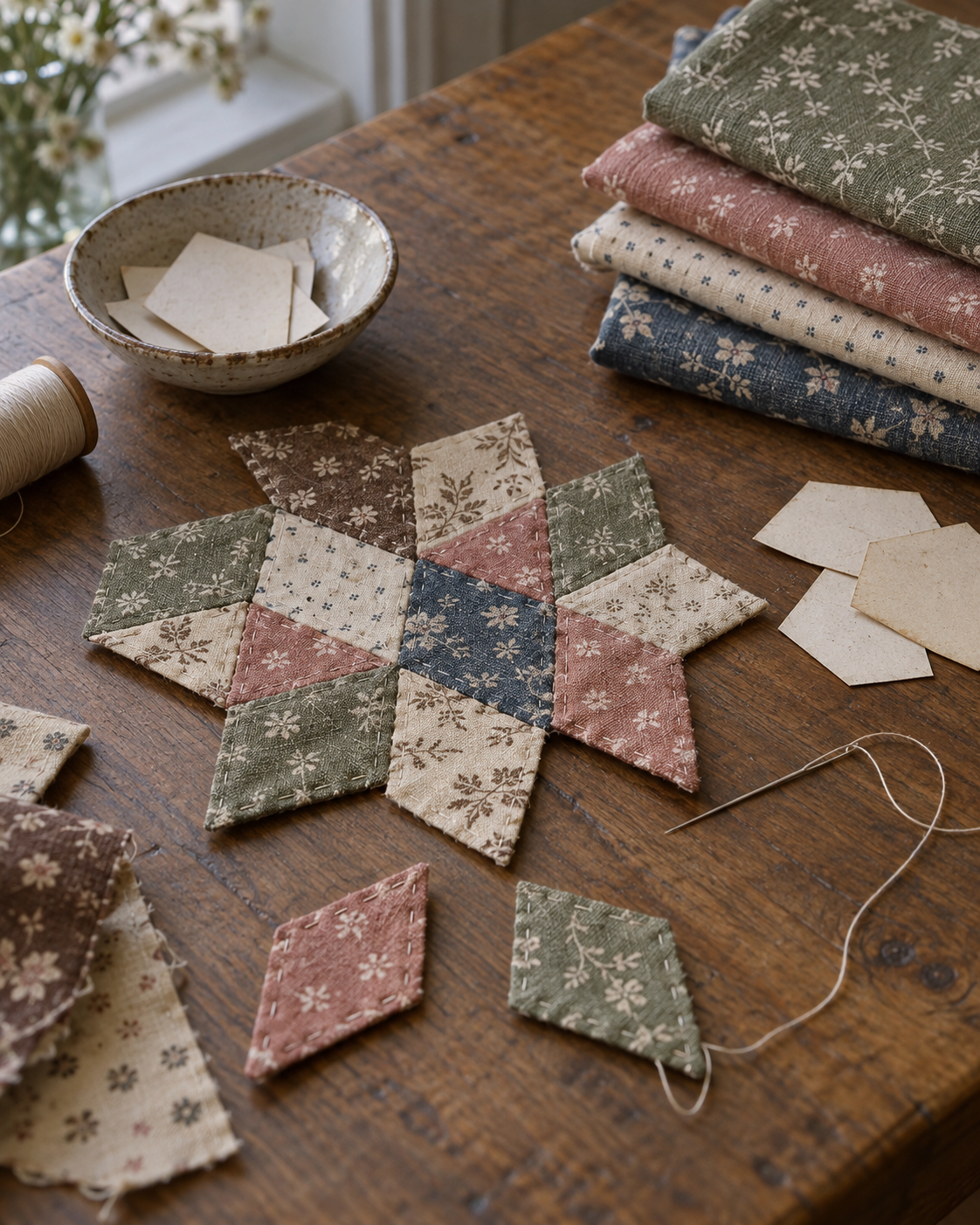
Jane Austen’s Other Work: The Patchwork Coverlet at Chawton
Jane Austen, her sister Cassandra, and their mother made a patchwork coverlet with more than 2,500 tiny diamonds in its border. I went looking for the story behind those fabrics and found myself wondering where the quilts we make today might end up two centuries from now.
**The image accompanying this article is an AI-generated illustration of diamond piecing, not a photograph of the Austen family coverlet. You can see the actual coverlet at Jane Austen’s House.
In May 1811, Jane Austen wrote to her sister Cassandra to ask whether she had remembered to collect pieces for their patchwork. They were, Jane said, “at a standstill.”I was delighted to find this in her correspondence. Not because I think Jane Austen and I had identical sewing lives—I own a rotary cutter and she wrote Pride and Prejudice—but because waiting on one particular fabric is a problem I recognize. I have plenty of fabric. That has never prevented me from deciding that the one piece I need is somewhere else.We cannot know for certain whether the patchwork mentioned in Jane’s letter is the coverlet that survives at Jane Austen’s House in Chawton. The museum connects the letter to the coverlet, which it attributes to Jane, Cassandra, and their mother. It dates the piece to around 1810. Jane Austen’s House The surviving piece is often called Jane Austen’s quilt. Strictly speaking, it is a patchwork coverlet: a pieced top with a cotton backing, but no batting between them and no quilting stitches holding layers together. I know. We have barely begun admiring it and I am already correcting what people call it. But the coverlet was complete with those two layers. The patchwork itself was the finished work. Textile conservator Kate Gill examined its construction.
The diamonds. So many diamonds.
A large diamond sits at the center, cut from fabric printed with birds and a basket of flowers. Around it are rows of smaller floral diamonds separated by narrow strips of spotted fabric. Then there is the border, made with more than 2,500 tiny diamonds, each with sides measuring about 30 millimeters. Jane Austen’s House I would like to know how the three women felt about that border by the time they reached the end of it. Unfortunately, the historical record has neglected the exact sort of detail I most want. Jane was willing to write that they had run out of pieces, but apparently did not leave us a full account of the emotional consequences of sewing diamond number 2,417.The design itself suggests they had a plan. The central arrangement has fourfold symmetry, and the border matches from top to bottom and side to side. Gill’s examination found that the symmetry extends to the placement of individual printed fabrics. That takes more than cutting whatever scrap happens to be handy and hoping it looks intentional later. I have tried that method. It has its limits. Jane Austen’s House; Kate Gill Conservation The museum identifies at least 64 different fabrics in the coverlet. Some are lightweight printed fabrics of the sort used for dresses, while the border also includes furnishing fabrics. The pieces were made by English paper piecing: fabric was secured around paper shapes, then the shapes were stitched together by hand. The museum describes stitches as small as about twelve to an inch.Those numbers tell us something about the time involved, but the arrangement tells us just as much about the women making it. They were considering color, print, repetition, and balance while working with the pieces available to them. Saving fabric could be practical. Making something beautiful from it still required choices.
The fabric had a life before the coverlet
Jane’s request to Cassandra gives us one possible source of new pieces. Cassandra was staying with their brother Edward’s family in Kent, where clothing made for his large household might have left useful remnants. That is a possibility noted by the museum, rather than a record of where any particular fabric came from. Jane Austen’s House Printed cotton was valuable enough that offcuts were worth keeping. It also had a history far beyond the Austen home. Cotton cloth circulating in England was connected to growing, manufacturing, trade, and colonialism. Jane Austen’s House discusses the wider cotton trade alongside the coverlet. We cannot trace every piece in this coverlet to its origin, but I would love to know where the Austen women found those prints. Which came from clothing, which were left over from furnishings, and which, if any, did Cassandra bring back from Kent? Two hundred years later, that trail is probably impossible to follow. Still, it makes me look at the individual fabrics, not just the finished design.That is one reason I enjoy studying old textiles. A single piece can be personal, practical, and beautiful while also carrying a much larger story about how people lived and what materials they could obtain.
What we can see—and what we cannot
We do not know exactly when the coverlet was begun or finished, or how Jane, Cassandra, and their mother divided the work. We cannot tell who planned the layout or who sewed the last diamond into the border.It is tempting to fill in those blanks. I can readily picture the three of them discussing prints, changing their minds, and disagreeing mildly over a placement before somebody decided it was fine where it was. That might have happened. It might also be me projecting my own sewing room onto theirs, and I have enough projects without taking responsibility for theirs too.The coverlet gives us plenty to examine without making up the conversation around it. Its seams and fabric placement are still there. Even its changing colors tell part of the story. Gill found that some dyes have faded with exposure to light, while protected areas on the back retain brighter color. The coverlet the Austen women saw was not quite the one we see now. Kate Gill Conservation And that may be the detail I find most fascinating: we can still see it at all. Something made in their home more than two hundred years ago has lasted long enough for us to study their fabric choices and their stitches. I wonder whether they ever considered that possibility. Most of us are occupied with getting a project finished, washing it, giving it away, or deciding whether the binding looks all right. We are rarely planning for a museum conservator to inspect the back.It makes me wonder where the things we are sewing now will end up. A quilt might wear out from years of being used and loved. It might be passed to a grandchild, spend decades in a closet, or turn up in the hands of someone who has no idea who made it. Perhaps a little of its story will travel with it. Perhaps someone will have to look closely at the fabric and stitches and make their best guess.Jane Austen left us novels that tell us a great deal about how she observed people. Her family’s coverlet shows us decisions made with fabric: what to save, what to place beside something else, and how to keep working when the pieces they needed had not arrived. I can’t know where the quilts in my sewing room will be two hundred years from now. I do like imagining that one of them might make somebody curious enough to look closer.If you’d like the wider picture of sewing and patchwork in Austen’s time, I wrote about it in Quilting 250 Years Ago.
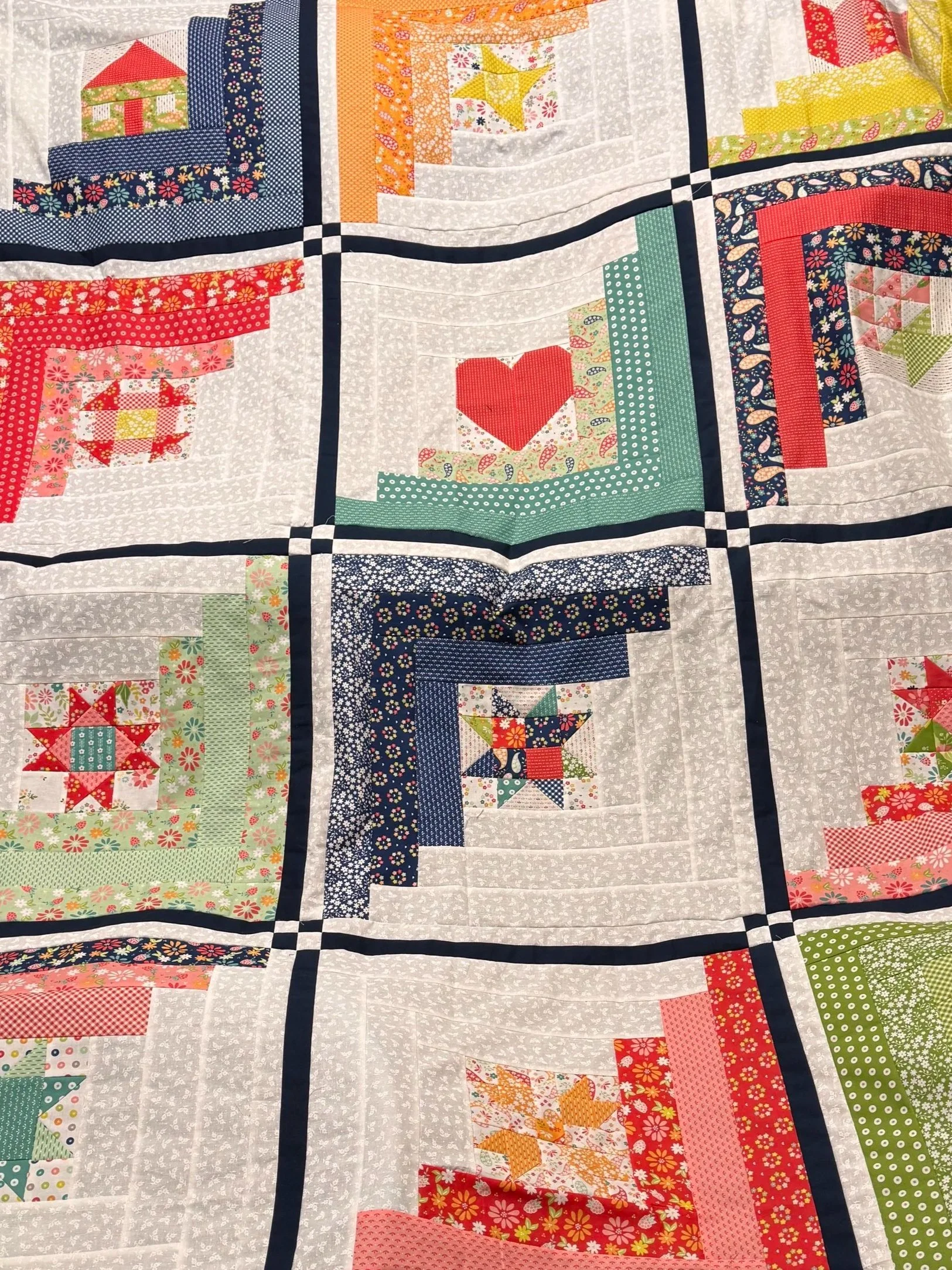
Before It Was a Log Cabin: The History of a Block Built from the Center Out
The Log Cabin may have an American name, but its center-outward design belongs to a much older human story. Follow this remarkably versatile block from ancient geometry and Manx patchwork to Lincoln, Civil War fundraising and the unverified tradition of black-centered quilts marking Underground Railroad safe houses.
The Log Cabin block begins with a square.
Around that square, the maker adds one strip, then another, turning the block and working outward until something much larger has grown from the original center. It is a beautifully simple construction, although “simple” should not be confused with dull. Rotate the finished blocks and they form Barn Raising, Straight Furrow, Streak of Lightning, Sunshine and Shadow, or one of the many other arrangements quilters have discovered within the same basic design.
Few blocks have done so much with such uncomplicated geometry.
At first glance, the Log Cabin also appears to be one of the most thoroughly American patterns in quilting. Its strips became logs, its center became the hearth, and its name evoked pioneer cabins, westward settlement and Abraham Lincoln. It is difficult to imagine anything more comfortably wrapped in the American story unless someone stitched an eagle into the corner and served it with apple pie.
The construction itself, however, may be much older than the name.
Beginning at the Center
Long before anyone called this a quilt block, people were organizing objects and spaces around a center. Stonehenge contains circular and horseshoe-shaped arrangements of stones around a central area. Baskets were coiled outward from a beginning point. Ancient key patterns turned straight lines around themselves to create squared spirals. Buildings enclosed courtyards, mosaics surrounded central images with successive borders, and textile makers used repeating lines to lead the eye inward or outward.
None of these is an early Log Cabin quilt, nor do they prove that the block descended from Stonehenge, ancient basketry or Celtic art. They demonstrate something more basic: beginning in the middle and building outward is one of humanity’s oldest and most natural approaches to design.
That distinction matters because the Log Cabin has more than one possible beginning. Its underlying geometry is ancient and widespread. Its development as a strip-pieced textile method is difficult to trace and may have occurred in more than one place. Its familiar name and the American stories attached to it belong mainly to the nineteenth century.
When the Pattern Became a Cabin
The earliest American references identified by quilt historians appear during the Civil War.
At the 1863 Ohio State Fair, a Cleveland quiltmaker received special commendation for a “log cabin quilt.” In June 1866, an Iowa diarist known only as Abbie recorded going to town to purchase fabric for her Log Cabin. The following month, she wrote that she was working on it. Quilt historian Barbara Brackman credits researcher Virginia Gunn with identifying these early references.
The entries do not tell us when the first strip was ever sewn around a square. They tell us that by the 1860s, Americans recognized the construction by the name Log Cabin.
The timing gave that name particular weight. William Henry Harrison’s 1840 presidential campaign had already turned the log cabin into a political symbol of humble origins. Abraham Lincoln, born in a Kentucky log cabin in 1809, became even more closely associated with that image when he ran for president twenty years after Harrison.
As the quilt pattern rose to prominence during the Civil War, the cabin could suggest home, self-reliance, frontier endurance, Lincoln and loyalty to the Union. In 1864, a Pittsburgh fundraiser offered a Log Cabin quilt to raise money for hospitalized Union soldiers. That does not mean every woman making one was sewing a political declaration. She may simply have liked the pattern. Quilters were presumably allowed to make attractive things without issuing a public statement through every seam.
Still, the Civil War setting helps explain why this particular name took hold. The block arrived at exactly the right moment to become part of an American national story. Its popularity continued as the country approached its centennial in 1876, when the cabin offered a tidy image of how far the nation believed it had traveled—from rough frontier beginnings to modern prosperity. The Huntington’s history of a Log Cabin quilt places the pattern within this Civil War and centennial setting.
America’s relationship with the Log Cabin is therefore genuine. What is less certain is whether America invented the textile construction it named.
A Roof Before a Cabin?
On the Isle of Man, a related form of strip patchwork is traditionally known as the Roof Pattern. It is made by sewing folded strips to a foundation and working outward from a center. At first glance it looks like a Log Cabin, but the traditional construction is distinctive. The maker could use measurements taken from her own hand rather than a ruler. Each strip was folded to form a narrow pleat, concealing the larger hand stitches while adding weight and thickness. The foundation remained in the finished block, and traditional examples were often made without a separate layer of batting.
Modern accounts sometimes date the earliest surviving Manx patchwork to approximately 1820. That date is repeated frequently, although accessible documentation establishing the provenance of those early pieces is limited. We can confidently say that the Manx Roof Pattern is a regional method of building strips around a center. We cannot confidently draw a straight line from the Isle of Man to the American Log Cabin.
Related quilts also appear in Ireland. Irish quilt researcher Roselind Shaw has documented a wool-and-flannel Log Cabin quilt from Islandmagee, County Antrim, dated to approximately 1885. The Ulster Folk Museum confirms that Log Cabin quilts made from narrow strips of wool, cotton or silk became popular in Ulster.
Did Irish immigrants carry an older version of the construction to America? Did the American pattern later cross the Atlantic in the opposite direction? Did textile ideas circulate back and forth through Ireland, Britain, the Isle of Man and North America? Or did makers in several places independently discover the very practical idea of sewing strips around a center?
At present, the evidence cannot choose among those possibilities.
German-speaking immigrants brought rich textile traditions to America too, particularly linen weaving and woven coverlet making. Their descendants created many remarkable geometric quilts. However, no firmly dated German example has established that immigrants carried this particular block from Germany. A Log Cabin quilt made by a woman with German ancestry tells us who made that quilt, not where the pattern originated.
The most honest history is therefore not a tidy claim of invention. It is a story of an intuitive design appearing in related forms, traveling under different names and becoming especially popular in nineteenth-century America.
We saw an ancient arrangement, gave it an excellent frontier name and made it part of the national identity. Very on-brand.
What Was in the Center?
The center square eventually accumulated stories of its own.
A red center is often described as the hearth or heart of the cabin. Yellow may represent a light glowing in the window. Black has been associated with mourning, secrecy and, most controversially, the Underground Railroad.
Those interpretations may have mattered deeply to some makers, but they were not universal rules. A center square could commemorate a person, express a political loyalty or carry a meaning understood within one family. It could also be the scrap nearest the maker’s hand.
Unless the quiltmaker explained her choice, the finished quilt cannot tell us why she selected a particular color. A red center does not prove she was thinking about a hearth, and a black center does not prove she was signaling a safe house.
Sometimes a scrap is a symbol. Sometimes it is simply the scrap that fit.
The Black Center and the Underground Railroad
According to a popular Underground Railroad tradition, a Log Cabin quilt with a black center was displayed to identify a safe house. The story became widely known through Jacqueline Tobin and Raymond Dobard’s 1999 book, Hidden in Plain View. The book grew from conversations with Ozella McDaniel Williams, an African American quiltmaker and retired school administrator who said a quilt code had been preserved through her family’s oral history.
Williams’s account deserves to be treated respectfully. Oral history is important, especially when researching people whose experiences were poorly represented in written records. A secret practice shared within one family or community might never have appeared in a newspaper, diary or abolitionist report. The absence of written evidence does not make localized use of a quilt impossible.
It does prevent us from presenting an extensive quilt code as established history.
Williams’s account has not been independently confirmed through another family line, a named ancestor connected to the code, a dated family quilt or a contemporary firsthand record. Some of the pattern names included in the proposed code were not documented until after slavery ended.
The National Park Service administers the National Underground Railroad Network to Freedom, which documents and interprets verified Underground Railroad history. Its historians report that no firsthand account has yet been found describing freedom seekers or their allies using a quilt code. National Park Service Underground Railroad FAQ
A black-centered quilt may have identified a safe house somewhere. A family Bible, letter or oral history still waiting to be discovered could change what we know.
Check your genealogy, folks. I need answers.
For now, the most accurate conclusion is that the story is possible but unverified. More importantly, a black center by itself cannot tell us what its maker intended.
A Pattern Larger Than Its Name
The history of the Log Cabin is interesting precisely because it refuses to fit inside one little box.
Its basic geometry—beginning with a center and building outward—is far older than quilting. Its development as a strip-pieced textile construction remains uncertain and may have occurred in several places. Its American name emerged during the Civil War era, when the log cabin was already associated with humble beginnings, Abraham Lincoln and the national imagination.
From that simple construction came extraordinary variety. By turning the blocks, changing the placement of light and dark fabrics, varying the width of the strips or shifting the center away from the middle, quiltmakers could create movement, pathways, zigzags, diamonds and fields of light. One block could be restrained and orderly or wonderfully unruly without ceasing to be recognizable.
Perhaps that is why it has lasted. The Log Cabin allows a maker to begin with one small piece and build around it, adding what she has until a larger structure appears. The center can hold meaning—or none at all. The fabrics can be carefully selected or rescued from worn clothing. The finished quilt can carry a national story, a family story or simply the quiet evidence that someone found beauty in a pile of scraps.
America may keep the name Log Cabin. It is a good name, and after more than 160 years we have earned some attachment to it. But the pattern beneath that name—the simple act of beginning with a center and building outward—belongs to a much older and far larger human story.
~Chris
When Flour Came Wrapped in Fabric
Feed-sack dresses were not made from the rough burlap I had imagined. They were sewn from reusable cotton commodity bags that once held flour, sugar, livestock feed, and other necessities. Here is how household thrift, skilled sewing, and clever marketing turned everyday packaging into clothing, quilts, and household goods.
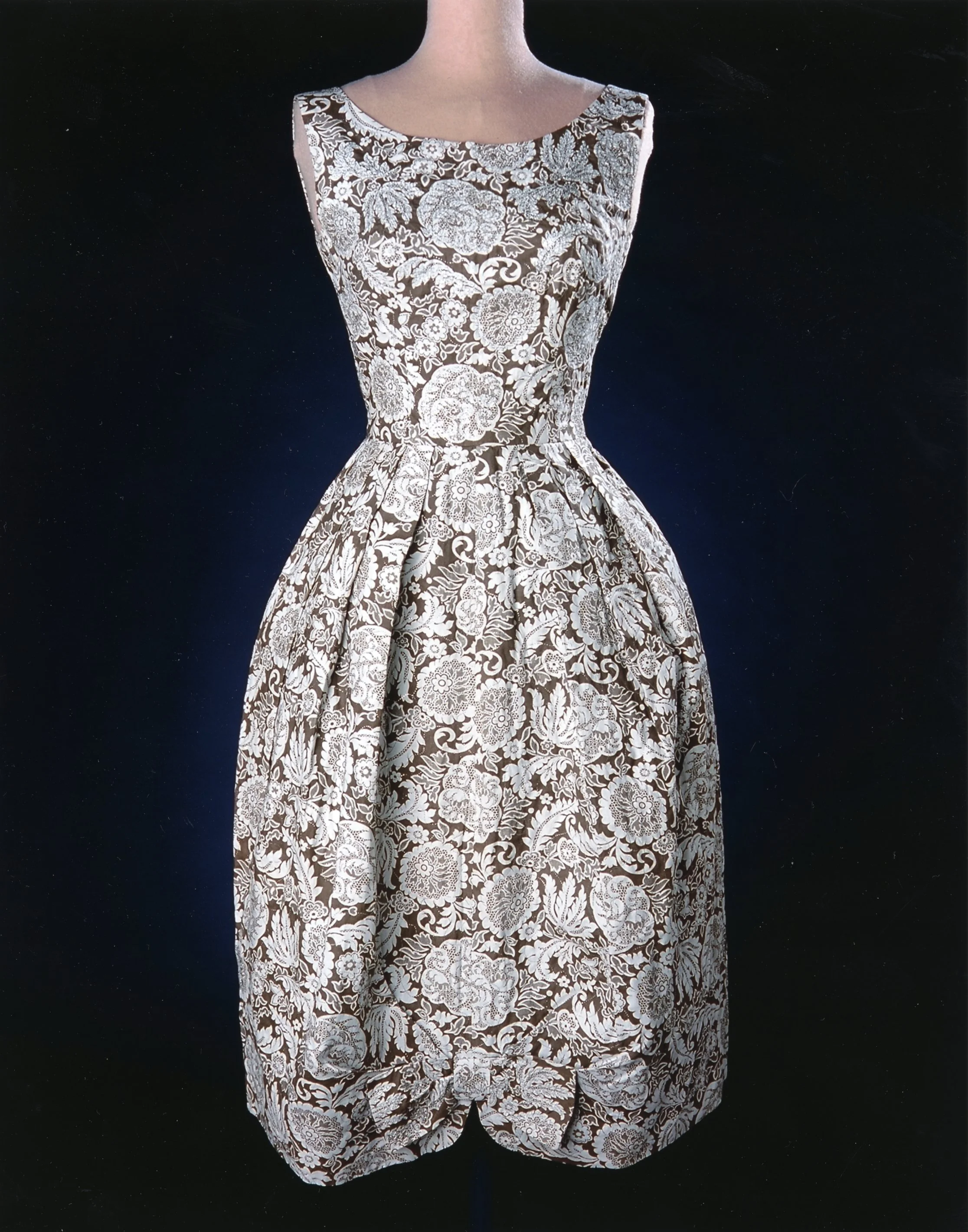
Feed-sack dress made by Mrs. Dorothy Overall in 1959 for the Cotton Bag Sewing Contest. Courtesy of the National Museum of American History, Smithsonian Institution. Public domain.
*Feed-sack dress made by Mrs. Dorothy Overall in 1959 for the Cotton Bag Sewing Contest. Courtesy of the National Museum of American History, Smithsonian Institution. Public domain.
When I first heard about feed-sack dresses, I immediately wondered how anyone could bear to wear one. The only commodity sacks I knew were made from burlap, and a burlap dress sounded less like resourceful sewing and more like punishment.
I was not around when flour, sugar, and livestock feed came in cotton sacks. By the time I arrived, those products were packaged in paper, plastic, or the coarse burlap sacks I had seen. I assumed the dresses I had heard about were somehow made from that same rough material.
They were not.
The feed-sack dresses and quilts I had been reading about were made from woven cotton, not the rough burlap I had imagined. Some sacks were plain, while others were printed with the small florals, dots, plaids, stripes, and novelty designs we now associate with fabrics from the 1930s and 1940s. Once the seams were opened and the sacks were washed, they became usable pieces of cloth.
That discovery made feed-sack dresses considerably easier to understand. It also led me into a much more interesting history involving household necessity, skilled sewing, and manufacturers that eventually realized the fabric surrounding their product could help sell what was inside it.
Before Feed Sacks Became Pretty
During the nineteenth century, cloth bags gradually replaced the wooden barrels traditionally used to ship dry goods. They were lighter, easier to transport, and still useful after the contents had been consumed.
Although we commonly call them feed sacks, they held far more than livestock feed. Flour, sugar, salt, rice, seed, fertilizer, and other dry goods were packaged in cotton bags. The International Quilt Museum uses the broader and more accurate term cloth commodity bags for sacks used to package these different products.
Long before manufacturers began printing cheerful designs on them, women were saving the plain cotton bags. Once the contents were gone, the sacks were washed, opened along the seams, and put back to work. Some became dish towels or curtains. Others became underwear, quilt backs, and clothing.
The earliest cotton sacks were usually white or cream and printed with the name of the mill, the contents, or the weight of the product. Those markings had to be soaked, scrubbed, bleached, covered, or carefully positioned when the fabric was cut.
No child needed to advertise a flour mill while walking to school.
Women were reusing these bags well before the Great Depression. The financial hardship of the 1930s made the practice more important and more widespread, but it did not create it. What changed during the early twentieth century was the appearance of the sacks—and the manufacturers’ understanding of who was choosing them.
When the Fabric Began Selling the Flour
Manufacturers eventually realized that women were not simply using the sacks after the flour or feed was gone. The fabric itself could influence which product a family purchased.
By the 1920s, and increasingly during the 1930s and 1940s, companies began offering sacks made from printed cotton. Small florals, dots, stripes, plaids, geometrics, novelty prints, and border designs appeared. Some manufacturers used inks that were easier to remove or switched to paper labels that could be soaked off.
The familiar version of this history says that manufacturers noticed families struggling during the Depression and began using prettier fabric to help them. The printed sacks were certainly useful, but this was also a very effective marketing decision.
A sack of flour might be necessary. A sack of flour packaged in fabric that coordinated with a woman’s current fabric stash was much more appealing.
One sack was rarely enough to make an entire garment. Depending on the size of the sacks and the person wearing it, a dress might require several matching bags. Curtains, bedding, and adult clothing could require even more.
Women searched through available sacks for matching or coordinating prints. Neighbors could also trade sacks when someone needed another piece of a particular design.
This gave families a reason to continue purchasing the same brand. The flour inside might be perfectly acceptable, but if another company offered a print that completed the dress already underway, the packaging could determine what went home.
Manufacturers responded by offering more designs and promoting the many things that could be made from them. Pattern companies and textile-bag organizations published sewing ideas that explained how many sacks different projects required and how to prepare the fabric for use.
Women had found value in material that began as packaging. Manufacturers discovered that value could sell more flour.
The Fabric Was Useful, but It Was Not Effortless
Feed-sack fabric is sometimes described as free because the family needed to purchase flour or feed anyway. The fabric did not require a separate trip to the store, but turning it into clothing or a quilt still required considerable work.
The household first had to acquire enough sacks. Farm families purchasing large quantities of animal feed may have accumulated fabric more quickly than families buying smaller bags of flour, sugar, or salt. Finding enough matching fabric could require repeated purchases, searching, saving, and trading.
The sacks then had to be emptied, washed, and opened. Heavy stitching held them together, and removing it could leave a row of small holes along the edges. Labels and logos had to be washed away, hidden within seams, or avoided when the pieces were cut.
Only then could the sewing begin.
Women selected patterns, matched prints, fitted garments, added collars and trims, embroidered plain fabric, and arranged scraps into quilts. They were not simply cutting holes into an empty sack and pulling it over someone’s head.
Many surviving feed-sack dresses are so carefully made that nothing about them immediately reveals where the fabric began. They look like garments made from the small floral and geometric cotton prints popular at the time—which is precisely what the sack manufacturers intended.
Even so, wearing feed-sack clothing could carry embarrassment. For some families, it was an obvious sign that new fabric was unaffordable. Children could be teased, and women often took great care to remove any markings that disclosed the material’s original purpose.
The pretty prints are part of the history, but so is the necessity behind them. These women were not participating in a charming repurposing trend. They were clothing their families and furnishing their homes with the materials available to them.
Their work required judgment, planning, and sewing skill. It also changed the market. Manufacturers produced more desirable sacks because women’s preferences influenced which products families bought.
Feed Sacks Outlasted the Depression
Feed-sack sewing is so closely associated with the Great Depression that it is easy to assume the practice ended with the 1930s. It did not.
Cotton sacks became especially useful during World War II, when wartime demand created textile shortages and families were encouraged to conserve and reuse materials. They continued to be used throughout the 1940s and 1950s, particularly in rural communities.
The Smithsonian’s National Museum of American History owns a flour-sack dress made in 1959. Its collection also includes a flour-sack bassinet quilt dated between 1950 and 1969.
This makes dating a quilt by its feed-sack fabric difficult. A sack manufactured in the 1930s might have remained in someone’s sewing supplies for years before becoming part of a quilt. A dress could be worn until it was no longer useful and then cut into pieces for another project.
Quilters have storage skills historians do not always account for.
Paper bags, plastic packaging, and new methods of bulk transportation eventually replaced most cotton commodity sacks. The newer packaging was cheaper, but families no longer received a useful piece of fabric along with something they already needed to purchase.
Is It Really Feed-Sack Fabric?
Once I understood that the feed-sack dresses I had read about were made from cotton rather than burlap, another question followed: How can anyone tell whether a piece of vintage fabric actually came from a sack?
Sometimes the answer is obvious. An intact sack may still have its original seam, chain stitching, label, product markings, or the name of the mill printed on it.
An opened sack may retain a row of tiny holes where the heavy needle passed through the fabric. The State Historical Society of North Dakota uses these holes as one clue when identifying flour-sack textiles in its collection.
Once those edges were trimmed away and the fabric was cut into clothing or quilt pieces, much of the evidence disappeared. Feed-sack prints can look very similar to other cotton fabrics manufactured during the same period. Unless the family preserved the history of the fabric, a small floral scrap may be difficult to identify with certainty.
Not every vintage print in an old quilt once held flour or chicken feed. It may have the correct age, weave, and style, but without stitching holes, markings, or a known history, there is room for doubt.
What Is the Modern Feed Sack?
There is no exact modern replacement for printed feed sacks. Products may still be sold in cloth bags, and we still have items called flour-sack towels, but neither provides several yards of printed cotton along with an ordinary household purchase.
The closest comparison may be the fabric already passing through our homes.
Sheets can become quilt backs. Worn cotton shirts can become quilt blocks. Old jeans can become bags. Clothing that no longer fits can be altered or taken apart and made into something entirely different.
The connection is not the particular type of fabric. It is the decision to look at material that has finished one job and consider whether it can perform another.
That idea feels especially relevant now. Fabric is expensive, many households are looking for ways to reduce spending, and some of us already own enough material to remain productive for quite some time.
The women who sewed with feed sacks were responding to the cost of living, the materials available to them, and the needs of their families. They did not merely tolerate the fabric. They selected prints, planned projects, exchanged sacks, and used considerable skill to turn packaging into clothing, quilts, and household goods.
I began this history imagining women enduring dresses made from burlap. Instead, I found cotton prints, carefully constructed garments, very effective marketing, and another example of women recognizing possibilities in a material that might otherwise have been discarded.
The cotton sacks may be gone, but the question behind them remains useful:
What do I already have, and what can I make from it?
Sources and Further Reading
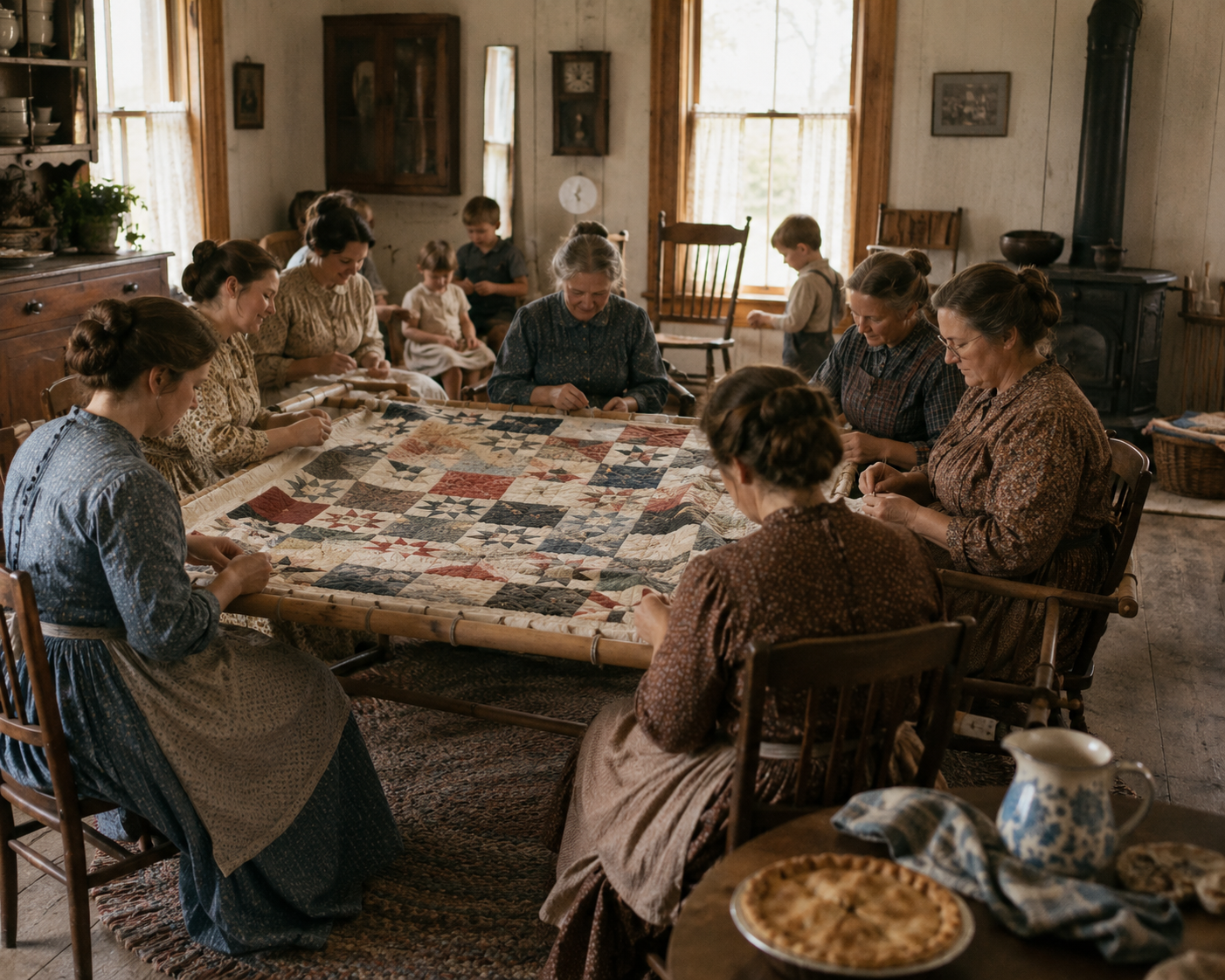
When Quilting Bees Brought Communities Together
Quilting bees were about far more than finishing quilts. Long before social media, neighbors gathered around a quilt frame to share news, teach skills, celebrate milestones, and support one another through life's joys and hardships. This week's Quilting History explores how these gatherings stitched communities together—and why their legacy still lives on today.
Last week, I mentioned that today’s history post would head in a different direction. We will get there, but after the week I have had, this story felt more appropriate. Sometimes the best thing about history is the reminder that people have always needed one another, and quilting bees are a wonderful example of how communities once gathered, worked, talked, and cared for each other around a quilt frame.
For many of us, the words quilting bee bring to mind a group of women sitting together, quietly stitching while coffee and pie wait nearby. That picture is not entirely wrong, but it is incomplete. Quilting bees were practical work gatherings, social occasions, teaching spaces, and important parts of community life. In isolated rural areas, they gave people a reason to come together and offered a chance to exchange news, share skills, and help a neighbor complete a large job.
Before sewing machines and longarm quilting, finishing a quilt required an enormous amount of handwork. Once a quilt top had been pieced, the layers had to be assembled and quilted with thousands of stitches. One person could do it alone, but it might take weeks or months. A group of experienced quilters gathered around a frame could complete much of the work in a day, especially when the quilting design was simple and everyone knew what she was doing.
The gathering usually began because a quilt needed to be finished, but the work was only one part of the day. Neighbors brought food, children came along, and conversations continued while hands stayed busy. People shared family news, recipes, gardening advice, sewing techniques, and updates about illness, births, deaths, weddings, and local events. In communities where homes were far apart and travel was difficult, these gatherings helped people remain connected.
Quilting bees were also places where knowledge was passed from one generation to the next. Younger quilters learned how to space stitches, mark designs, manage tension, and work efficiently at the frame. They also learned the habits and traditions of the women around them. Much of this information was never written down. It was demonstrated, corrected, repeated, and remembered.
The social importance of quilting bees should not be overstated or romanticized. The work could be tiring, the expectations placed on women were often demanding, and not every gathering was warm or harmonious. Quilting bees were made up of real people, which means there was likely friendship, laughter, judgment, gossip, disagreement, and the occasional person whose stitches were probably discussed after she went home.
They also did not look the same in every place or community. Some were organized to finish a bride’s quilt before her wedding. Churches and charitable groups made quilts for families facing illness, poverty, or disaster. Communities gathered to sew for soldiers during wartime, while immigrant families brought quilting and textile traditions shaped by their own cultures and experiences. African American, Indigenous, European American, and other quilting communities developed different practices depending on available materials, regional customs, and family traditions.
Although women generally did the quilting, a bee could become a larger family or neighborhood event. Children played nearby, meals were shared, and the evening might include music, games, or visiting after the sewing was finished. In areas with few opportunities for recreation, a quilting bee offered both productive work and a welcome break from the isolation of daily life.
Modern quilters may not need a roomful of neighbors to finish a quilt before winter, but the desire to gather has not disappeared. We find each other through guilds, retreats, quilt shops, classes, sew-alongs, church groups, and online communities. The setting is different, and most of us are no longer leaning over the same wooden frame, but we still share patterns, techniques, family stories, advice, encouragement, and opinions about fabric.
That may be the most enduring part of the quilting bee. Quilts have always been useful objects, but the making of them has also created opportunities for friendship and support. The quilt may have been the reason people gathered, but the relationships built around it were often just as important.
Next week, we will return to the topic I had originally planned. This week, however, a little history about people showing up for one another felt like the better place to pause.
~Chris
The Beautiful Chaos of Victorian Crazy Quilts
Victorian crazy quilts turned irregular scraps, luxurious fabrics, and elaborate embroidery into richly layered works of textile art. This week, I’m exploring how the style developed, why its apparent chaos required real skill, and why my already ambitious WIP list kept me from starting one of my own—for now.
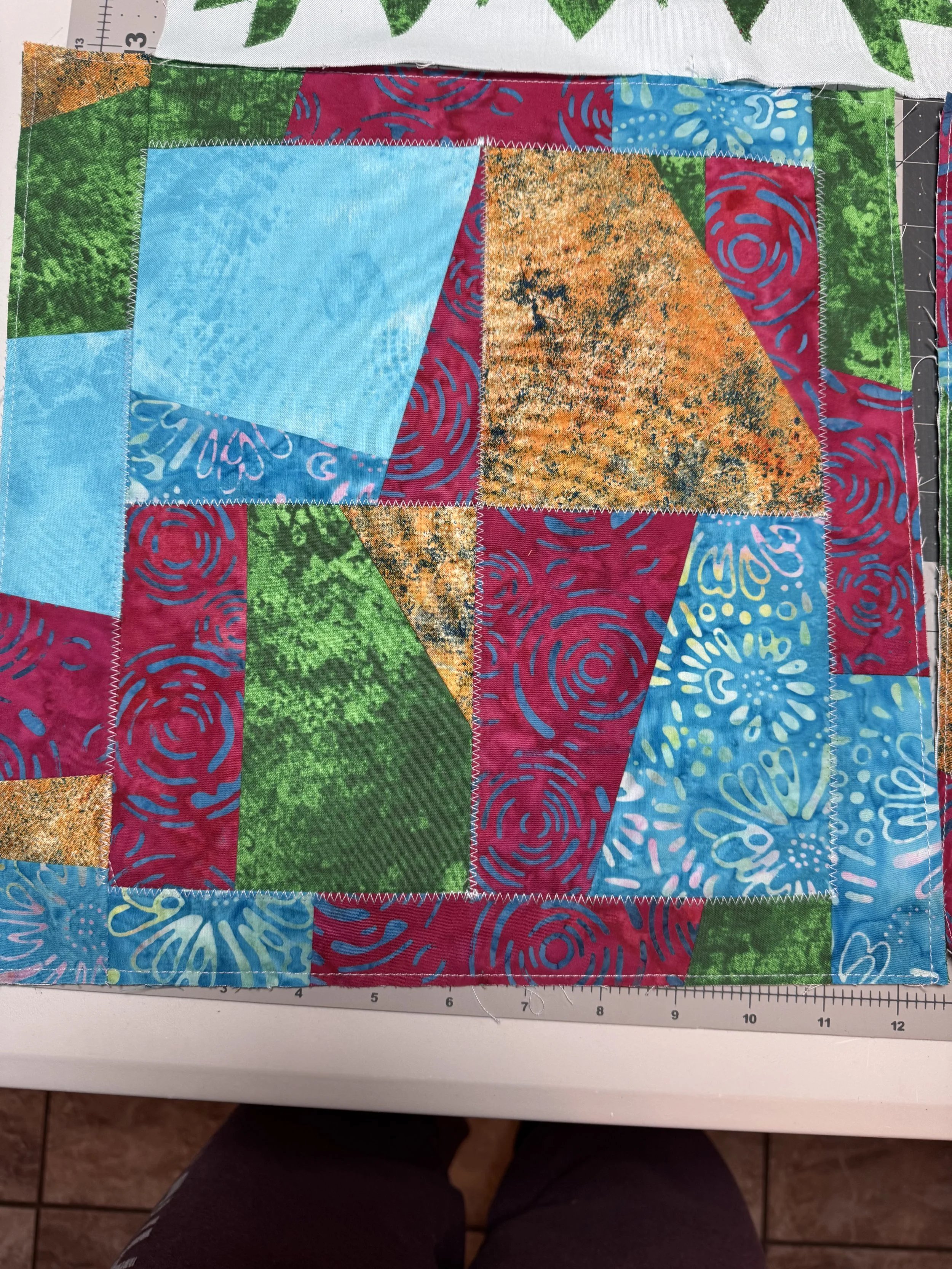
Photo caption: One of my improvisational quilt blocks. They are not traditional crazy quilt blocks, but their irregular piecing and decorative stitching (which is not completed) offer a small glimpse of the freedom that makes crazy quilting so appealing.
When Breaking the Rules Became an Art Form
Last week, we explored Baltimore Album quilts, where carefully planned appliqué, balanced blocks, and remarkable precision were very much part of the appeal. Victorian crazy quilts moved in an entirely different direction. Instead of orderly repetition and matching shapes, they embraced irregular pieces, lavish embellishment, and the general belief that when it came to fabric, thread, ribbon, beads, and embroidery, more was probably better.
Welcome to the wonderfully unruly world of crazy quilting.
High-style crazy quilts emerged during the last quarter of the nineteenth century and became a major needlework trend during the 1880s. Their makers combined influences from Japanese art and design, English embroidery, popular imagery, and the richly decorated interiors of the Victorian era. Magazines encouraged women to make increasingly elaborate examples, while newspapers and periodicals also criticized the craze as excessive, frivolous, or evidence of poor taste.
More Art Than Bed Quilt
When we hear the word quilt, most of us picture something made to cover a bed and keep someone warm. Many Victorian crazy quilts, however, were intended primarily as decorative objects. The finest examples were often smaller parlor pieces, displayed across furniture or placed where visitors could admire the maker’s fabrics, embroidery, and artistic skill.
Interestingly, many early crazy quilts were not technically quilted in the way we usually use that word. Their irregular patches were commonly sewn onto a foundation fabric and then backed with a lining, but they often contained no batting and were rarely quilted through all the layers. Some were tied instead. American makers frequently constructed smaller sections or blocks and then joined them to create the larger piece.
The high-style versions used an astonishing variety of materials. Silks, satins, brocades, velvets, ribbons, wool suiting, calico, and even cigar ribbons might all find their way into the same textile. The industrial growth of the late nineteenth century made a much wider selection of manufactured fabrics available, giving makers access to colors, textures, and novelty materials that earlier generations could not have imagined.
Naturally, piecing together mismatched velvet, silk, lace, and ribbon was only the beginning.
The seams might be covered with feather stitches, herringbone stitches, French knots, and other decorative embroidery. Makers added flowers, vines, birds, fans, animals, initials, dates, buildings, political figures, and personal symbols. Lace, metallic thread, beads, sequins, shells, tassels, painted details, commercial appliqués, and photo transfers could all become part of the design.
Some crazy quilts served almost like textile scrapbooks, preserving pieces of clothing, commemorative ribbons, signatures, family memories, and small clues about the people who made them.
By the mid-1880s, the craze had become popular enough that manufacturers offered precut silk kits, marked foundation fabrics, embroidery patterns, transfer designs, and decorative pieces created specifically for crazy quilts. Evidently, the Victorian era had its own version of the quilt kit—and quilters were just as susceptible to it as we are.
Where Did the “Crazy” Come From?
The word crazy did not simply mean that the maker had abandoned all reason and attacked the scrap basket.
The name was associated with the cracked or “crazed” appearance of the irregular lines, much like the fine cracks seen in ceramic glazes. Asymmetrical patterns, broken-looking geometric lines, and unexpected compositions were also associated with Japanese design, which attracted widespread attention in the United States following the 1876 Centennial Exposition in Philadelphia.
Japanese art offered Western audiences a very different approach to composition. Designs did not always depend upon centered motifs, mirror-image balance, or orderly repetition. Natural forms, asymmetry, empty space, and unexpected angles could create their own kind of harmony. Those ideas appeared throughout the decorative arts of the period and became part of the visual language of crazy quilting.
That does not mean every crazy quilt looked the same or followed one exact formula. The most elaborate Victorian examples represent what historians often call the high-style crazy quilt, but crazy patchwork could be made from humble fabrics as well as luxurious ones. The materials, construction, and amount of embellishment varied widely. What connected them was an appreciation for irregularity, varied texture, asymmetry, and decoration that did not need to justify itself by being especially useful.
Crazy, but Not Random
At first glance, a crazy quilt can look as though someone emptied several scrap baskets onto the floor, added every spool of embroidery thread in the house, and decided to see what happened.
The longer you study one, however, the more intentional it becomes.
The shapes may be irregular, but the maker still had to consider color, contrast, scale, and movement. Heavy areas needed to be balanced with quieter ones. Velvets and dark fabrics reflected light differently from silk and satin. Embroidery helped lead the eye from one section to another, while small motifs created places to pause and look more closely.
The apparent disorder often concealed careful planning and a strong understanding of composition. Crazy quilting may have broken the traditional rules, but it did not eliminate skill. It simply required a different kind of skill.
My Turn at Breaking the Rules
One of the things I have enjoyed most about writing this quilt-history series is that it keeps introducing me to techniques I might not otherwise explore. Crazy quilting is one of those techniques, and with the current heat wave keeping me firmly indoors, this would have been the perfect time to make my first Victorian-inspired crazy quilt block.
Unfortunately, I also have a rather ambitious WIP list already competing for my attention. Adding another project—no matter how tempting—simply did not make the cut.
Making the kind of block I wanted to make, with foundation piecing, decorative embroidery, and enough embellishment to properly explore the style, would have required time I was not willing to take away from the projects already waiting on my sewing table. Apparently, even creative freedom has to wait its turn behind the WIP list.
Instead, I am sharing two improvisational blocks I had already made. They are not crazy quilt blocks, and I do not want to present them as though they are. They do, however, offer a general idea of what can happen when repeated patterns and predictable shapes are set aside in favor of irregular pieces, unexpected angles, and decorative stitching.
Making them reminded me that “random” is not necessarily effortless. Years of traditional piecing have trained my brain to look for balance, alignment, and some kind of underlying order. Even when I am intentionally working in an improvisational style, I still catch myself trying to make everything behave.
Apparently, old quilting habits die hard.
The more I have learned about Victorian crazy quilts, the more I appreciate just how much work went into them. The piecing was only the foundation for layers of embroidery, texture, imagery, and personal detail. These were not simply scraps thrown together without a plan. At their best, they were carefully composed works of textile art.
I still intend to give crazy quilting a proper try someday. When I do, I want enough time to enjoy the decorative stitching and embellishment instead of rushing through it simply because I promised myself a block for a blog post. For now, the WIP list wins—but crazy quilting has officially been added to the someday list.
And we all know how short that list tends to be.
Photo caption: Two of my improvisational quilt blocks. They are not traditional crazy quilt blocks, but their irregular piecing and decorative stitching offer a small glimpse of the freedom that makes crazy quilting so appealing.
Why Crazy Quilts Still Matter
One of the things I enjoy most about quilting history is discovering that quilters have always experimented. They borrowed ideas from art, fashion, travel, new technology, and the materials available around them. They adapted older techniques, invented new ones, and occasionally decided that the existing rules could use a little rearranging.
Crazy quilts remind us that quilting has never been only about perfect points, matching seams, and practical bedcovers. It can also be a place for excess, curiosity, memory, and artistic play. A quilt does not always have to be useful. Sometimes it can exist simply because someone wanted to make something beautiful, interesting, or entirely unlike anything she had made before.
After spending years training ourselves to be precise, there is something appealing about a style that welcomes irregularity. That does not mean crazy quilting is easy. If anything, its beautiful chaos may require even more thought.
It simply allows the maker to choose which rules are worth keeping—and which ones can wait at the bottom of the scrap basket.
Baltimore Album Quilts: Scrapbooks Stitched in Fabric
Baltimore Album quilts are some of the most admired quilts in American quilt history—and for good reason. These elaborate appliqué quilts were part artwork, part keepsake, and part fabric scrapbook, often filled with flowers, birds, baskets, ships, signatures, and memories. This week, we’re looking at the history behind Baltimore Album quilts, why they became so treasured, where you can see examples today, and why modern quilters still find inspiration in all that beautiful, slightly intimidating fancy work.
In last week’s quilt history post, we talked about medallion quilts and how those center-out designs created such a beautiful framework for storytelling, skill, and design. This week, we’re moving from the overall structure of the quilt to something a little more detailed, a little more personal, and filled with appliqué work impressive enough to intimidate even the most devoted appliqué enthusiast.
We’re talking about Baltimore Album quilts.
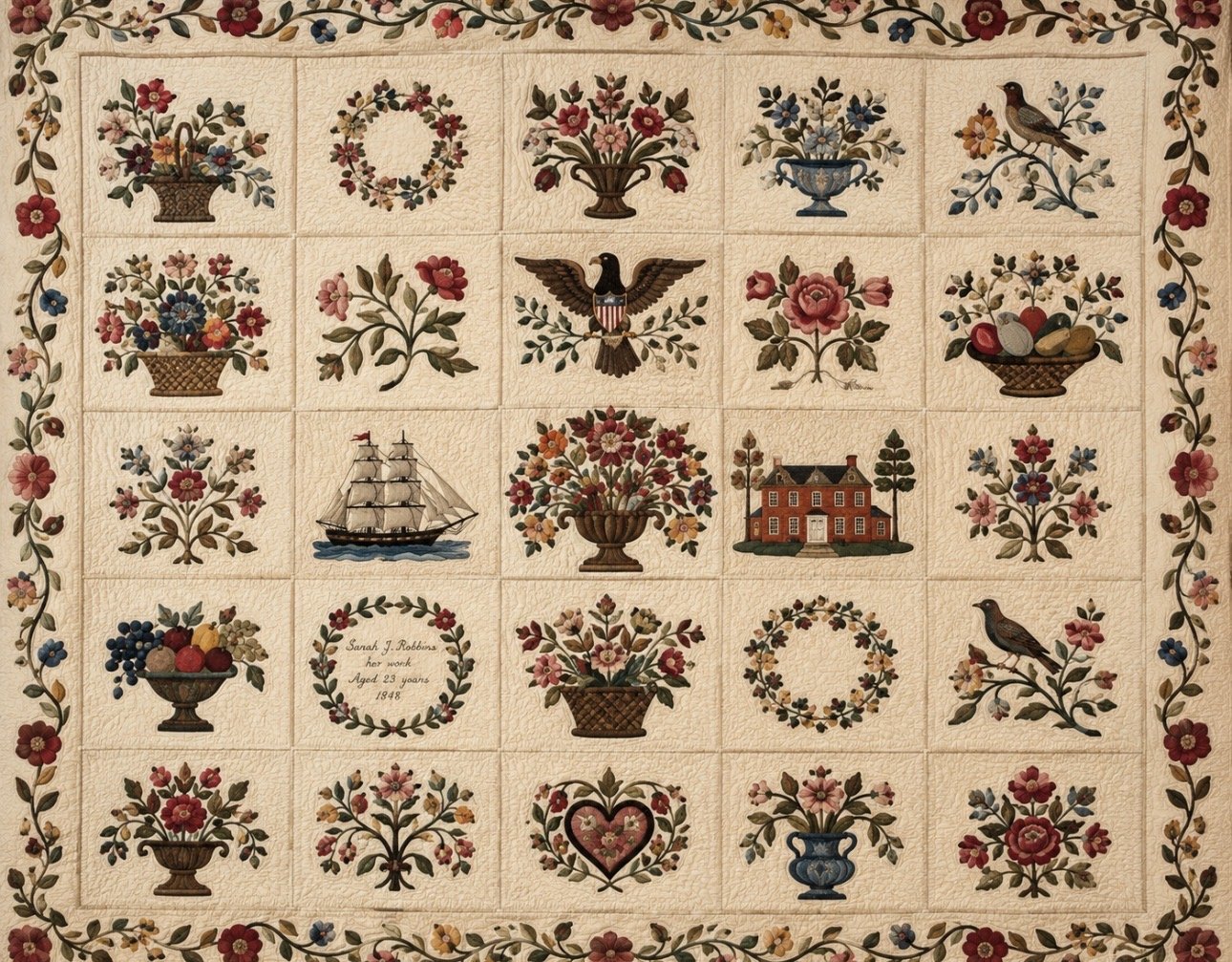
Baltimore Album quilts are some of the most admired quilts in American quilt history, and once you see one, it is easy to understand why. These were not plain utility quilts made quickly to keep a bed warm. They were elaborate, decorative, symbolic works of textile art. Many were filled with flowers, birds, baskets, buildings, ships, patriotic symbols, and beautifully stitched details that still make modern quilters stop and stare.
And possibly whisper, “Well, there goes my confidence.”
What Is a Baltimore Album Quilt?
Baltimore Album quilts first became popular in and around Baltimore, Maryland, during the 1840s. Baltimore was a growing port city with access to trade, printed cottons, and imported goods, which helped make more elaborate quiltmaking possible. These quilts were often made with carefully chosen fabrics rather than simple leftovers, and they reflected both the prosperity and the creative culture of the time.
Unlike a quilt made from one repeated block, Baltimore Album quilts were usually made of individual appliquéd blocks, with each block featuring its own design. One block might show a basket overflowing with flowers. Another might include a bird, a wreath, a ship, a building, or a patriotic emblem. Many were stitched on light or white backgrounds, allowing the colorful appliqué to stand out clearly.
The word “album” is important. In the 19th century, friendship albums and autograph albums were popular keepsakes. People collected signatures, poems, drawings, and messages from friends and loved ones. Baltimore Album quilts carried that same idea into fabric. Some were signed, some were dated, and some were made by groups of women, with each person contributing a block.
In that sense, these quilts were not only decorative. They were personal records. They held names, relationships, memories, and moments in time. They were part artwork, part community keepsake, and part family treasure.
Basically, scrapbooking with fabric, patience, and a whole lot of fancy work.
Why Baltimore?
Baltimore was especially suited to this style of quiltmaking. By the 1840s, it was a busy commercial city with access to beautiful fabrics and a growing middle class. That matters because Baltimore Album quilts required time, supplies, skill, and planning. These were not “throw something together before winter” quilts. These were “clear the table, thread the needle, and don’t make any big plans for a very long while” quilts.
The blocks were carefully designed and often very detailed. Appliqué shapes could include tiny leaves, layered flowers, curved stems, birds, fruit, urns, and other decorative motifs. Some quilts also included inked names, dates, or fine details added after the stitching was complete. That combination of appliqué, color, symbolism, and personal inscription is part of what makes these quilts so fascinating.
They were made to be useful, yes, but they were also clearly made to be seen. A Baltimore Album quilt was not just a bedcover. It was a statement of artistry, skill, affection, and community.
The Art Inside Each Block
One of the most striking things about Baltimore Album quilts is that each block can feel like its own small picture. A single quilt might include a basket of flowers, a wreath, an eagle, a ship, a heart, a fruit bowl, or a carefully arranged bouquet. When the blocks are placed together, the whole quilt begins to feel almost like a gallery wall made of fabric.
The appliqué work could be incredibly detailed. And we have to remember that these quilters were not working with fusible web, digital patterns, rotary cutters, or YouTube videos paused at exactly the right moment. They were working with fabric, needle, thread, skill, patience, and, fortunately for them, eyesight that had not yet been challenged by years of screens and late-night stitching.
Many of the motifs used in Baltimore Album quilts also carried meaning. Flowers could suggest beauty, affection, friendship, or remembrance. Eagles, flags, and other patriotic images reflected national pride. Ships made sense in a city shaped by trade and the harbor. Baskets, wreaths, and fruit were common decorative images, but they could also suggest abundance, home, celebration, or care.
Of course, quilt history always asks us to be a little careful. Not every symbol has one fixed meaning, and not every story attached to a quilt can be proven. Some meanings are well documented, while others come from broader decorative traditions or later interpretations. Still, even when we cannot know exactly what every maker intended, it is clear that these quilts were made with thought. They were not random. They were carefully planned, deeply decorative, and full of visual language.
Quilts as Friendship and Memory
One of the reasons I love learning about Baltimore Album quilts is that they remind us how social quilting has always been. Today, many of us sew alone in our homes, surrounded by fabric stacks, thread clippings, coffee cups, and whatever animal has appointed itself quality control manager. But historically, quilts often carried community with them.
Some Baltimore Album quilts were made by one very skilled maker. Others were group projects, with different women contributing blocks. Some were created as gifts for brides, ministers, friends, or people who were moving away. When blocks were signed or dated, they became more than pieces of appliqué. They became records of real people.
A signed quilt block is not just fabric. It is a name. It is a relationship. It is someone saying, “I was here, and I made this for you.”
That is part of why these quilts still feel so powerful. They are beautiful, certainly, but they are also intimate. They remind us that quilts have always had the ability to hold memory. They can preserve friendships, mark transitions, honor families, and tell stories long after the original makers are gone.
Why They Still Inspire Quilters Today
Baltimore Album quilts continue to inspire modern quilters because they bring together so many things we love about quilting: color, design, craftsmanship, history, symbolism, and complexity. Admittedly, there is enough complexity here to make a person wonder how anyone had the time, patience, or properly caffeinated courage to finish one.
For appliqué lovers, these quilts are especially meaningful. Modern Baltimore-style patterns still borrow from those historic motifs: flower baskets, wreaths, birds, hearts, urns, vines, and elaborate borders. Today’s quilter may use different fabrics, different tools, different techniques, and a much brighter lamp, but the connection is still there.
That is one of the wonderful things about quilting. We are not simply copying the past. We are continuing the conversation.
A quilter in the 1840s may have stitched a flower basket to honor friendship, faith, family, or beauty. A modern quilter might stitch one because she loves the shape, the challenge, the color possibilities, or the connection to history. The reasons may change, but the act of making still links us together.
The fabrics change. The tools change. The lighting improves, thankfully. But the desire to make something meaningful with our hands remains very much the same.
Where You Can See Baltimore Album Quilts
One of the best ways to appreciate Baltimore Album quilts is to look at actual examples, even if you are only able to view them online. Photos do not fully capture the texture, stitching, and scale, but they are still enough to make a modern quilter pause and wonder if she should either begin an appliqué masterpiece or quietly go bind something simple instead.
The Metropolitan Museum of Art has Baltimore Album quilts in its collection, including examples with signed blocks and detailed appliqué. Their online collection is a wonderful place to study the blocks, motifs, and arrangement up close.
The Maryland Center for History and Culture in Baltimore is especially important because of its connection to the place where these quilts became famous. It has an internationally known collection of Baltimore Album quilts and has featured exhibitions dedicated to them.
The International Quilt Museum in Lincoln, Nebraska, also has Baltimore Album quilt examples in its collection and is always worth exploring if you enjoy quilt history. Even when a specific quilt is not currently on display, museum collection pages and past features can still be valuable for research and inspiration.
You may also find Baltimore Album quilts or related album quilts in other museum textile collections, including decorative arts museums and historical societies. As with many fragile historic textiles, these quilts are not always on permanent display. Light, handling, and age all matter, so museums often rotate quilts in and out of exhibitions to help preserve them.
In other words, check before you travel. Historic quilts are wonderful, but they do not always keep convenient hours for those of us suddenly seized by the need to see 1840s appliqué in person.
Starting Small Is Allowed
If you ever decide to make a Baltimore Album-style quilt, I fully support you.
I also support starting with one block.
There is no rule that says you have to begin with an heirloom masterpiece large enough to humble every quilter in a five-state radius. A single appliquéd block can teach you a lot. It can help you appreciate the skill behind historic quilts, practice curves and shapes, and discover whether this style of appliqué brings you joy or makes you want to quietly place the project in time-out.
And honestly, both are useful things to learn.
Baltimore Album quilts ask us to slow down. They ask us to notice detail. They ask us to stitch with patience. They remind us that a quilt can be more than a pattern or a project. It can be a record, a gift, a memory, and a work of art.
Final Stitches
Baltimore Album quilts are admired not only because they are beautiful, but because they show what happens when fabric, friendship, history, and skilled hands come together. They are part scrapbook, part artwork, part historical document, and part very elegant quilting flex.
And maybe that is why they still capture our attention today. They remind us that quilts do not have to be complicated to matter, but when they are complicated, meaningful, and beautifully made, they can leave a legacy that lasts for generations and still fill us with awe.
Next week in quilt history, we’ll look at crazy quilts and how Victorian makers turned fabric scraps, embroidery, and embellishment into something wonderfully dramatic.
Because apparently quilters have always known how to make “a little extra” into an entire art form.
Why Quilters Started in the Middle
Medallion quilts begin in the middle and grow outward, border by border, creating a beautiful center-first design with deep roots in textile history. In this quilt history post, we’ll look at how medallion quilts developed, why they’re different from round robin quilts, and why this slow, thoughtful style still inspires quilters today.
Quilt History
The Story Behind Medallion Quilts
If you’ve ever looked at a medallion quilt and thought, “Well, that’s fancy,” you’re not alone.
Most quilts today are made block by block, row by row. We cut our pieces, make our blocks, stack them up, rearrange them seventeen times, take a picture with our phone, rearrange them again, and eventually convince ourselves we meant to do it that way.
A medallion quilt works a little differently.
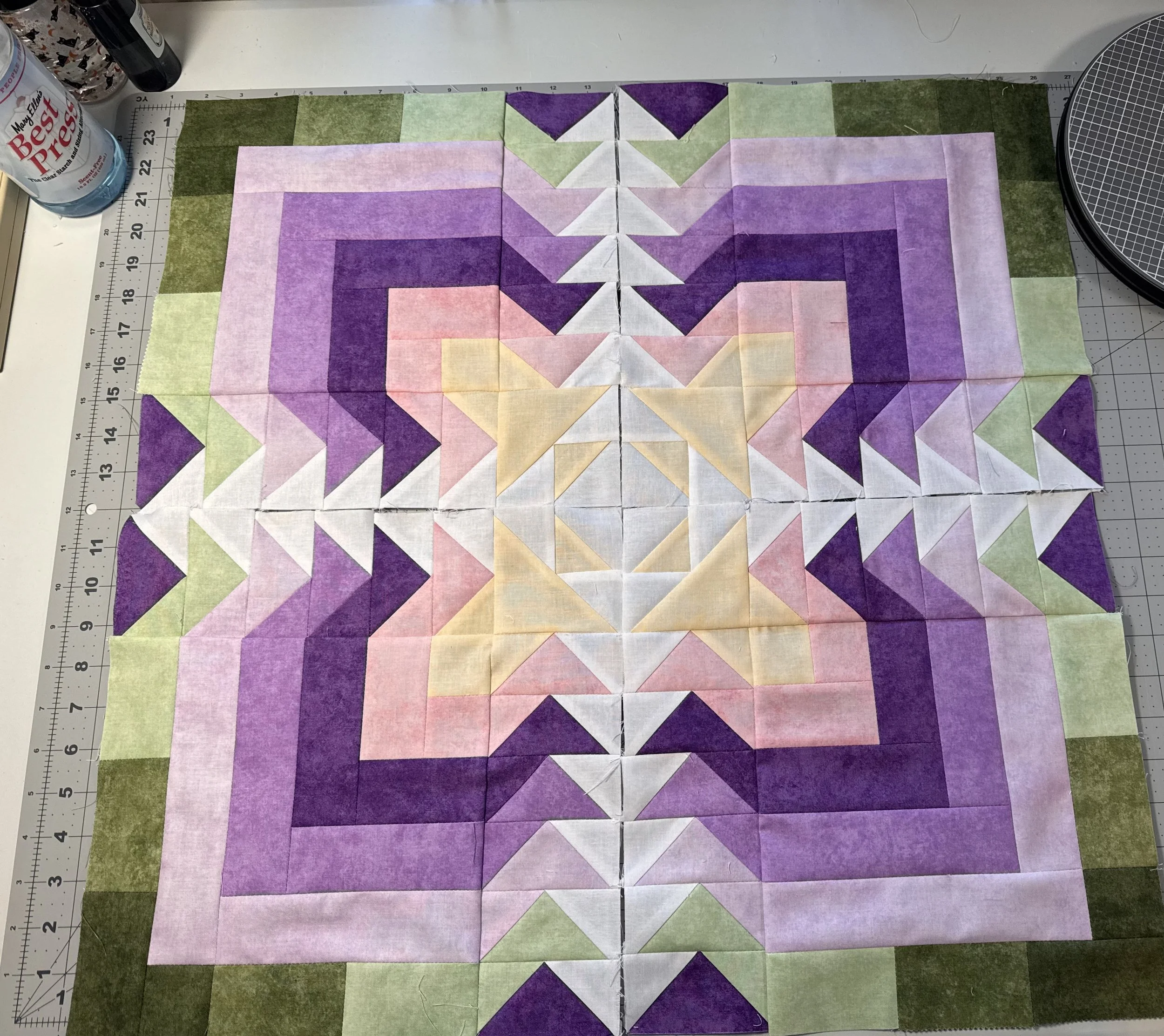
Instead of beginning with rows of repeated blocks, a medallion quilt starts with one central design and grows outward. Border by border, round by round, the quilt expands from the middle until it reaches its finished size.
It’s a beautiful style with deep roots in textile history, and once you understand where it came from, it makes perfect sense.
Before Quilt Patterns Were Everywhere
Today, if we want to make a quilt, we have no shortage of help.
We have books, magazines, YouTube tutorials, PDF patterns, quilt-alongs, printable charts, Pinterest boards, and more opinions about pressing seams than any reasonable person should have to sort through.
Two hundred and fifty years ago?
Not so much.
Quiltmakers relied heavily on what they learned from family, neighbors, local communities, and their own experience. Printed quilt patterns as we know them today were not sitting around waiting to be downloaded, and nobody was pausing a video tutorial to figure out which way the triangle should face.
Much of the knowledge was passed along by hand, by eye, and by practice.
That meant quilts often grew from what the maker had available and what she found meaningful. Sometimes the center was carefully planned from the beginning. Other times it may have started with a treasured piece of fabric, a favorite motif, an appliquéd basket, a floral design, a wreath, or a central panel too beautiful to chop into little pieces.
And honestly, if you’ve ever bought a fabric and then decided it was “too pretty to cut,” congratulations. You may have more in common with historic quiltmakers than you realized.
A Quilt That Grew Like a Picture Frame
One of the easiest ways to understand a medallion quilt is to think of it like framing a picture.
You begin with the center.
Then you add a frame.
Then maybe another.
Then perhaps a border with piecing, appliqué, vines, stars, flying geese, or whatever design the quilt seems to be asking for next.
Medallion quilts can include all kinds of borders: simple strips, pieced units, floral appliqué, geometric designs, or fabric arranged to show off special prints. In the late eighteenth and early nineteenth centuries, chintz fabrics and appliqué designs became especially fashionable in England, France, and America, and some quilts used large printed motifs or appliqué as dramatic centerpieces.
Each border became another chapter in the quilt.
And just like chapters in a book, some flow smoothly while others feel like the maker may have paused, looked at her fabric pile, and said, “Well. This is what we have now.”
I respect that.
Wait...Isn’t That a Round Robin Quilt?
This is where things can get a little confusing.
At first glance, medallion quilts and round robin quilts can look very similar because both grow outward from a central block.
The difference is usually who adds each round.
A traditional medallion quilt was often planned and made by one quiltmaker, or perhaps within one household, with the design growing from the center outward.
A round robin quilt is a group project. One quilter starts with a center block, then passes it to another quilter who adds a border. Then it moves to the next person, who adds another border, and so on until the quilt eventually returns to the original maker. The American Quilter’s Society describes a round robin as a group project where each member adds a border to a central block, creating a medallion-style quilt.
So, if a medallion quilt is a solo performance, a round robin is more like a quilting potluck.
Everyone brings something to the table.
Sometimes it all works beautifully.
Sometimes Aunt Linda brings lime Jell-O with shredded carrots.
Either way, it’s memorable.
Modern round robins are especially popular in quilt guilds and small quilting groups, and they can be a wonderful way to see how different makers interpret the same starting point. Each border carries the personality of a different quilter: her color choices, her skill level, her favorite blocks, and possibly her strong feelings about half-square triangles.
While round robin quilts often use a medallion-style layout, they are not quite the same thing historically. Medallion quilts have roots reaching back centuries, while round robins are more closely tied to modern quilting groups, guilds, swaps, and collaborative projects.
Every Quilt Was Different
One of my favorite things about studying antique medallion quilts is realizing there really wasn’t one single “correct” way to make one.
Some are perfectly balanced.
Some are wildly ambitious.
Some are elegant and restrained.
Some look like the maker was determined to use every idea she had ever loved in one quilt, and honestly, who among us has not been there?
Borders could vary in width. Patterns could change. Colors could shift. Fabrics could run out. A quilt might begin with a refined center and end with a border that says, “We are finishing this today, and nobody is going to stop me.”
That individuality is part of what makes medallion quilts so fascinating.
They remind us that quiltmaking has always been part skill, part creativity, part resourcefulness, and part negotiation with whatever fabric is actually sitting in front of you.
Why I Love Them
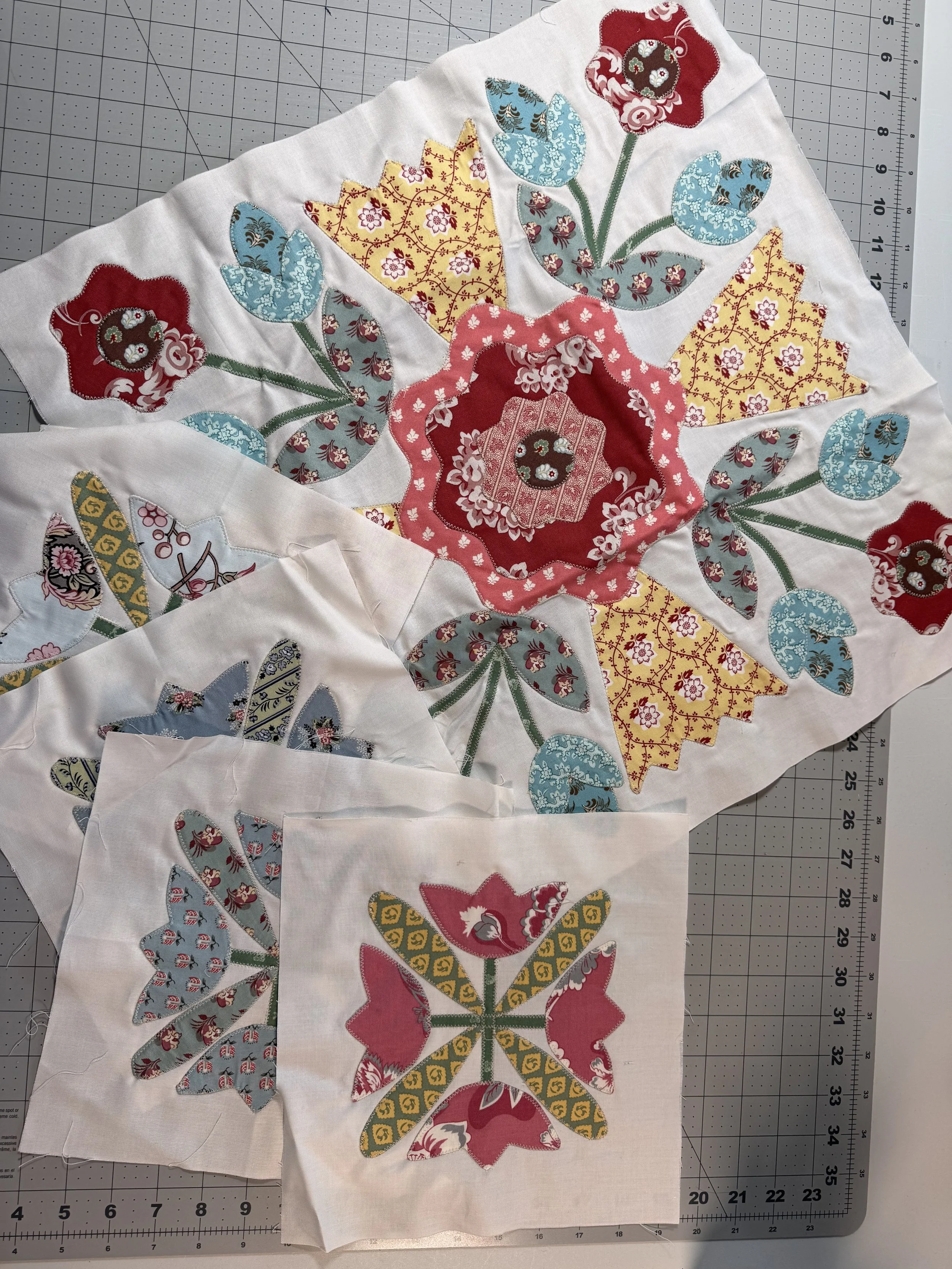
As I’ve been working on my own Jane Austen 250th Anniversary appliqué quilt, I’ve found myself appreciating medallion quilts even more. (Quilting 250 Years Ago)
There’s something peaceful about focusing on one section at a time.
Instead of racing toward the finish line, the quilt slowly grows outward. The center gets your full attention. Then the next border. Then the next.
Each round feels like its own small accomplishment.
It reminds me that quilting wasn’t always about finishing quickly. It wasn’t about checking off a project so we could move to the next thing as fast as possible.
Sometimes it was about working slowly.
Using what was available.
Making something beautiful one decision at a time.
And perhaps occasionally staring at a border and wondering what on earth possessed you to choose that many tiny pieces.
History may not record those moments, but I feel confident they happened.
A Style That Never Really Disappeared
Although quilting styles have changed dramatically over the centuries, medallion quilts have never truly disappeared.
Modern designers still use the same center-out idea in traditional quilts, appliqué quilts, English paper piecing designs, sampler quilts, mystery quilts, and collaborative round robin projects.
The fabrics may change.
The tools may change.
The rotary cutter may occasionally threaten a finger.
But the basic idea remains the same: begin with something meaningful, then build around it.
There is something wonderfully steady about that.
Looking Closely
The next time you see a medallion quilt at a quilt show, in a museum collection, or in a book, don’t just admire the whole finished piece.
Start in the center.
Then let your eyes travel outward, border by border.
You’re following the same path the maker did.
One round at a time.
One decision at a time.
One “well, I hope this works” moment at a time.
It’s a quiet reminder that beautiful things don’t always have to begin at the edge.
Sometimes they begin right in the middle.
Did You Know?
Many eighteenth- and nineteenth-century medallion quilts featured a strong central design surrounded by multiple borders. Some used piecing, some used appliqué, and some highlighted printed chintz fabrics that were highly prized in their time. While every quilt was different, the center-first design became one of the defining features of the medallion style and continues to inspire quilters today.
Coming Next Week
Next week in quilt history, we’ll explore Baltimore Album quilts—those breathtaking appliqué masterpieces filled with flowers, baskets, birds, buildings, and symbols that turned quilts into works of art.
~Chris
Quilting 250 Years Ago…
Step into Jane Austen’s England and discover what quilting and patchwork looked like 250 years ago. From precious fabric scraps and printed cotton chintz to medallion coverlets, English paper piecing, and hand-stitched seams, this history post explores how women created beautiful textile work long before rotary cutters, sewing machines, or fabric group texts existed.
History Thursdays | Chris Cross Quilts
A Peek Into Jane Austen’s Sewing Basket
When I started working on my Jane Austen 250th anniversary appliqué quilt, I found myself wondering what quilting actually looked like in Jane Austen’s England.
Not the romantic version in my head, where everyone is peacefully stitching by candlelight in a perfectly tidy room, wearing a lovely dress, with no thread stuck to their sleeves, while someone else plays the pianoforte and another sings beautifully, because apparently nobody in my imagined Regency sitting room is off-key.
The real version.
The women of Jane Austen’s world were not surrounded by rotary cutters, acrylic rulers, sewing machines, precut bundles, or a suspiciously large fabric stash that they absolutely intend to organize someday.
Their sewing was slower. More deliberate. And much more connected to the value of fabric itself.
And the first thing I learned is that we have to be a little careful with our words.
Today, we tend to use the word “quilt” for all sorts of things: pieced quilts, appliqué quilts, bedcovers, wall hangings, table runners, and possibly that project hiding in the closet that we are not emotionally ready to discuss.
Historically, though, patchwork and quilting were not exactly the same thing.
Patchwork means pieces of fabric sewn together.
Quilting means layers of fabric stitched together, usually with some kind of filling or wadding between them.
A piece could be patchwork without being quilted. A piece could be quilted without being patchwork. And sometimes, of course, the two came together beautifully.
Which brings us to Jane Austen.
Jane Austen’s Famous Coverlet
One of the most fascinating surviving pieces connected to Jane Austen is the patchwork coverlet kept at Jane Austen’s House in Chawton.
It is often casually called the Jane Austen quilt, but technically it is a coverlet rather than a quilt because it does not have internal wadding. It has a patchwork top and a cotton backing, but not the middle layer we usually expect in a quilt today.
So, yes, I know. We are already being forced into terminology before we even get to the pretty fabric.
The coverlet was made around 1810 by Jane Austen, her sister Cassandra, and their mother. It has a central medallion-style design, hundreds of small diamonds, and more than sixty different fabrics.
And yes, it was stitched by hand.
The small pieces were made using what we now call English paper piecing, where fabric is wrapped around paper shapes and stitched together by hand.
So while Jane Austen may not have been making quilts in exactly the way we define them now, she absolutely lived in a world where women stitched, pieced, planned, saved scraps, and created beautiful textile work with their hands.
And honestly, that may be even better.
Fabric Was Precious
Two hundred and fifty years ago, fabric was expensive.
Every inch represented labor: growing, spinning, weaving, dyeing, printing, transporting, selling, sewing, mending, and remaking.
Clothing was not disposable. Garments were altered, handed down, remade, and reused. A dress might become another dress. A worn garment might become children’s clothing. Smaller remnants might find their way into household sewing.
That little pile of scraps we all keep “just in case”?
They had one too.
But their “just in case” had a lot less hobby-storage guilt and a lot more practical necessity.
Chintz and the Love of Printed Cotton
One of the most beautiful parts of this period is the use of printed cottons, especially chintz.
Chintz was inspired by the colorful painted and printed cottons of India. These fabrics were admired for their vivid colors, floral designs, vines, birds, and botanical motifs. In Britain, printed cottons became fashionable and desirable, especially as textile production and trade changed.
Some surviving quilts and coverlets from the late 1700s and early 1800s feature large floral medallions, appliqué motifs, and carefully arranged printed fabrics.
Rather than looking like the block-based quilts many of us make today, these pieces often feel more like textile gardens.
Flowers.
Vines.
Diamonds.
Borders.
Symmetry.
A whole lot of patience.
Which is why my Jane Austen appliqué block suddenly feels like it has ancestors.
Patchwork Was Not Always Blocks
When modern quilters hear “patchwork,” we often think of blocks.
Nine-patches.
Stars.
Flying geese.
Log cabins.
All the familiar quilt-shop friends.
But in Jane Austen’s era, patchwork could look very different. Surviving pieces often used diamonds, hexagons, triangles, and other small geometric shapes. Some were arranged around a central medallion. Some used borders made of hundreds or even thousands of tiny pieces.
The Austen family coverlet, for example, includes a border made with tiny diamonds. It is carefully planned and symmetrical, not random scraps tossed together in a hurry.
That matters.
Because sometimes we talk about old patchwork as if it was only about using up leftovers. And yes, economy mattered. Fabric was valuable. Scraps were saved.
But these pieces were also designed.
Women were making artistic decisions about balance, color, repetition, contrast, and layout long before any of us had a design wall, a fabric pull, or the ability to send six pictures to a friend and ask, “Which one looks less weird?”
No Rotary Cutters Here
Imagine making patchwork without:
rotary cutters
acrylic rulers
cutting mats
sewing machines
electric irons
spray starch
LED lights
downloadable PDF patterns
YouTube tutorials
group texts asking, “Does this fabric work?”
Every shape had to be marked and cut by hand.
Every seam was sewn by hand.
Every decision took time.
Progress was not measured by how many blocks could be finished in a weekend. A bedcover might take months or years, especially when it was worked around the ordinary demands of home, family, visitors, illness, weather, and whatever else life brought through the front door.
Which makes me feel slightly less dramatic when one appliqué block takes me forever.
Slightly.
Sewing as Part of Daily Life
In Jane Austen’s world, needlework was part of a woman’s daily life. It was practical, decorative, social, and expected.
Women mended, altered, embroidered, pieced, and stitched. They worked near windows for good light. They stitched in sitting rooms, in family circles, and during quiet hours.
The sewing itself gave their hands something to do while conversation moved around them.
That part feels familiar, doesn’t it?
Today we have guild meetings, retreats, sew-alongs, Facebook groups, podcasts, audiobooks, and fabric photos sent with the urgent caption, “Be honest. Is this ugly?”
The tools have changed.
The reason we gather around them really hasn’t.
From My Sewing Room
Working on this Jane Austen 250th anniversary appliqué quilt while listening to her novels has made the distance between her world and ours feel surprisingly small.
I have better tools.
Better lighting.
A sewing machine.
A rotary cutter.
Access to more fabric than any one person reasonably needs, although let’s not sit with that thought for too long. I still have collections I want to buy.
But the rhythm of it still feels familiar.
A chair pulled up to a project.
Fabric spread across a table.
Hands busy enough to let the mind wander.
A story playing in the background.
A small piece of beauty slowly taking shape.
Maybe that is why quilting and patchwork continue to hold us.
Not simply because people needed bedcovers.
But because people have always needed a way to make ordinary life feel a little more meaningful, one stitch at a time.
~Chris
Next week in quilt history, we’ll take a closer look at medallion quilts and why that center-out design became such a beautiful part of textile history.