
Some of my earliest memories of embroidery come from my grandparents' home. I remember the tea towels with Victorian-style ladies representing the days of the week and the decorative stitching along the hems of pillowcases. I don't remember giving much thought to who had made them or how much work had gone into them. They were simply part of the house, as familiar as the furniture and the dishes in the cupboards.
I believe my grandmother embroidered some of those linens and my great-grandmother made others. I still have a beautiful decorative table linen that my great-grandmother stitched, probably sometime in the early twentieth century. Its flowers are worked in shades of red, pink, and burgundy, with carefully shaded petals, winding green stems, and delicate edging. The fabric has aged, but the embroidery remains remarkably beautiful.
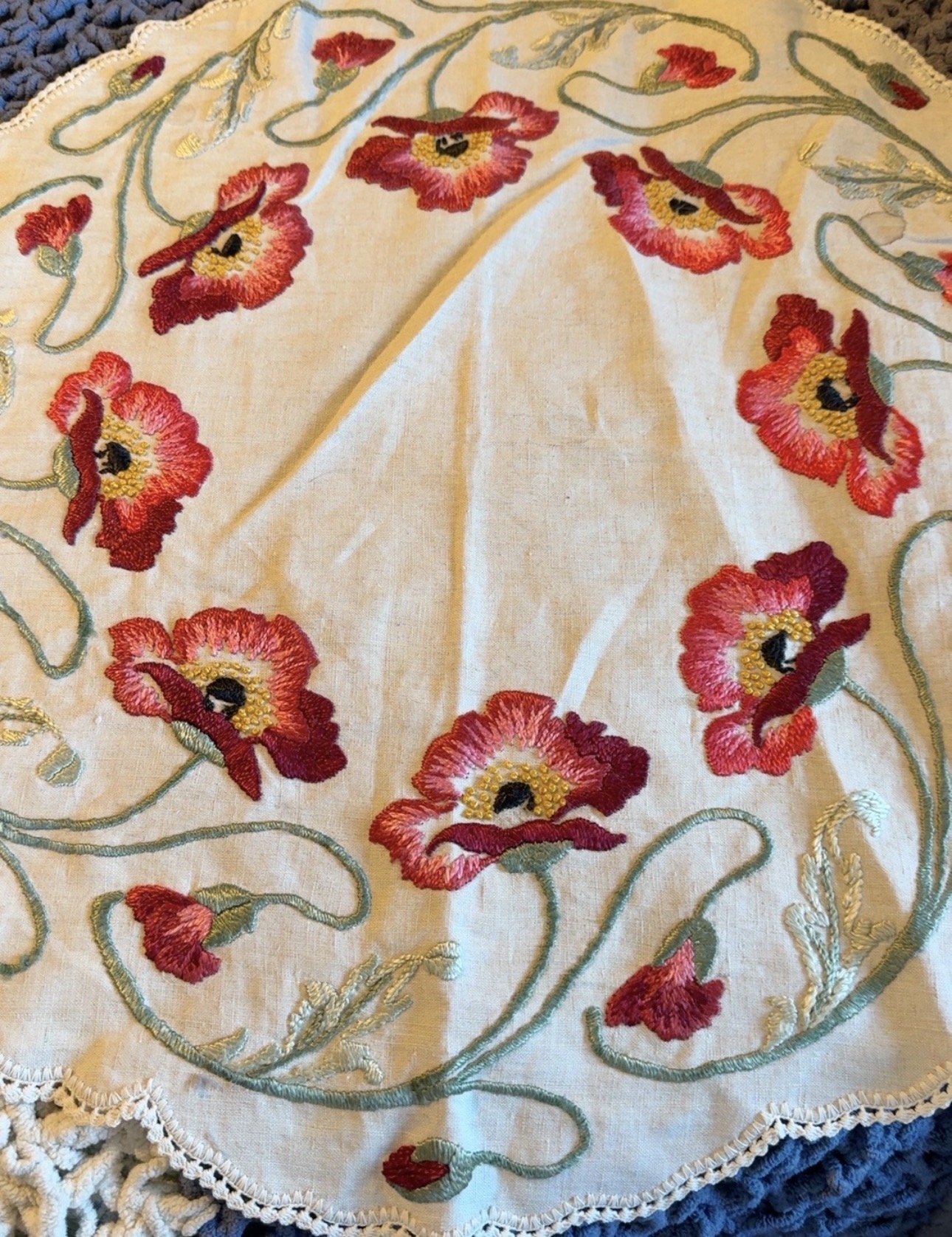
My great-grandmother's embroidered table linen
I wish I knew more about the circumstances in which she made it. Was it something she worked on during quiet evenings? Was it intended for a particular table or occasion? Did she enjoy embroidery, or was it simply another skill she had learned and put to use? I have no idea.
What I do know is that I can hold something she made with her own hands, and now that I've taken up embroidery myself, I have a much greater appreciation for the work involved.
That personal connection is part of what makes embroidery so fascinating to me. The history of needlework is much older than my great-grandmother's table linen, of course. Much, much older.
A History Written With Needle and Thread
Embroidery has been practiced for thousands of years, although its exact beginnings are difficult to establish. Textiles are fragile, and many early examples have not survived. What remains gives us only part of the story, but it is enough to demonstrate that decorating fabric with needle and thread has been an important artistic and practical tradition across numerous cultures.
What makes embroidery particularly interesting is that it did not develop as a single tradition that spread unchanged throughout the world. Different cultures developed their own materials, stitches, designs, and meanings. Embroidery could identify a person's community, communicate wealth or social position, embellish ceremonial clothing, or preserve artistic traditions.
In China, silk embroidery developed into a highly sophisticated art, with techniques capable of producing extraordinary detail and shading. Embroidered textiles discovered in ancient Chinese tombs demonstrate that skilled needleworkers were producing elaborate designs more than two thousand years ago.
Across Central Asia, embroidered textiles became important expressions of regional and family identity. In Europe, elaborate embroidery decorated religious vestments, royal clothing, and furnishings.
These traditions were not identical, and their histories cannot be reduced to one neat progression from simple household stitching to elaborate art. Embroidery was already an accomplished artistic practice in many societies long before it became the familiar decoration on the tea towels and pillowcases I remember.
When Embroidery Was Valuable Enough for Kings
One of the most remarkable surviving examples of medieval English needlework is the tradition known as Opus Anglicanum, or English work.
During the Middle Ages, English embroiderers became internationally renowned for their intricate silk and metal-thread embroidery, particularly on ecclesiastical garments. Their work was commissioned and treasured by wealthy patrons and religious institutions.
Some of the finest surviving examples date to the thirteenth and fourteenth centuries. Embroiderers used colored silk and precious metal threads, including techniques such as underside couching and split stitch, to create elaborate religious imagery.
These were not simple decorations added to clothing during someone's spare time. They were technically demanding works requiring considerable training, specialized materials, and many hours of labor. The surviving examples demonstrate a level of artistic sophistication that challenges the notion of embroidery as merely a domestic pastime.
The distinction between embroidery as art and embroidery as household work is one we still encounter today. A painted flower might be displayed in a gallery, while an equally carefully composed flower stitched onto a table linen could spend its life beneath a vase.
Both require artistic decisions. Both demand technical skill. Yet historically, the value assigned to them has often been quite different.
The Education of a Young Needleworker
By the seventeenth, eighteenth, and nineteenth centuries, needlework had become an important part of many girls' education in Europe and colonial North America, although opportunities and expectations varied considerably by class, location, and period.
Young girls learned practical sewing skills that could help them maintain clothing and household textiles. Some also learned decorative embroidery, often through the creation of samplers.
Early samplers could serve as records of patterns and stitches, a useful reference for a needleworker who might later reproduce a particular design. Over time, especially in the eighteenth and nineteenth centuries, many schoolgirl samplers became more structured educational exercises.
They might include alphabets, numbers, decorative borders, religious verses, and the maker's name and age. Some featured houses, trees, animals, and carefully arranged floral motifs.
Today, these samplers offer historians valuable information about education, family life, artistic conventions, and the expectations placed on girls.
I find the names and ages particularly interesting. There is something about seeing a child's name stitched into fabric two hundred years ago that makes the past feel considerably less distant.
It also reminds us that embroidery was not always a leisurely hobby. For some women, sewing and needlework were essential household skills. For others, embroidery was paid work, sometimes undertaken under demanding conditions. And for many girls, proficiency with a needle was expected whether they enjoyed the activity or not.
The history of embroidery includes artistic achievement and personal pleasure, but it also includes labor, obligation, and economic necessity.
From Fine Needlework to Household Linens
The embroidered linens I remember from my grandparents' home belong to another chapter of this history.
During the nineteenth and twentieth centuries, decorative embroidery became increasingly accessible to home needleworkers through printed patterns, commercially prepared materials, instruction books, and magazines.
Manufacturers sold stamped linens with designs already transferred onto the fabric, eliminating the need to draw a pattern by hand. Embroidery transfers made it possible to reproduce popular motifs on tea towels, pillowcases, tablecloths, dresser scarves, and other household textiles.
Floral borders, baskets, birds, monograms, and figures in elaborate dresses became familiar designs.
The days-of-the-week tea towels I remember were part of a broader tradition of embroidered household sets. Some featured women performing different chores, while others used flowers, animals, or humorous illustrations. The designs reflected both the domestic expectations of their time and the creativity of the people who stitched them.
There is a certain irony in spending hours decorating a towel intended for drying dishes, although I suppose quilters are in no position to question the practicality of decorative handwork.
My great-grandmother's table linen is a particularly lovely example of what a skilled needleworker could accomplish with fabric and thread. The shading in those flowers required more than simply following an outline. The placement of the stitches, the choice of colors, and the way one shade blends into another all contribute to the finished design.
I don't know whether she chose those colors herself or followed a printed pattern. Either possibility leaves me impressed with the workmanship.
And it makes me wonder how many equally beautiful pieces were worn out through use, discarded when fashions changed, or simply lost as households were cleared out over the generations.
When Embroidery Found Its Way Into Quilts
Embroidery and quilting have shared a long and sometimes elaborate relationship.
One especially striking example is the Victorian crazy quilt, which became fashionable in the United States during the late nineteenth century.
Unlike quilts constructed from repeated geometric blocks, crazy quilts often featured irregular pieces of fabric arranged in decorative compositions. Silk, velvet, satin, and other fabrics could be combined in a single piece.
Embroidery played a major role in their appearance. Makers embellished the seams with feather stitches, herringbone stitches, chain stitches, and other decorative treatments. Some added embroidered flowers, insects, initials, fans, or other motifs within the fabric patches.
Despite their name, many elaborate Victorian crazy quilts were not quilted in the traditional sense. Some were backed or tied rather than stitched through a batting layer, and many were intended for display rather than regular use as bedcovers.
These quilts provided an opportunity to demonstrate an extraordinary range of needlework skills.
The combination of fabric, embroidery, and personal expression is part of what makes them so interesting. Each patch could become a little composition of its own, while the embroidery connected the individual pieces into a larger design.
Embroidery has continued to appear in quilts in many forms, from redwork and embroidered quilt blocks to appliqué embellishments and contemporary art quilts.
The techniques may change, but the possibilities remain enormous.
A Little Appliqué, a Little Embroidery, and a Lot of Thread
My own embroidery projects are considerably less elaborate than some of the historical examples we've been discussing, but I have thoroughly enjoyed adding another form of needlework to my collection of sewing interests.
I've been working on Missouri Star's Spellbound Sue quilt, a collection of twelve different blocks combining piecing, appliqué, and embroidery. I've completed two of the twelve so far, and I'm in no particular hurry to finish the remaining ten. It may be next year, or even the year after, before I assemble the quilt. I have plenty of other projects competing for my attention, and I'm enjoying the embroidery enough that I don't feel the need to rush through it.
The embroidery sits beside my recliner, where I can pick it up whenever I feel like stitching. The blocks have been particularly enjoyable because they combine appliqué and embroidery. Fabric creates the dresses, hats, and other larger elements, while embroidery adds the smaller details that bring the scenes together.
One block features pumpkins and a little witch, while another includes a window, hanging greenery, and a candle. Each block has its own design, and I enjoy watching those details develop. Eventually, all twelve will become a quilt. When that will happen is anybody's guess.
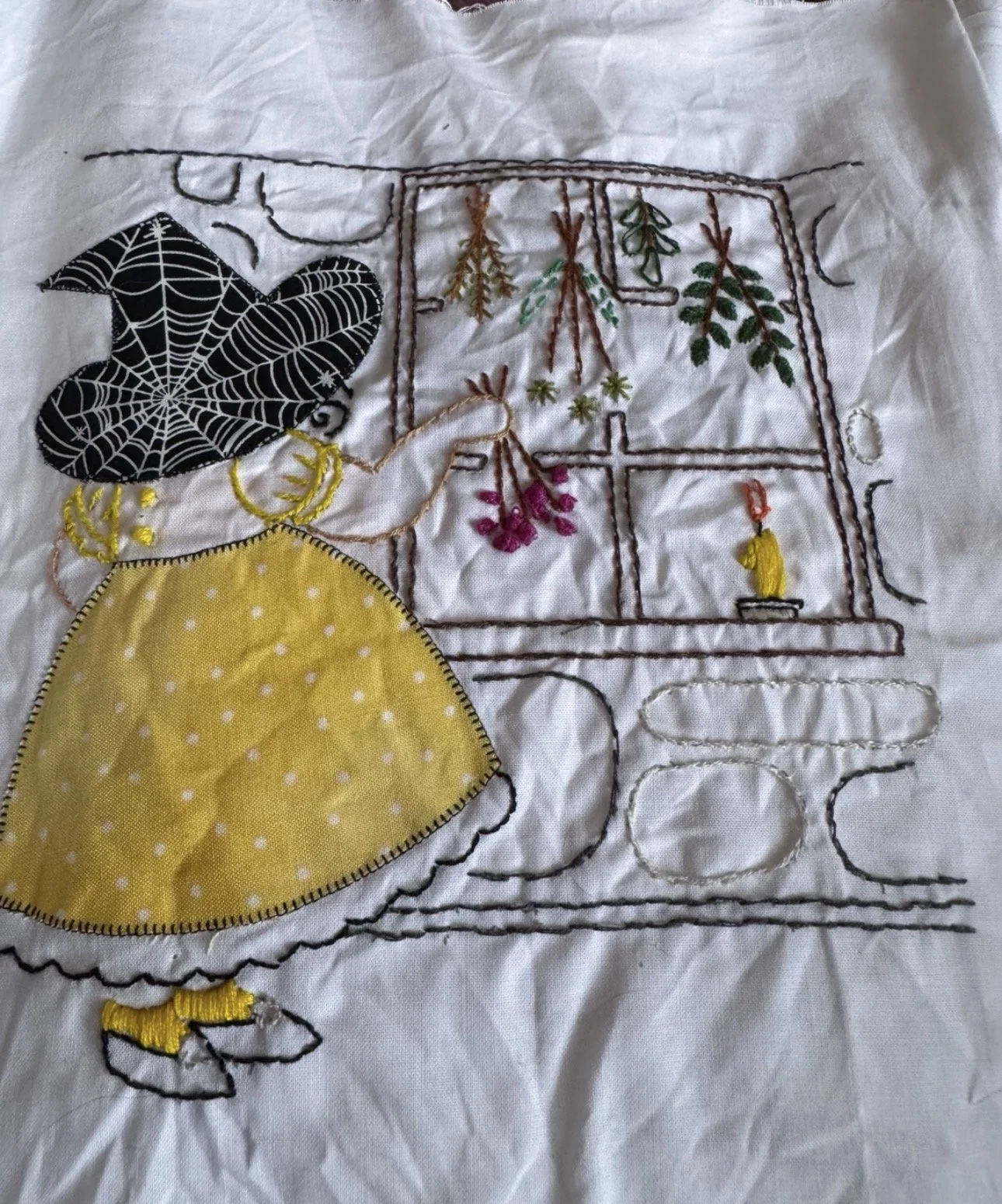
Spellbound Sue - Missouri Star pattern
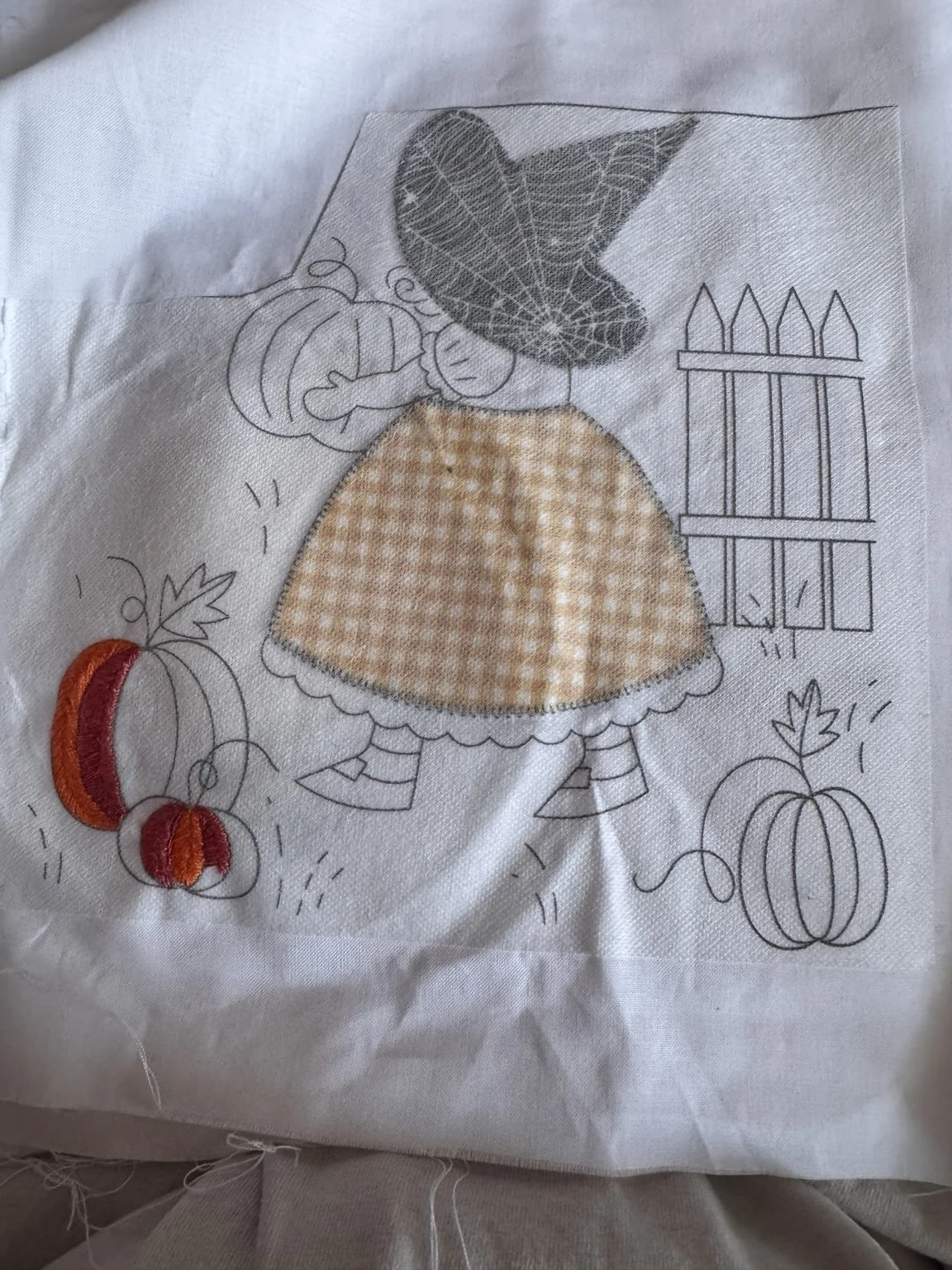
Spellbound Sue - Missouri Star pattern (work in progress using the peel and stitch)
I also have a Missouri Star Peel & Stitch design featuring a mug of hot chocolate, complete with whipped cream, snowflakes, and decorative greenery. I'm working on a 10-inch square of fabric, with no particular finished project in mind just yet. I'll likely make additional designs in a similar theme and eventually incorporate them into a quilt.
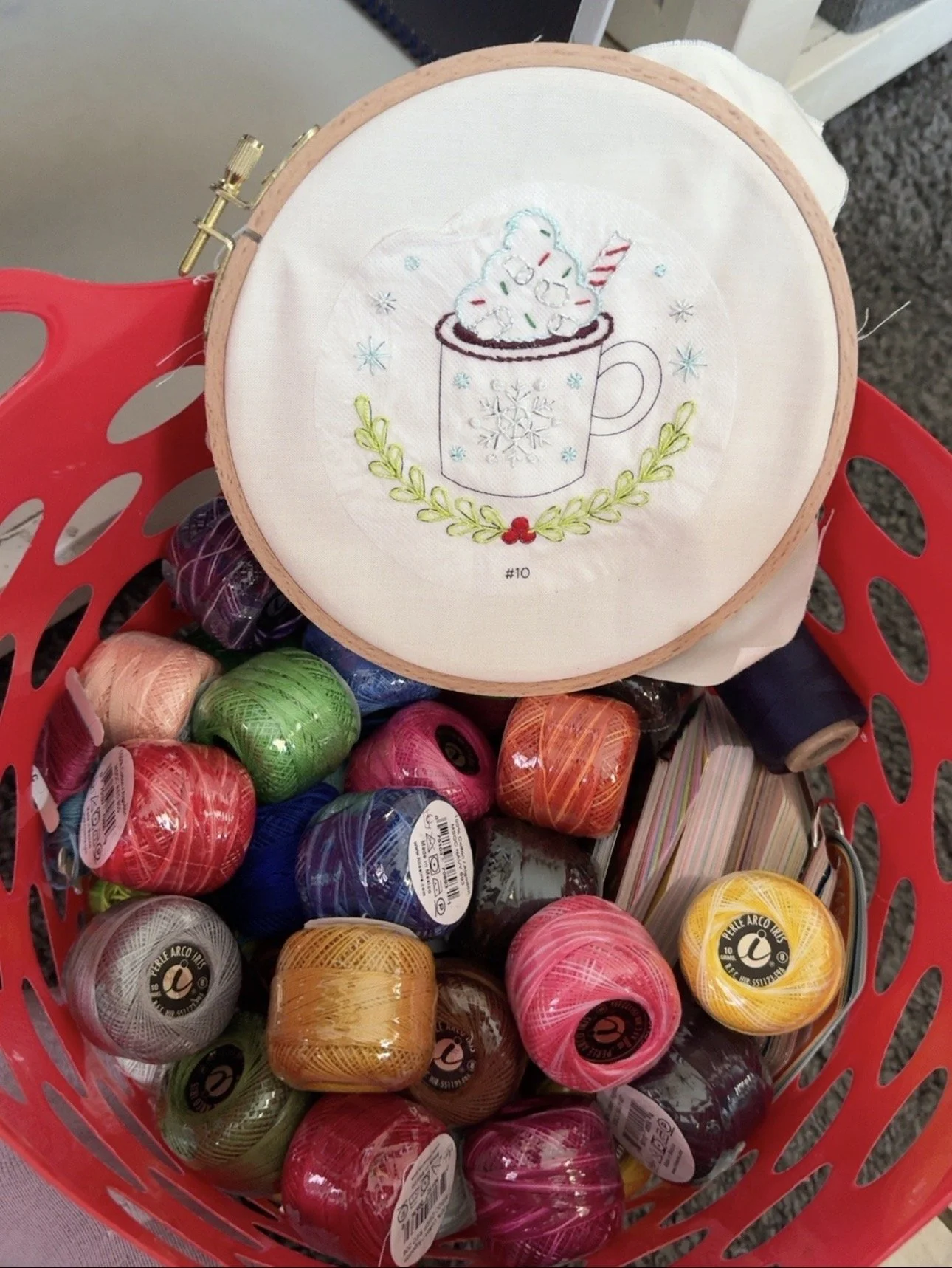
I enjoy the stitching itself, but I have to admit that seeing the finished result is still my favorite part. There is something satisfying about watching a plain piece of fabric gradually become a recognizable scene.
One of the things I appreciate about embroidery is how little it takes to get started. You don't need an elaborate kit or even a purchased pattern. A piece of cotton fabric, a needle, some embroidery floss, and a hoop are enough. You can draw your own design or trace a simple picture onto fabric. A flower from a child's coloring book would work just fine for personal practice. Start with a few basic stitches and see where it takes you.
There's plenty of time to learn the more complicated techniques.
Assuming they aren't French knots.
Looking at my great-grandmother's work, I have a much greater appreciation for the skill involved. Those beautifully shaded flowers and carefully worked details demonstrate a level of competence that I would love to develop.
Her embroidered table linen even has tiny French knots worked into the flower centers.
Unfortunately, the ability to make a French knot appears to be a genetic gift I did not receive.
I've watched every damn tutorial, read the instructions, studied the diagrams, and followed the steps. The thread goes around the needle, the needle goes through the fabric, and what emerges bears little resemblance to the intended result.
Somewhere in my family history, a woman could produce dozens of beautiful little knots without the benefit of YouTube. A century later, I have access to practically every embroidery instruction ever written, and I still can't manage one.
I'd like to think she'd have been willing to teach me. Although, after watching me attempt the same stitch for the fifteenth time, she might have handed me a different project.
What Survives in the Stitches
One of the things I appreciate most about embroidery is how readily it connects the present with the past.
When I look at the linens from my grandparents' home, I remember much more than the designs themselves. I remember the house, the people, and the feeling of being there. The embroidery is part of those memories, even though I doubt I paid much attention to the work when I was young.
Now I have pieces that my great-grandmother made, and I'm creating embroidered pieces of my own. The materials may be different, and I have access to tools, patterns, and instructional videos she could never have imagined, but the basic process is remarkably familiar.
A needle passes through fabric. Thread forms a stitch. Another stitch follows, and gradually an image begins to appear.
I don't know whether any of my own embroidery will still be around a hundred years from now. I certainly don't know whether someone will look at it and wonder what I was thinking while I worked.
Perhaps they'll admire the colors, recognize the design, or remember seeing it in my home. Maybe they'll wonder why some of the knots look a little questionable.
What I hope is that they'll appreciate the work, and perhaps understand a little more about the person who made it.
After all, that's part of what my great-grandmother's embroidery has given me. I may not know the circumstances in which she stitched those flowers, but I can still admire her handiwork and recognize the skill behind it.
And every time I pick up my own needle and thread, I feel a little more connected to that history.
Chris
Chris Cross Quilts and More
Further Reading and Historical Sources
Victoria and Albert Museum — Opus Anglicanum
Medieval English embroidery, including the silk and metal-thread techniques used to create elaborate ecclesiastical garments.
https://www.vam.ac.uk/articles/a-z-opus-anglicanum
Smithsonian Institution — American Samplers
Embroidered samplers and their role in education, domestic life, and American textile history.
https://americanhistory.si.edu/collections/object-groups/american-samplers
International Quilt Museum — Crazy Quilts and Mad Women
The decorative crazy quilts of the late nineteenth century and their combination of fabric and embroidery.
https://www.internationalquiltmuseum.org/exhibition/crazy-quilts-and-mad-women
The Metropolitan Museum of Art — Crazy Quilt, circa 1883
A historical example of the crazy quilt tradition and its decorative needlework.
