
Why Are Tiny Hand-Quilting Stitches So Difficult?
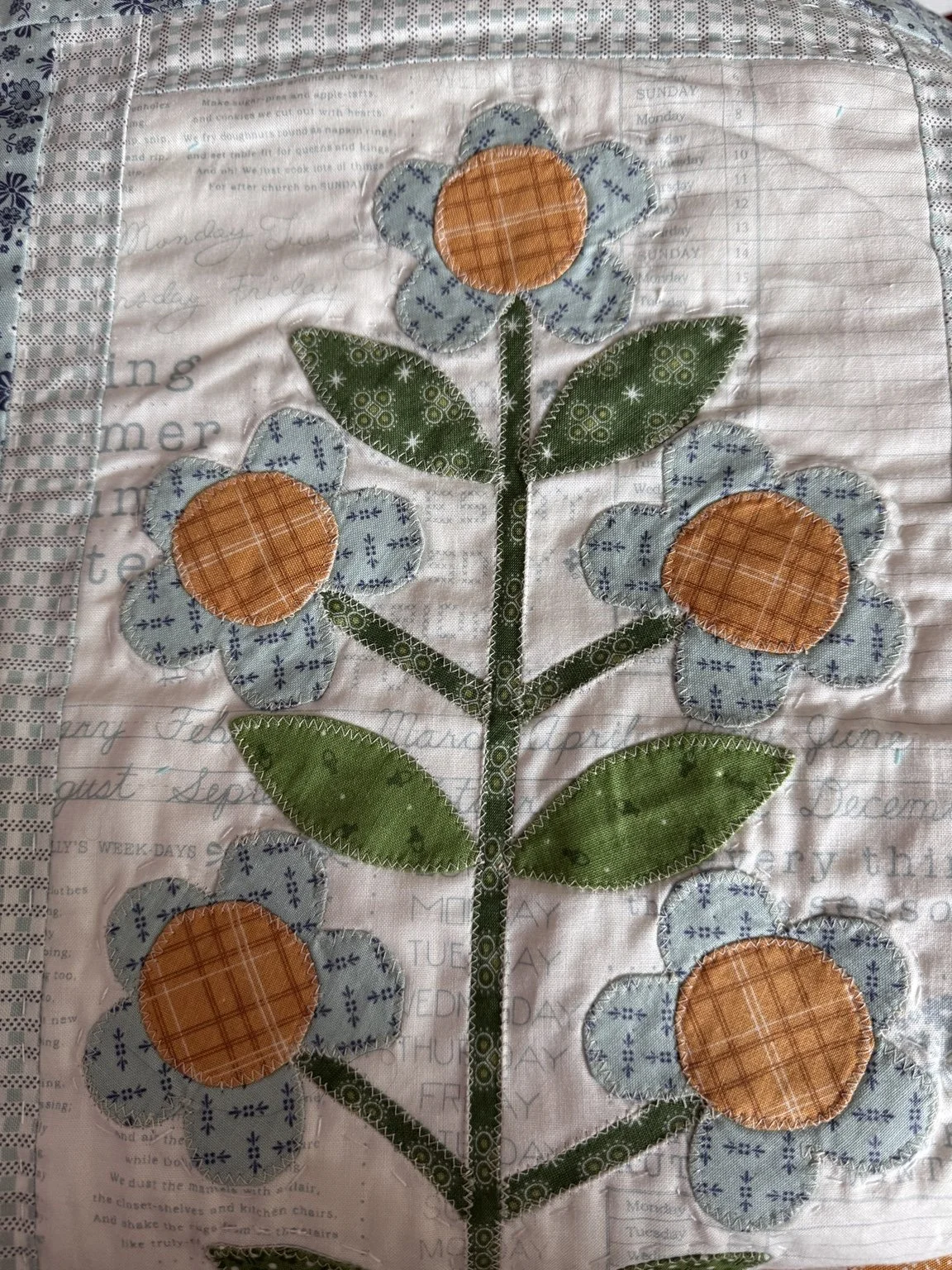
Why are tiny hand-quilting stitches so difficult? As I struggle to reach even four stitches per inch, I went looking for answers. From needles and batting to thread, technique, and a whole lot of practice, hand quilting turns out to be another quilting rabbit hole worth exploring.
I have recently started hand quilting, which has introduced me to an entirely new way of questioning my quilting abilities.
I can sit for an evening, work my way along a quilting line, look back at my stitches and think they don't look half bad. Then I start reading about hand quilting and discover that six stitches per inch is often considered a reasonable place to begin. Keep reading and you'll find people talking about eight, ten, twelve, and even twenty stitches per inch.
Twenty.
I'm currently struggling to get four.
Naturally, this made me curious. How in the world are people making stitches that small? Is there some technique I'm missing? Is it the needle? The batting? The thread? Or is the rather disappointing answer simply that I need to sit here and do this about ten thousand more times?
And then, because one quilting question never seems to remain one quilting question for very long, I started wondering about the women who made those beautifully hand-quilted antique quilts. They didn't have YouTube videos demonstrating the rocking stitch in slow motion. They didn't have LED lights, magnifiers, ergonomic thimbles or the ability to order six different packages of needles from the recliner because somebody on the internet said one of them might change their life.
They still managed to make those tiny stitches.
So, what am I missing?
My first thought was the needle, and there may actually be something to that. Traditional hand-quilting needles are called betweens, and they're surprisingly short if you've never used one. That short length isn't accidental. It makes the rocking motion used in traditional hand quilting easier and allows several small stitches to collect on the needle before the thread is pulled through.
Then there are milliners, or straw needles, which some hand quilters prefer. They're longer, and the shaft remains fairly consistent in diameter through the eye, which can make them particularly useful with heavier threads.
I would love to tell you that my research uncovered the best hand-quilting needle and we can all go buy it and move on with our lives.
It did not.
Apparently choosing a hand-quilting needle is like choosing most things in quilting. There are strong opinions, perfectly reasonable arguments on several sides, and experienced quilters making beautiful quilts with completely different choices.
The more I read, the more I think the best needle may simply be the one that allows your hand to make the stitch comfortably. I'm going to experiment with several because I don't know yet what that needle is for me.
I also hadn't given much thought to batting. I knew batting changed the loft, drape and appearance of a finished quilt, but I hadn't really considered what it was doing to the person trying to push a tiny needle through it.
Of course it matters.
A thin batting compresses differently than a lofty one, and the needle has less distance to travel through the quilt sandwich. Fiber content and density affect how easily that needle passes through as well. Suddenly "How do I make smaller stitches?" had turned into "What exactly am I trying to make those stitches through?"
Then I got to thread. Finer traditional hand-quilting threads lend themselves to a different stitch than the heavier threads often used for more visible modern hand quilting. Fabric density matters too. The quilt sandwich I happen to be holding isn't necessarily the same quilt sandwich someone else was holding when she produced those beautiful little stitches I'm comparing mine to.
Which brings me back to practice.
I was hoping to find a loophole here.
There doesn't appear to be one.
The traditional rocking stitch itself is a learned movement. The hand above the quilt and the finger underneath have to work together while the needle rocks through all three layers. Experienced hand quilters can load several tiny stitches onto the needle before pulling the thread through, and when you watch someone who has done it for years, the whole thing looks ridiculously easy.
Then you try it.
It is not ridiculously easy.
But that made me think again about those antique quilts and the women who made them. We're looking at the finished work and not necessarily considering the hands that made it.
Many women learned to sew when they were children. They mended clothing, made garments, worked on household linens and spent years handling needles and thread because sewing was an ordinary part of life. By the time an experienced quilter sat down to produce the kind of fine hand quilting we admire today, she may already have spent thousands of hours sewing.
I have not.
Not even close.
There's also a bit of survivor bias involved when we look at historical quilts. Not every woman in the nineteenth century was sitting around producing twenty perfect stitches per inch. Everyday quilts survive with larger stitches, uneven quilting, repairs, worn fabrics and all sorts of evidence that actual human beings made and used them. The spectacular examples are spectacular precisely because they are exceptional, and those are understandably the ones more likely to be carefully preserved, collected, photographed and displayed.
I'm comparing my first attempts not only with experienced hand quilters, but sometimes with the best work of generations that came before me.
That seems a little unreasonable when I put it that way.
So I'm still curious about six stitches per inch. I want to get there. I want to try different needles and pay attention to what happens when I use different batting and thread. Mostly, though, I need to practice the rocking motion until my fingers understand something that my brain currently understands only in theory.
For now, four stitches per inch is where I am.
And I'm actually okay with that.
Hand quilting is one more thing I've discovered about quilting that looked fairly straightforward until I tried it myself. Then the door opened and, behind it, was another entire world of needles, thread, batting, technique, history and people who have spent decades getting very, very good at something.
I seem to keep finding those doors.
That's probably one of the reasons I love quilting.
Of course, I know myself well enough to know how this will probably go. Someday I'll look down, count six reasonably even stitches in an inch and be ridiculously pleased with myself.
For approximately five minutes.
Then I'm going to wonder how they get eight.
If you're an experienced hand quilter, I'd really like to hear how this happened for you. Was it simply practice? Did changing your needle, batting or thread make a noticeable difference? And, perhaps most importantly, do you ever stop counting the stitches?
~Chris
A New Quilting Gadget Gives Me Hope—and That’s Saying Something
I dread sandwiching quilts. Pins shift, spray basting gives me headaches, and something always seems to wrinkle. I finally tried the Micro Stitch tool—and after years of frustration, I might have found a better way.
There are several parts of quilting I genuinely enjoy. Piecing is satisfying, pressing seams is oddly calming, and choosing fabric could easily become a full-time occupation if anyone were willing to pay me for it.
Sandwiching quilts, however, is another matter entirely.
No matter how carefully I smooth the backing, batting, and quilt top, I seem to end up with shifting, bunching, or a wrinkle hiding somewhere underneath. I can pin until the entire quilt looks like it has developed armor, and somehow the backing still finds a way to misbehave. I have also tried spray basting, but the smell gives me a headache, so that method and I are no longer on speaking terms.
Disclosure: This post contains affiliate links. As an Amazon Associate, I earn from qualifying purchases. If you choose to purchase through these links, I may receive a small commission at no additional cost to you. Thank you for supporting Chris Cross Quilts & More!
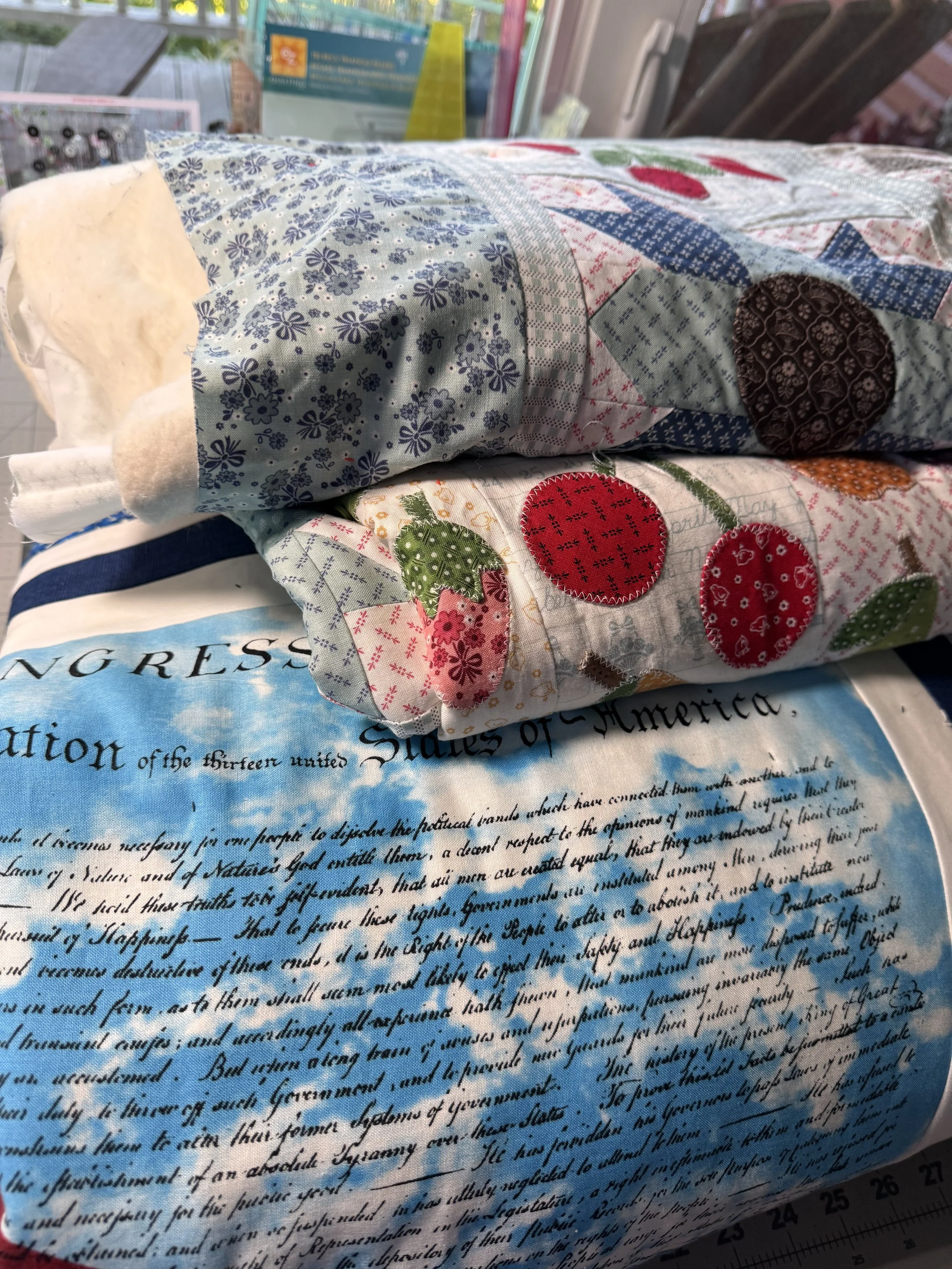
Last night I had four quilts waiting to be sandwiched, which is not exactly my idea of a relaxing evening. Before I started, though, I decided to try something new: the Micro Stitch tool.
I managed to sandwich two of the four quilts, and my first thought was, Why am I only finding out about this now?
The tool uses tiny plastic fasteners to hold the three quilt layers together. Once I had them in place, the quilts felt much more stable than they usually do when I pin. The layers did not seem to shift while I moved the quilts around, and the entire process felt a little less like wrestling a stubborn octopus.
I should be clear that I have not quilted either of them yet, so this is still very much a first impression rather than a final review. The real test will come when I run them through the machine and see whether the backing stays smooth. Still, I have high hopes. If these little fasteners prevent slipping and puckering, I will gladly spend a few minutes clipping them out afterward. That seems like a perfectly reasonable trade.
Sometimes the most useful quilting tools are not the flashy ones. They are the quiet little gadgets that solve the job you have been dreading for years.
I will report back once these quilts have been quilted and the Micro Stitch has survived the full test.
In the meantime, it has been unbelievably hot here, which means I have been staying inside with the air conditioning, my sewing machine, and a steady supply of audiobooks. I am starting book fifteen of Jennifer Chiaverini’s Elm Creek Quilts series, and I am honestly surprised by how much I have enjoyed these books.
I didn't expect to become quite so invested in the characters, but here we are. They've become perfect sewing-room companions, especially on afternoons when it's simply too hot to be outside.
What I discovered recently made me smile even more. Many of the quilts featured throughout the series have actually been turned into companion pattern books, so you can make some of the quilts you've been reading about. I had no idea those even existed. Now, of course, I'm trying very hard to convince myself I don't need another quilting book on my shelf...although we all know how that usually ends.
If you enjoy listening to books while you quilt, I'd definitely recommend giving the series a try. Just don't blame me if you end up adding a few more quilting books to your collection along the way.
Now I still have two more quilts waiting to be sandwiched, but for once, I'm not quite as grumpy about it.
Have you tried the Micro Stitch tool? I would love to know whether it has earned a permanent place in your quilting toolbox, or whether you have another basting method I need to know about.
~Chris
Why I Won't Teach You How to Make Half-Square Triangles (And Why That's Good News)
There are hundreds of half-square triangle tutorials online—but where should you start? In the first edition of Chris's Quilting Notebook, I share my favorite beginner resources, including a trusted tutorial, a quilting reference book, a versatile ruler, and a beginner-friendly pattern. Think of this as a notebook rather than a classroom—honest recommendations from one quilter to another.
Welcome to Chris's Quilting Notebook.
If you've spent any time searching for quilting advice online, you've probably noticed something. No matter what you're trying to learn, you'll find dozens—sometimes hundreds—of tutorials promising to show you the "best" way.
Half-square triangles are a perfect example.
There are videos that teach you to make them two at a time, four at a time, eight at a time, with specialty rulers, without specialty rulers, oversized and trimmed down, or cut to perfection right from the start.
After a while, it becomes less about learning how to make a half-square triangle and more about figuring out whose advice to trust.
That's where I hope Chris's Quilting Notebook will be a little different.
There are already wonderful quilters teaching half-square triangles, and many of them do it far better than I ever could. They've spent years refining their techniques, creating excellent videos, and helping thousands of quilters build their skills.
Rather than reinvent something that's already being taught so well, I'd rather spend my time finding those outstanding resources, learning from them myself, and sharing the ones I think are truly worth your time.
Think of this as a notebook rather than a classroom.
Every week you'll probably find me down some quilting rabbit hole. One week it might be half-square triangles. The next it could be batting, rulers, thread, fabric collections, quilting books, or a tool everyone seems to be talking about. Whatever I'm researching, I'll share my notes here—the good, the bad, and occasionally the things that make me wonder why anyone thought that was a good idea.
My goal is simple: to save you a little time, help you spend your quilting dollars wisely, and point you toward resources I genuinely believe are worth recommending.
This week's rabbit hole? Half-square triangles.
Why Half-Square Triangles Matter
Half-square triangles, often shortened to HSTs, are one of the most versatile building blocks in quilting. A simple square divided diagonally into two triangles can be arranged in countless ways to create stars, pinwheels, zigzags, diamonds, flying geese variations, and hundreds of classic quilt blocks.
Learning to make accurate half-square triangles opens the door to an enormous number of quilt patterns.
The funny thing is that making them isn't the difficult part.
Deciding how you want to make them is.
Some methods prioritize speed. Others focus on accuracy. Some require trimming every unit, while others are designed to eliminate as much trimming as possible. None of those approaches are necessarily right or wrong—they're simply different solutions for different quilting styles.
After spending time watching several popular tutorials and comparing methods, one thing became very clear.
Most experienced quilters eventually settle on the method that fits their style of quilting. What works beautifully for someone making dozens of charity quilts each year may not be the same approach preferred by someone creating one heirloom quilt at a time.
That's reassuring, because it means you don't have to find the one "correct" method.
You simply need to find the one that works best for you.
(Affiliate Disclosure: Some of the links in this article are affiliate links. This means that if you choose to make a purchase through one of these links, I may earn a small commission at no additional cost to you. I only recommend products, books, and resources that I personally use, genuinely like, or believe are worth sharing. Thank you for supporting Chris Cross Quilts & More!)
My Notebook Recommendations
Rather than overwhelm you with dozens of options, here are the resources I'd recommend to a friend who's ready to learn.
My favorite beginner-friendly tutorial
If you're completely new to half-square triangles, I'd start with Erica Arndt's tutorial. She walks through four different methods, explains why you might choose one over another, and demonstrates each one clearly.
One feature I especially appreciated was the chapter markers. Instead of scrubbing through a long video trying to find the section you want, you can jump directly to the method you're interested in. She also includes a printable HST cheat sheet that's worth downloading and keeping in your sewing room.
If you prefer learning from books
One of my favorite references is Quilter's Complete Guide.
This isn't the kind of book you read once and put back on the shelf. It's the kind you reach for again and again when you can't quite remember a technique, need to double-check measurements, or simply want to refresh your memory. Whether you're just starting out or you've been quilting for years, it's a resource I think belongs in every sewing room.
A ruler I think is worth considering
I own more quilting rulers than I'd probably like to admit, including several specialty rulers designed specifically for half-square triangles.
And yet...
More often than not, I reach for my Creative Grids 6½" × 24½" ruler because it's already sitting on my cutting mat. It's versatile, accurate, and handles far more than just half-square triangles. If you're trying to build a quilting toolbox without buying a specialty ruler for every task, this is one I'd recommend.
A beginner-friendly pattern to practice with
If you're looking for a project to put those new half-square triangle skills to work, I recommend the Stardust Charity Quilt Along from Fat Quarter Shop.
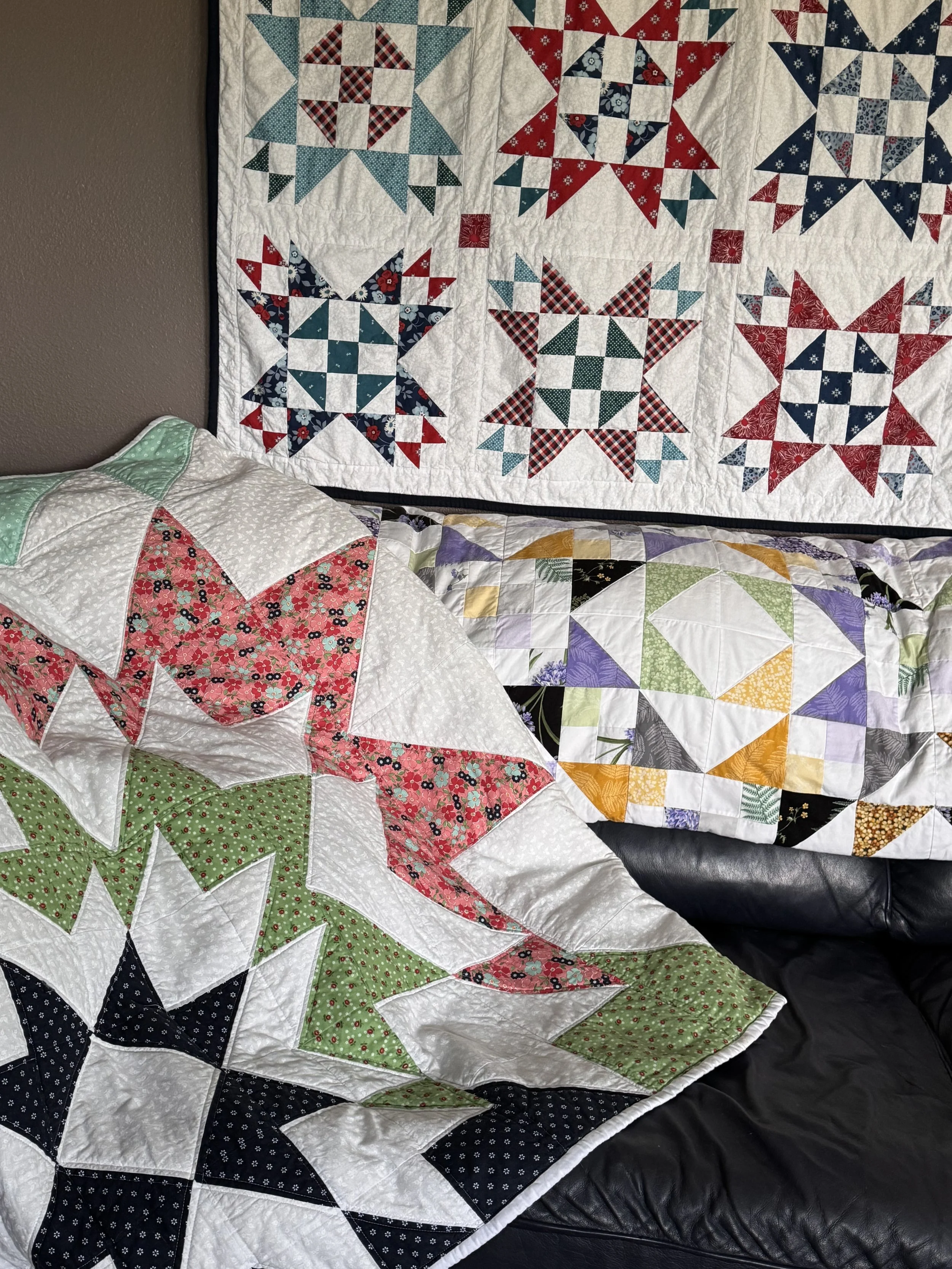
I've made this quilt myself (it's the one pictured in the lower left corner of the photo above), and it's a wonderful project for practicing HSTs without feeling repetitive. The instructions are clear, the design is beautiful, and the pattern is available as a free PDF.
One Last Note from My Notebook
If you come back each Tuesday expecting another step-by-step tutorial, you'll probably be surprised.
That's not really what this notebook is about.
It's about doing the research, asking the questions, comparing the options, and sharing what I learn along the way.
There are wonderful teachers in the quilting world, and I plan to keep learning from them right alongside you.
My hope is that Chris's Quilting Notebook becomes a place where you can save a little time, avoid a few unnecessary purchases, discover outstanding resources, and maybe find your next favorite quilting teacher.
After all, there are only so many hours in a day. If I can spend a few of mine digging through the options so you don't have to, I'd call that time well spent.
Until next Tuesday,
Chris
Thank you for supporting Chris Cross Quilts & More. Every purchase made through an affiliate link helps me continue creating free quilting resources, reviews, and inspiration for this community.